
The catastrophic collapse of ice and rock in Nepal has exposed a deeper climate challenge: how do communities, rivers and infrastructure adapt when the mountains themselves are becoming less predictable?
In the space of minutes, the landscape of Nepal’s Trishuli Valley was transformed.
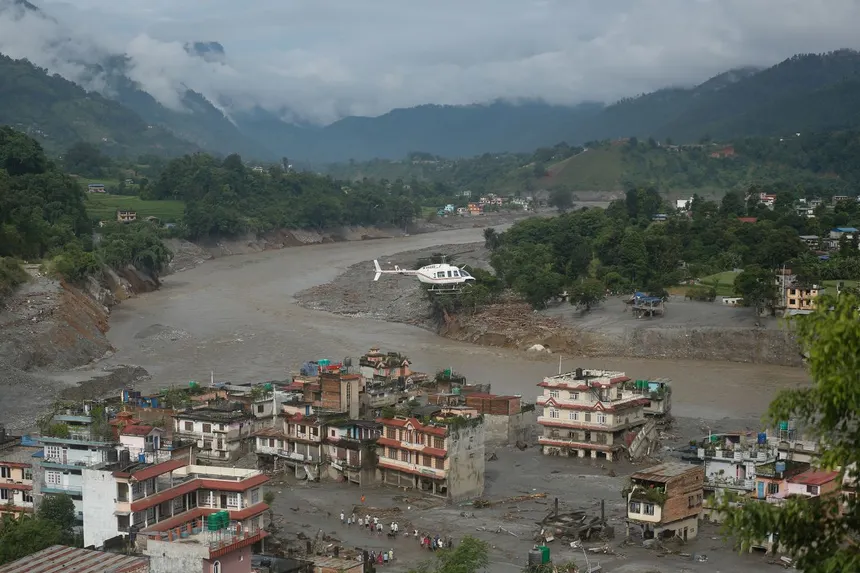
High above the valley, a section of mountain and glacier gave way, sending enormous quantities of rock and ice cascading towards the river below. The material accelerated through the steep Himalayan terrain before reaching the valleys and settlements downstream, where the disaster changed character again.
The mountain became a river.
Ice, rock, mud and water surged through the landscape, overwhelming roads, bridges, buildings and communities. At the Nepal-China border, a crossing that had connected the two countries was swept away. Further downstream, the Trishuli River became a channel for a wall of debris that tore through settlements and infrastructure.
For people caught in its path, there was little time to understand what was happening.
They ran.
Those who reached higher ground watched as the river widened and rose, carrying boulders, vehicles, trees and pieces of buildings downstream.
The destruction continued for tens of kilometres.
But the significance of the disaster extends far beyond the valley where the flood struck.
It has become another stark reminder that the Hindu Kush Himalaya is entering an era of profound environmental change—and that changes taking place high above the valleys can have consequences far downstream.
When the mountain became a river
The August 26 disaster was not a conventional flood.
A preliminary scientific reconstruction using satellite imagery describes a high-elevation slope failure involving both rock and glacier ice that developed into a channelised mass flow and flood cascade. Researchers mapped a representative route of more than 21 kilometres from the source area to Gyirong Port, while stressing that the precise volume, initiation mechanism and source-scale hydrology remain uncertain.
That uncertainty matters.
Mountain disasters are rarely simple.
A slope can fail because of geological weakness, water, temperature changes, rainfall, seismic activity or a combination of factors. Once material begins moving, however, one hazard can rapidly become another.
A collapse can become an avalanche.
An avalanche can become a debris flow.
A debris flow can enter a river.
And a river carrying enormous quantities of rock, mud and ice can become a force capable of destroying infrastructure kilometres downstream.
That cascading nature of the disaster is perhaps its most important lesson.
The question is no longer simply whether a mountain slope is stable.
It is whether the entire chain of systems below it—from rivers and roads to hydropower plants, farms and settlements—is prepared for what happens when that stability fails.
The disaster after the disaster
At the Himalayan Academy in Wakot, the immediate emergency has taken on another form.
A school has become a temporary home.
Classrooms that once held desks and pupils now accommodate families who have nowhere else to go. Children play where lessons were taught. Teachers have taken on responsibilities that extend far beyond education.
Among those seeking shelter are expectant mothers, some nearing childbirth, facing not only the anxiety of bringing a child into the world but the uncertainty of what will happen afterwards.
The principal initially opened the school to a few families.
Then more arrived.
Her dilemma is painfully simple.
How long can the school remain a shelter before the children who normally study there lose their own place of learning?
The disaster has therefore created a second crisis: displacement.
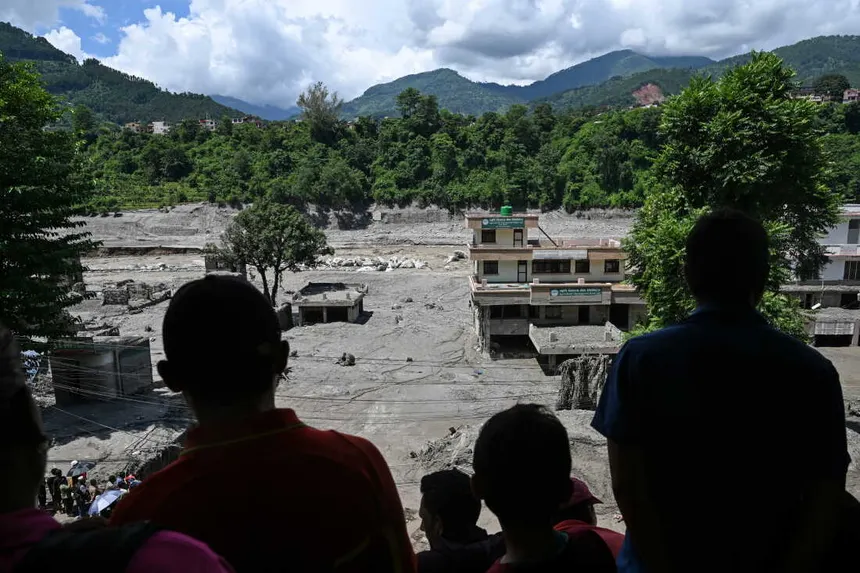
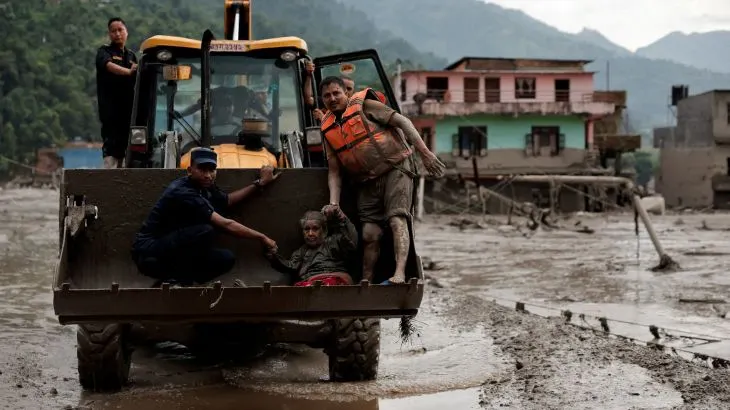
For some families, returning home is not an option. Mud has hardened over houses. Roads and bridges have disappeared. In some places, the homes that once defined people’s lives are buried beneath debris.
And underneath the physical destruction is another loss—the certainty that home is a safe place.
That psychological shift can be as profound as the destruction itself.
A river that once represented food, irrigation, transport and livelihood can suddenly become a source of fear.
Why people stay
For families living along Himalayan rivers, however, leaving is not as simple as it sounds.
Take a farmer such as Raju Mizar, whose paddy fields have been destroyed.
His harvest is gone.
Yet he remains near the river, selling bananas at the market.
His predicament captures one of the central challenges of climate adaptation: the places most exposed to environmental hazards are often the same places where people have built their livelihoods.
The river provides water.
The valley provides fertile land.
The roads connect farmers to markets.
The mountains provide the landscape in which communities have lived for generations.
Moving away from danger can therefore mean moving away from economic survival.
This is why climate displacement cannot be reduced to a question of whether people are willing to relocate.
The harder questions are:
Where would they go?
Who would provide land?
How would they earn a living?
Where would their children attend school?
And who would pay for the move?
For governments facing increasingly complex climate risks, these questions may become as important as building stronger bridges or installing better warning systems.
A changing mountain
The disaster comes against a backdrop of rapid change across the Hindu Kush Himalaya.
ICIMOD’s 2026 glacier assessment says the rate of glacier ice loss across the region has doubled since 2000. Its analysis found that glaciers have lost up to 27 metres of ice thickness since 1975, while nearly two billion people downstream depend on the region’s water systems.
The changes are not limited to glaciers.
Snow cover is changing.
Permafrost is thawing.
Mountain slopes are becoming more vulnerable to instability.
Glacial lakes are expanding in some areas.
And communities are increasingly exposed to combinations of floods, landslides, avalanches and other hazards.
Scientists, however, caution against drawing a straight line between every mountain disaster and climate change.
The preliminary scientific reconstruction of the August 26 event found unusually warm conditions in the wider region but did not establish that warming triggered the collapse. Researchers say the precise initiation mechanism remains unresolved. (arXiv)
That distinction is crucial.
Climate change does not need to be declared the direct cause of every avalanche for the changing climate to matter.
It can alter the conditions under which mountains, glaciers, snow and frozen ground behave.
And as those conditions change, the risk landscape changes with them.
The warning from the ice
The Hindu Kush Himalaya is sometimes described as Asia’s water tower.
It contains enormous stores of snow and ice and feeds ten major river systems. The river basins originating in the region provide water to roughly 1.9 billion people—about a quarter of humanity.
That makes what happens in the high mountains a concern far beyond Nepal.
The water flowing from the Himalayas supports agriculture, drinking-water supplies, ecosystems and energy production across Asia.
But the region faces a paradox.
Climate change can produce too much water at the wrong time through floods, landslides and glacial hazards, while also threatening too little water over the longer term as glaciers shrink and snow patterns change.
This is what makes the future of the Himalayas so consequential.
The question is not simply whether there will be water.
It is when it will arrive, how much will arrive, and whether communities and infrastructure will be able to withstand it.
Power in the path
The risks become particularly significant where Himalayan rivers meet infrastructure.
Nepal has placed hydropower at the centre of its economic development strategy. But the August disaster demonstrated the vulnerability of energy infrastructure to extreme mountain events.
Recent reporting indicates that numerous hydropower installations were affected by the disaster, with hundreds of workers believed to have been trapped in tunnels. Rescuers subsequently pulled workers alive from tunnels at the Upper Trishuli 3A hydropower plant.
The scale of the destruction has forced an uncomfortable question into the national conversation:
Are infrastructure projects being designed for the climate that existed when they were planned, or the climate that is emerging now?
A hydropower facility may be engineered to withstand historical flood levels. But what happens when a flood is carrying enormous boulders, trees, ice and sediment? What happens when a river changes its course? What happens when a mountain slope collapses upstream? These are not merely engineering questions.They are questions about climate risk, investment and development.
Nepal’s estimated losses from the disaster have reached about 387.5 billion Nepalese rupees, or $2.56 billion, according to the country’s disaster authorities. Thousands of homes were destroyed or damaged.
The financial cost therefore extends beyond rebuilding homes.
It includes roads, bridges, electricity infrastructure, businesses, agricultural land and the economic activity that depends upon them.
Can science see the next disaster?
Technology offers some hope.
Satellites can monitor glacier movement, map landslides and identify changes in mountain landscapes. Sensors can monitor rivers and provide early warnings. Communities can be trained to evacuate.
But technology has limits.
The preliminary reconstruction of the August event found no unambiguous large-scale surface change immediately before the failure in available satellite imagery.
That finding highlights one of the greatest challenges facing mountain scientists.
Some disasters announce themselves.
Others do not.
A community may have an early-warning system for a rising river but only minutes to react to a sudden avalanche upstream.
A satellite may identify a dangerous glacial lake but cannot necessarily predict precisely when a mountain slope will collapse.
An evacuation plan may exist on paper but fail if roads and bridges disappear.
Climate adaptation therefore cannot rely on a single technology.
It requires a system.
That means better monitoring, stronger infrastructure, land-use planning, community preparedness, reliable communications and, in some cases, moving people away from areas where the risk has become unacceptable.
A question of adaptation
For communities in the Trishuli Valley, adaptation is no longer an abstract policy term.
It is a question of where to live tomorrow.
The school principal sheltering displaced families must decide how long she can keep her doors open.
Farmers must decide whether to rebuild fields beside a river that has already destroyed them.
Government officials must determine where displaced communities can safely settle.
Engineers must reconsider how roads, bridges and hydropower projects are designed.
And scientists must improve their understanding of an environment that is changing faster than historical records can fully explain.
The 2026 UNDP-ICIMOD assessment of human security in the Hindu Kush Himalaya describes climate change as creating interconnected pressures across water, food and energy systems and argues for a people-centred approach to resilience.
That is perhaps the most important lesson from the disaster.
The answer cannot simply be to build higher walls around rivers.
Nor can it be to expect vulnerable communities to move without support.
Adaptation has to account for the entire system.
The river still flows
Eventually, the mud will dry.
Roads will be rebuilt.
Bridges will return.
Hydropower tunnels will be cleared.
Schools will reopen.
And the Trishuli will continue flowing south.
But for those who watched the river turn into a wall of destruction, it will never look quite the same.
The river remains a source of life.
It provides water, food and energy.
The mountains remain a source of beauty and livelihoods.
Yet both are changing.
The tragedy in Nepal is therefore more than the story of a mountain that collapsed.
It is a glimpse of the difficult choices confronting communities across the Hindu Kush Himalaya as the climate changes around them.
For nearly two billion people who depend on water from these mountains, the stakes are enormous.
The question is no longer whether the Himalayas are changing.
They are.
The question is whether societies downstream can change quickly enough with them.


