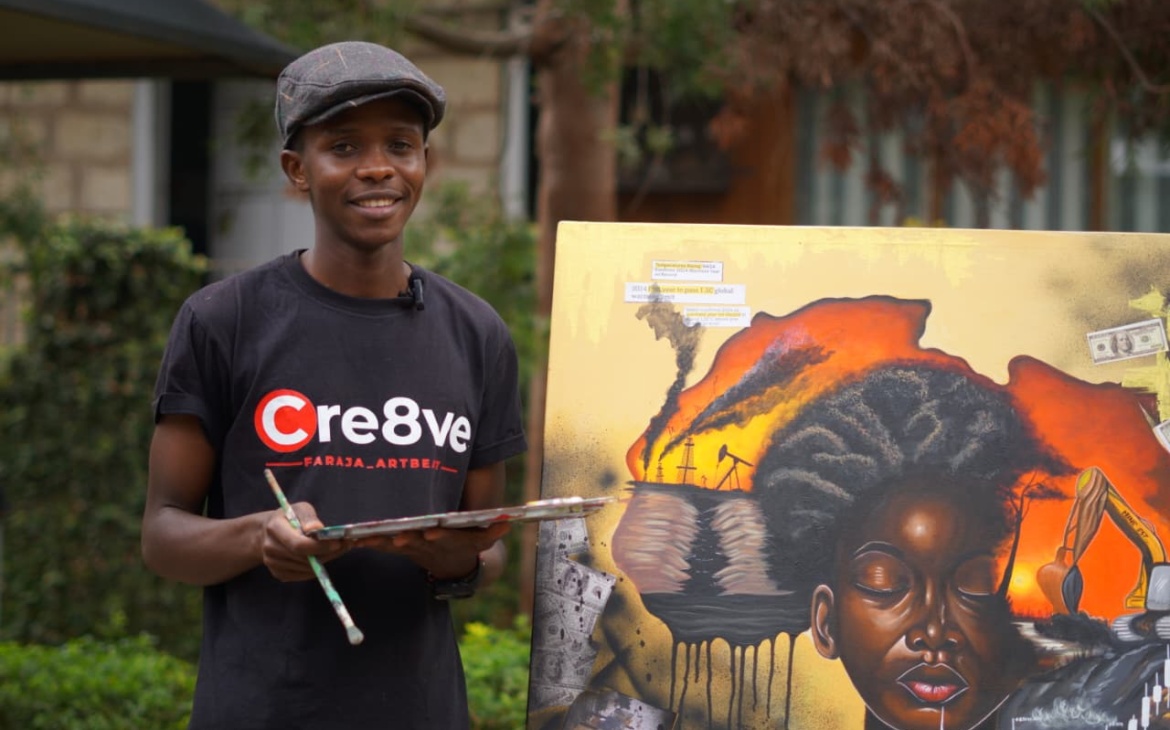
A delicate insect takes shape under Denzel Juma’s brush, its wings slowly emerging through layers of paint, embodying his craft as an artist. Around his studio, finished and unfinished works lean against the walls, vivid portraits of insects, native plants and landscapes that reflect Kenya’s natural heritage.
At first glance, the tiny creature at the centre of his latest canvas seems insignificant, the kind of insect most people would brush away without a second thought. For Juma, however, it represents a much larger conversation about humanity’s relationship with nature.
“The story that I’m going to tell you is about a tiny insect,” he says, standing beside the paintings. “The insect that has really inspired my paintings today.”
For the environmental and visual artist, whose work spans murals, canvas paintings and public installations, art has become a language for translating environmental issues into stories that ordinary people can see, question and relate to.
Over the past five years, he has used his creativity to bridge the gap between complex environmental policies and the communities expected to live with their outcomes.

Turning Policy Into Something People Can See
For Juma, art is far more than decoration. It is a bridge between science, policy, and everyday life.
“I use art to inspire communities to take action,” he explains. “And also to interpret the policies into visual storytelling so that people can really interpret it and understand it in our communities, so that they can take action.”
His journey into environmental art was not planned. Before focusing on conservation, he worked on projects outside the environmental space before realising his creativity could contribute to a growing movement for environmental awareness.
“I’ve been doing some of the works away from the environment, but I got passion into this particular space to make sure that I use my skill and my creativity to support the movement of environmental enthusiasts and conservationists,” he says.
That passion reaches back much further than his professional career. Growing up surrounded by nature, he says, shaped how he understands the environment today and continues to influence every piece he creates.
“My passion for this journey has been nature, because I’ve grown up in a place where I’ve been interacting with nature since my childhood,” Juma says. “This has really shaped my perspective to be an environmental artist, to really tap into my childhood memories, to bring them into life.”

Six Murals, More Than Ten Paintings, One Community
Rather than keeping his work inside galleries, Artist Juma has taken his environmental messages directly into public spaces.
Across Ngalula, the neighbourhood where he grew up, he has completed six large-scale environmental murals that have become familiar landmarks for residents. Alongside them, he has produced more than ten environmental paintings exploring biodiversity, conservation and humanity’s connection with nature.
For Juma, public art offers an opportunity to reach people who may never visit an exhibition but encounter environmental messages in the places they live and work every day.
Asked what it takes to create meaningful community art, he doesn’t point to artistic talent. Instead, he speaks about listening.
“First of all, it’s just accepting that you don’t know everything, and you really need to learn from each particular youth that you interact with,” he says
Those conversations, he explains, help refine ideas and ensure they reflect lived experiences rather than an artist’s assumptions.
“They help you shape your own perspective and really bring your ideas into full actualization, so that it has data and it’s really supported by the data and the support of other environmentalists who are in this particular space.”
Much of Juma’s work is driven by one belief: that modern urban life has distanced people from the natural world, and he uses his art with conviction that it will inspire change.
“My impact is to make people connect to nature and really go back to nature, because I think in our urban setup we have neglected nature, that we see nature as something that is away from us,” he says. “But nature is part of us. So I really need, in the future, [for] people [to] really connect with nature, protect nature, because we are also nature.”
It is a philosophy reflected throughout his work, whether painting insects that often go unnoticed or transforming neighbourhood walls into reminders that conservation begins where people live.

From Collaboration to Community Leadership
Artist Juma’s journey through environmental art has also included collaborations with organisations such as Greenpeace Africa, an experience he says broadened his understanding of how artists can contribute to environmental campaigns and public engagement.
Inspired by those experiences, he established Crea8ve Faraja, a community initiative that uses creativity to encourage environmental action and youth participation.
“What Crea8ve Faraja does is to create new roles in the community, to make sure that our community can take action, can see what challenges are in our environmental [space] and how they can take action and be part of this,” he explains.
Its vision extends beyond producing artwork.
“Crea8ve Faraja’s big vision is to see other young people join [the] environmental movement and support this particular process, because we need communities around this particular issue so that we can raise our voices and it can be heard,” he says.
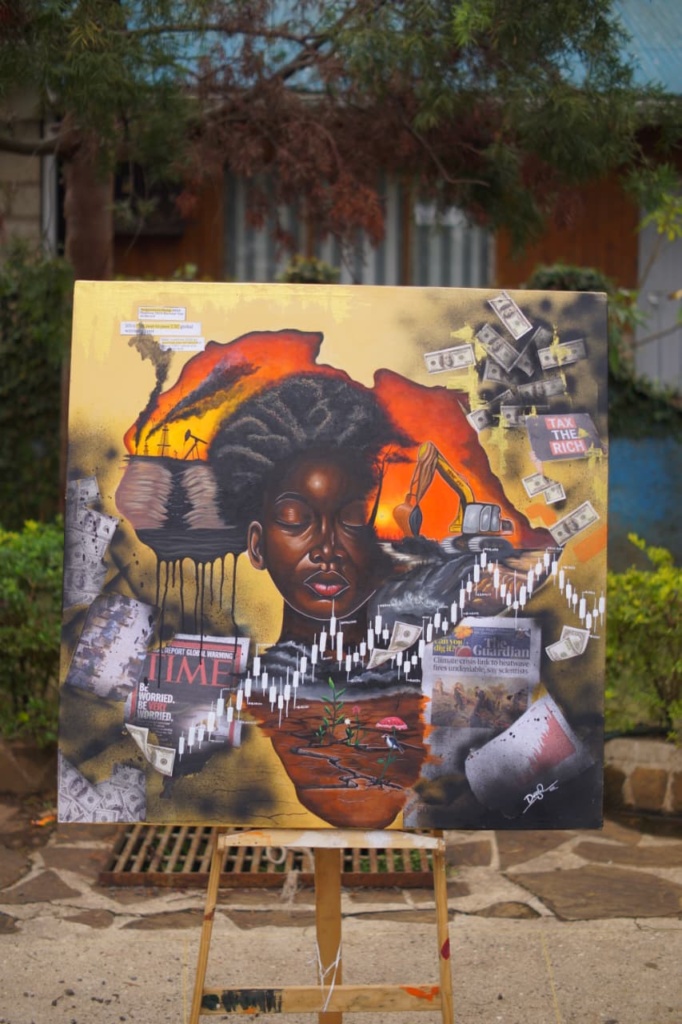
The insect paintings currently taking shape in Juma’s studio are part of a larger body of work that will be unveiled during his solo exhibition on October 20. The one-day exhibition will showcase a collection centred on biodiversity, nature and humanity’s often-overlooked relationship with the smallest forms of life.
Until then, his commissioned works and prints remain available, but the exhibition represents something different: a carefully developed collection that reflects years of observation, memory and environmental storytelling.
The tiny insect that first captured attention inside Juma’s studio ultimately represents something much larger. Through six murals in his community, more than ten paintings and a growing body of environmental art, he hopes people will begin to see nature not as something beyond the city, but as something that has always existed alongside them, waiting to be noticed once again.
Author Profile

-
Seeker.
Inspire AFRIKA.
Latest entries
 Weather Forecasts13 October 2026Rain and Rising Temperatures Forecast Across the Greater Horn of Africa
 Climate9 October 2026Beyond Negotiations: Africa Expects Concrete Outcomes from Antalya
 Animals7 October 2026In Kajiado’s Drylands, Collective Selling of Small Herds Is Changing the Livestock Trade
 Oceans6 October 202640 Years of Ocean Cooperation: The Western Indian Ocean’s Next Test Is Implementation