
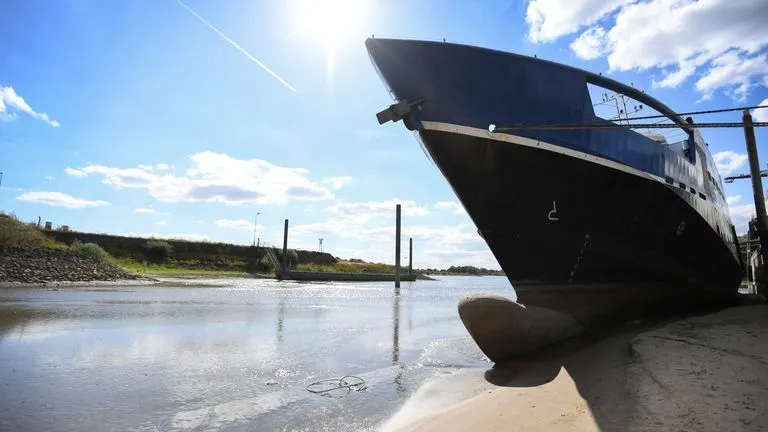
At the gauge in Kaub, the number reads 10 centimeters. It has been dropping for weeks, and shippers on the Rhine have watched it fall with mounting dread.
The water level here now sits around 120 centimeters, an absolute historic low. Most ships can no longer pass. The local ferry has stopped running altogether.
Herbert Friedman has spent his career on this stretch of river, and he has never seen anything like it.
“My god,” he said, recalling the morning he checked the gauge. “I thought this morning, oh my god, where is this going?”
The driest part of the year, meteorologists warn, is still to come. Friedman doesn’t sound entirely like he’s joking when he imagines what’s next. “By then,” he said, “we can ride camels here.”
It is a dark joke about a very unfunny problem. The Rhine is one of Europe’s most important arteries, carrying around 500 million tons of cargo every year, chemicals, fuel, steel, containers, the raw material bloodstream of Germany’s industrial economy.
In recent weeks, ships have been forced to cut their loads to just 20 percent of capacity to keep floating at all. That means five ships are now needed to carry what one used to. For many vessels, even that isn’t enough.
At Kaub, where roughly 300 ships pass on an ordinary day, there is now near-total silence. River transport here has come to a standstill.
A Cascade Set in Motion Months Ago
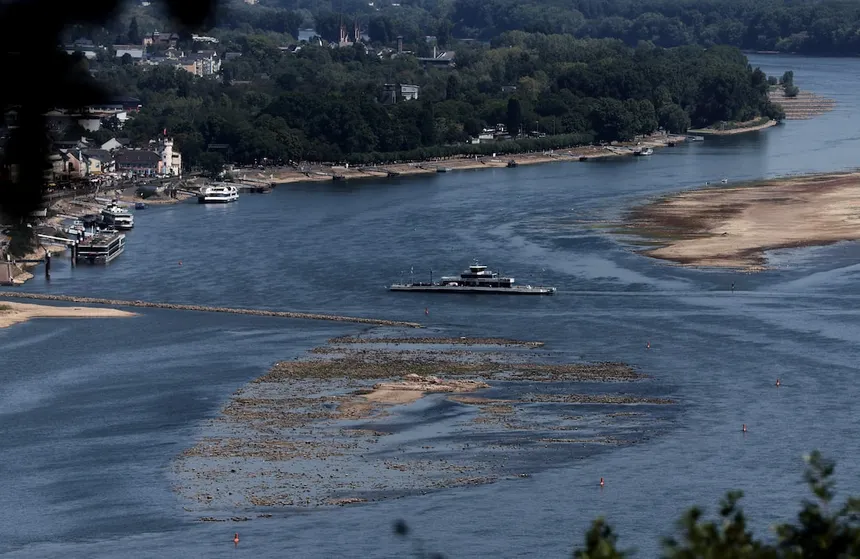
The scenes at Kaub can look like a freak event, a single bad summer. Professor Kerstin Stahl, a hydrologist at the University of Freiburg, says that framing misses the point entirely.
“It’s not normal at all,” she said. “It’s unprecedented, the low flows, and particularly for this time of the year. Normally, low flows happen much later in the year, in late fall or winter.”
What’s unfolding on the Rhine, Stahl explained, is not one cause but a stacked sequence of them. “The current event is really a combination of several things,” she said.
Below-average rainfall has persisted since February. Heat has dried out the land further through evaporation.
A winter with unusually low snowpack meant there was little meltwater running down from the high elevations this summer, and the last backup source, Alpine glacial melt, has also been thinned by years of glacier shrinkage.
“There’s not much more to be had from them as well,” she said.
The consequences reach far beyond shipping. Stahl pointed to impacts on groundwater, on lakes, on tourism, and on drinking water through saltwater intrusion in river deltas. Ecosystems are suffering too, she said, from high temperatures and low oxygen levels that have degraded water quality across the system.
Cargo Rerouted, Costs Multiplied
The river is effectively split in two at Kaub. Downstream, toward Duisburg, Düsseldorf, and Cologne, water levels remain workable enough for cargo from Antwerp and Rotterdam to get through.
Upstream, toward Ludwigshafen, Karlsruhe, and on to Basel in Switzerland, passage has become nearly impossible, straining supply chains for factories and power plants that depend on it.
At the port of Duisburg, Europe’s largest inland port, water is still deep enough for ships to arrive, but the workaround is straining the system in its own way. Cargo from large vessels is being transferred onto smaller ships and trucks for the rest of the journey.
“One big river ship usually taking 5,000 tons now maybe takes 1,000 tons,” said Joachim Holstein, a port worker in Duisburg. Moving what’s left overland is its own logistical headache. “We need around 40 trucks to transport this,” he said, “so it’s impossible to replace the volumes a river ship can carry with trucks.”
The price of that scarcity is showing up on invoices. According to traders, freight costs from Rotterdam to Karlsruhe have climbed to between 150 and 160 euros per ton, up from 45 euros at the end of June.
Building for a River That No Longer Behaves
If there’s a long-term fix, it isn’t fast. Tim Goedde, Director of ship management at HGK Shipping, says the industry is already looking at redesigning its fleet around shallower water.
“One alternative, of course, is the use of so-called low water optimized vessels,” he said. “But as you can probably imagine, these aren’t built overnight.”
A new ship, he noted, takes between one and a half and two and a half years to construct depending on its size, and given the scale of the Rhine’s existing fleet, replacing it can only happen “gradually, step by step.”
In the meantime, Germany’s government has reached for the tools it has. Transport Minister Steffen Bilger announced looser rules for freight trucks, including exceptions to the ban on Sunday and public holiday driving for goods hit hardest by the shipping crunch.
“We can’t influence the weather,” Bilger said, “but we could ensure that our economy gets through these difficult weeks better. That’s why we will now take corrective action where necessary.”
He was candid about the limits of that action: it helps transport companies survive the short term. It does nothing for the river itself.
Learning to Live with Less Water
For Stahl, that distinction is the real story here, and the one Germany hasn’t fully reckoned with. Droughts like this one, she says, cannot be prevented.
“In the long term, we can do climate protection and help ensure that it doesn’t get even worse,” she said, “but we’ll have to learn how to deal with this and adapt, and in particular negotiate who gets the water for what purpose.”
Agriculture, drinking water, energy, industry, all of them are now competing for a shrinking supply.
Germany, she said, is behind other countries in preparing for that negotiation. “Spain has them,” she said of formal drought management plans. “Germany is lagging behind a little bit.”
What’s needed, in her view, is a framework for prioritizing water use before the next crisis arrives, not after.
Asked whether the current emergency, once resolved, means the danger has passed, Stahl was unambiguous.
“We need to learn to live with certain periods that have either too much water or too little water,” she said, “and just accept that we cannot always have everything we want.” Managing that risk, she added, means being honest in advance about where the limits are, and where the region will simply have to do without.
Read Also: Climate Change Leaves Lake State Farmers Watching Their Crops Wither
Author Profile

- How can we learn if we don't question?
Latest entries
 Agriculture16 October 2026“There Is No Shortcut”: A Kiambu Grower’s Decade in Mushrooms
 COP3115 October 2026Pacific Leaders Call for Urgent Climate Action Ahead of COP31
 Agriculture13 October 2026Can the buffalo fix Kenya’s milk problem? Farmers say start with the feed bill
 Events12 October 2026Cybersecurity in the Floriculture Industry


