
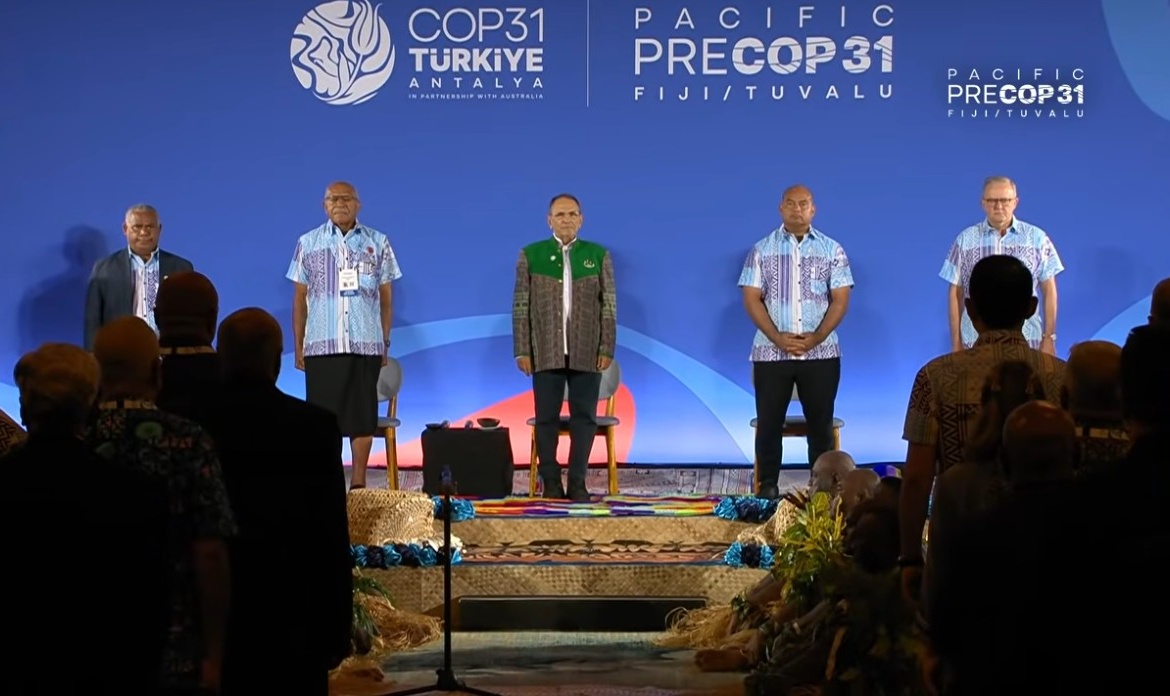
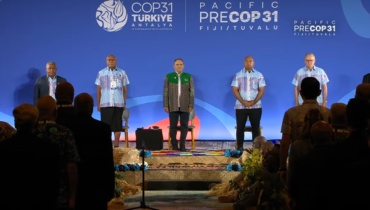
Pacific leaders have called for stronger international cooperation and urgent climate action ahead of the 31st United Nations Climate Change Conference (COP31), warning that vulnerable nations are already experiencing the devastating effects of rising sea levels and extreme weather.
The call came during a leaders’ plenary in Fiji following a visit to Tuvalu, a low-lying Pacific island nation on the frontline of climate change. Leaders, ministers and senior officials travelled to Tuvalu on Tuesday to engage with local communities and discuss the challenges facing vulnerable nations.
The visit culminated in the adoption of the Taku Pakasoa Declaration, a leaders’ declaration built around the Tuvaluan concept of strength through unity and collective action. It seeks to carry the Pacific’s call for climate action into COP31, scheduled for November 2026 in Antalya, Türkiye.
Fiji’s Prime Minister, Sitiveni Rabuka, urged leaders to translate their shared understanding of climate risks into concrete commitments, saying the world could no longer afford the gap between scientific knowledge and action.
“Our declaration must make our commitment to close the gap between what we know, and what we do, crystal clear,” Rabuka said.
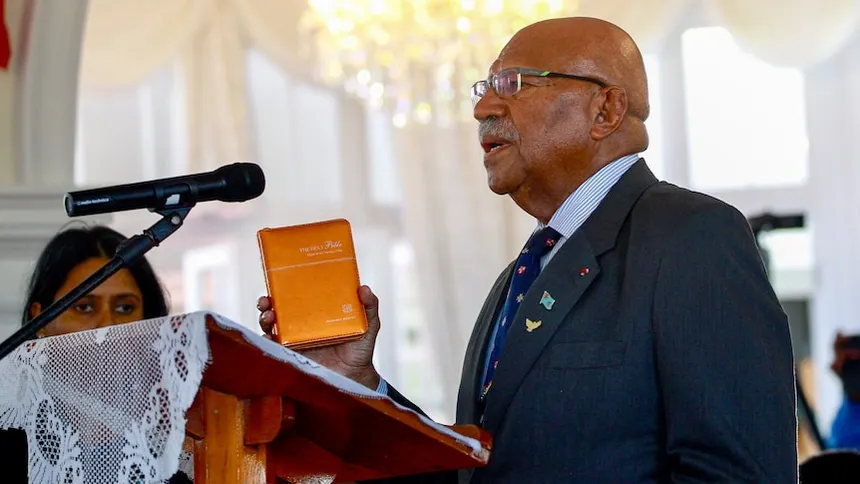
He called on leaders to measure their climate commitments against the future of vulnerable nations such as Tuvalu, asking whether the country would receive the support needed to expand its coastal protection efforts.
“In 10 years to 20 years’ time; ‘Are the shores we walked on and the land on which we spoke, still dry? And the air still filled with song?” he asked.
Rabuka said the Pacific sought to move beyond being viewed primarily as a region experiencing the consequences of climate change and become a source of solutions that could be demonstrated and scaled up.
“Here in the Pacific as a region and as a voice of the world’s largest ocean, we aim to create islands of innovation, to demonstrate and scale up solutions, and to move beyond being seen as a region where only the problem is measured to the place where solutions are shared,” he said.
Australian Prime Minister Anthony Albanese said climate change was already affecting communities across the Pacific, with rising sea levels threatening island nations and extreme weather posing growing challenges.
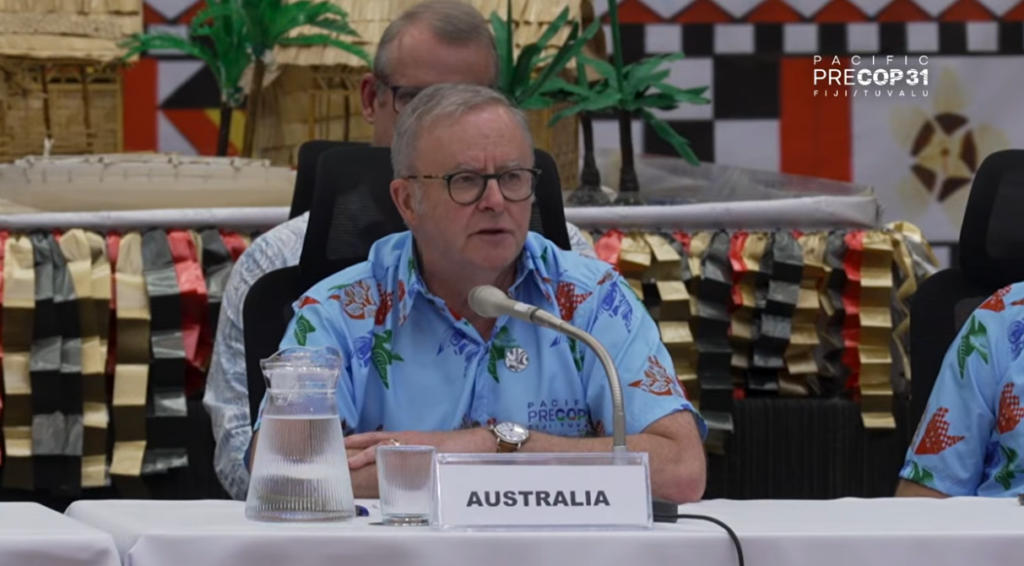
“In Tuvalu, as in the rest of the Pacific, climate change is not a problem for the future. It is here right now,” Albanese said, noting that sea levels in the western Pacific were rising at more than twice the global average.
He said leaders had a responsibility to listen to communities experiencing climate change and bring their concerns to the international stage.
“What this gathering is about is bringing those Pacific voices to the world,” he said, adding that the unity demonstrated at the meeting must be translated into action.
Albanese also highlighted Australia’s domestic renewable energy transition, saying renewable sources had supplied more than half of the country’s energy in the December quarter of the previous year.
However, he stressed that individual countries could not address the climate crisis alone and called for greater international support for initiatives such as the Pacific Resilience Facility, designed to strengthen resilience across the region.
The declaration also drew attention to the shared climate vulnerabilities of countries beyond the Pacific.
Nepal’s Minister for Foreign Affairs, Shisir Khanal, linked the challenges facing island nations to those confronting mountainous countries, where melting glaciers contribute to rising sea levels and threaten communities.
“Mountains and oceans are not opposite. They’re one water, one story, one shared future,” Khanal said.
He described the climate crisis as an issue of injustice, arguing that countries contributing relatively little to global emissions were paying heavily through loss of life and setbacks to development.
“As we prepare for COP31, Nepal calls for uncompromising fidelity to the 1.5-degree threshold,” he said.
United Nations Deputy Secretary-General Amina Mohammed said the Pacific had spent decades warning the world about climate change, and that the consequences were now being felt.
“Those who contributed least to this crisis cannot be expected to carry its greatest costs. Responsibility, capability and justice must shape the world’s collective response,” she said.
Mohammed added that Pacific nations were not merely waiting for assistance but were already demonstrating leadership through solidarity and collective action.
COP31 President-designate and Türkiye’s Minister for Environment, Urbanisation and Climate Change, Murat Kurum, also called on countries to unite behind the declaration and take action to protect future generations.
Meanwhile, UN Climate Change Executive Secretary Simon Stiell described the declaration as an important signal ahead of the negotiations in Antalya.
“The clock is ticking, the costs are mounting, but the solutions exist. Chief among them is cooperation in a fractured world,” Stiell said.
He called for COP31 to turn climate commitments into practical results that protect communities, defend the ocean and limit global warming.
As preparations for COP31 continue, the Taku Pakasoa Declaration places the Pacific’s demands for solidarity, climate justice and practical support firmly on the international agenda. Its significance will ultimately depend on whether countries translate the commitments expressed in Fiji into meaningful action for vulnerable communities.
Read Also: Türkiye’s COP31 Presidency Faces a Power-Sector Energy Transition Test
Author Profile

- How can we learn if we don't question?
Latest entries
 COP3115 October 2026Pacific Leaders Call for Urgent Climate Action Ahead of COP31
 Agriculture13 October 2026Can the buffalo fix Kenya’s milk problem? Farmers say start with the feed bill
 Events12 October 2026Cybersecurity in the Floriculture Industry
 Opinion & Analysis8 October 2026Why Africa Must Look to What Already Exists in Its Blue Economy

