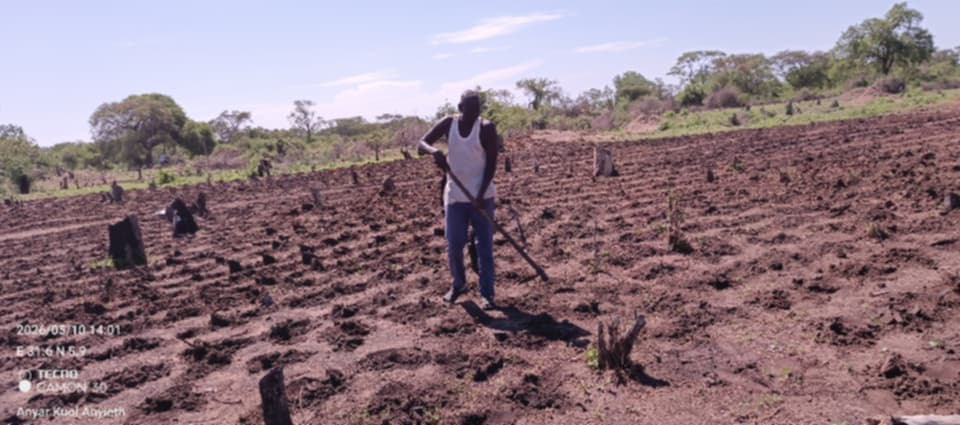
For Anyar Kuol, age 40, a farmer in Yuith Manguak-Awerial County, about seven kilometres from Kalthok along the Juba–Rumbek Road, farming has always been more than a livelihood; it is the only way to feed his family and support his community. But as climate change continues to alter rainfall patterns across South Sudan, hope is increasingly being replaced by uncertainty.
Standing in fields where maize plants are drying before reaching maturity, Anyar says this year’s farming season has become another painful reminder of how unpredictable the weather has become.
“Our crops are withering because there is no rain. We depend entirely on rainfall, and without it, there is nothing we can do,” he says.
His farming group established a 15-acre farm in 2024, hoping to improve food production in the area. However, drought destroyed almost the entire harvest in 2025, with only one acre producing crops. This year brought little relief.
After receiving a single rainfall on May 12, the group planted maize, expecting the rainy season to continue. Instead, the rains disappeared for nearly two months. The next significant rainfall came only on July 12, too late for many of the crops that had already dried up.
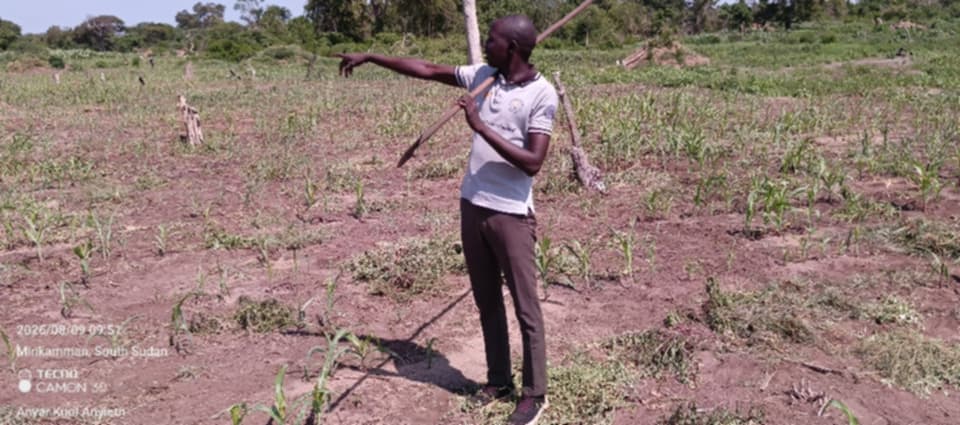
The prolonged dry spell has not only affected one farming group. Across the surrounding villages, fields remain barren, while many families have watched repeated planting efforts fail.
“If you move around this area, you will hardly see crops near people’s homes. They cultivate, but everything keeps drying up. It is heartbreaking,” he says.
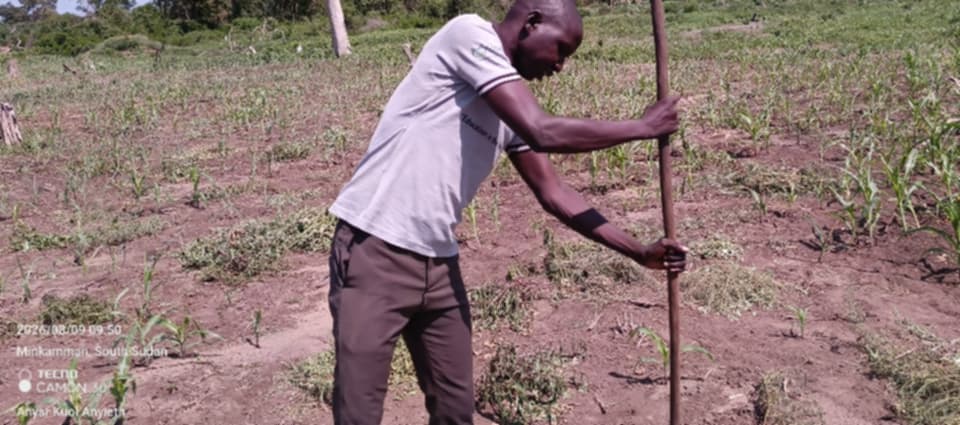
The worsening conditions highlight the growing impact of climate change on South Sudan’s agriculture, where the majority of households rely on rain-fed subsistence farming. Without irrigation systems or drought-resistant farming technologies, many communities have few options when seasonal rains fail.
Despite the challenges, Anyar refuses to surrender to despair. Instead, he and fellow farmers are exploring ways to adapt by planting drought-tolerant crop varieties and adjusting planting schedules to match changing weather patterns.
“We need seeds that can survive dry conditions. If irrigation is not available, then we must adapt by planting crops that can withstand drought and others that perform well when rainfall is abundant,” he explains.
He believes farmers should not abandon agriculture despite repeated losses.
“There is no benefit in giving up. Most people here survive through farming. If they stop cultivating, they become even more vulnerable to hunger,” he says.
Looking ahead, Anyar remains cautiously optimistic. Based on seasonal forecasts indicating increased rainfall later in the year, he plans to clear additional land and continue planting whenever conditions improve.
“Giving up is not the solution. Success comes when you keep trying,” he says.
For farmers across Lake State, the changing climate is no longer a distant environmental issue; it is an everyday struggle that determines whether families will have enough food to survive.
As droughts become more frequent and rainfall increasingly unpredictable, many are calling for greater investment in irrigation, access to climate-resilient seeds, and timely weather information to help communities adapt before another harvest is lost.
The South Sudan Meteorological Service (SSMS) has forecast drier-than-normal conditions and above-average temperatures across much of the country in August 2026.
According to the monthly weather outlook, most areas have a 40–80 per cent probability of receiving below-normal rainfall, with the greatest likelihood in parts of Eastern Equatoria, Western Equatoria, and Western Bahr El Ghazal.
Meanwhile, temperatures are expected to remain above normal nationwide, with some areas of Upper Nile, Jonglei, Greater Pibor Administrative Area, and Eastern Equatoria facing an over 80 per cent chance of unusually high temperatures.