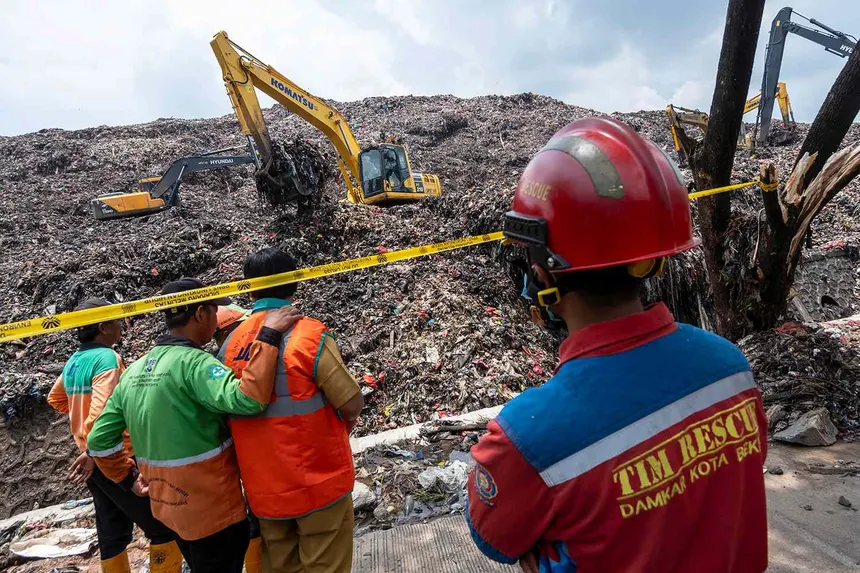
On the outskirts of Jakarta, a mountain rises where there shouldn’t be one. It is made entirely of trash, spread across more than 100 hectares and standing 65 meters tall, roughly the height of a 16-story building.
This is Bantargebang, Indonesia’s largest landfill, and one of hundreds across the country that are already at or beyond capacity. The air here is thick with heat, humidity, and the unmistakable smell of decades of rotting waste.
Bantargebang isn’t just an eyesore. It’s dangerous. Methane gas fires break out regularly, and the loosely piled mountains of garbage are prone to collapse.
In March, seven people were killed when one such mountain gave way, a stark reminder of the risks faced daily by the thousands who live and work at the site.
In response, the government has pledged to end unrestricted, open dumping in favor of controlled disposal, one of Indonesia’s biggest waste reforms in decades.
“We are reshaping the slopes at Bantargebang, improving the drainage system, and managing methane gas,” says Agung Pujo Winarko, head of the landfill.
Under the new approach, waste is leveled, compacted, and sealed with protective covering, rather than left to pile up unchecked.
Authorities in Jakarta have also begun rolling out waste sorting at the source, with the long-term goal that landfills like Bantargebang will eventually receive only residual waste, the leftover material that can’t be reused, recycled, or resold.
On paper, it’s a clear win: safer conditions, better environmental management, and a more modern approach to a crisis that has been building for years.
But for the thousands of people who make their living informally on the landfill, searching through the trash for items to resell, the reform sounds less like progress and more like an ending.
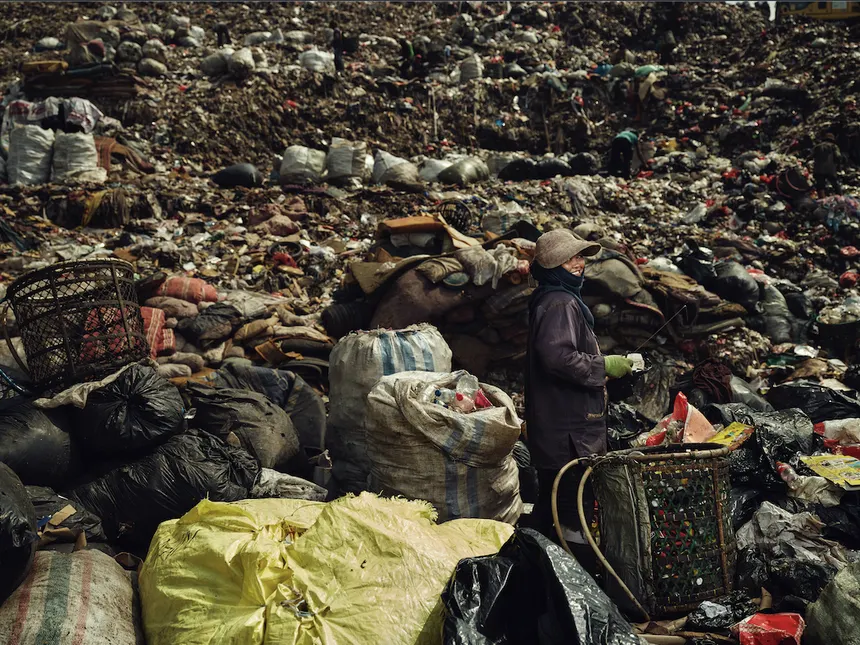
Rianisa is one of them. Like most informal waste collectors at Bantargebang, she works over 12 hours a day for just a few dollars, sorting through mountains of garbage by hand in punishing heat. It’s exhausting, dangerous work, but it’s also the only income many families here have ever known.
“Where will our income come from?” she asks. “All this time, our income has come from trash. If the trash is sorted elsewhere, what kind of trash will come here?”
It’s a question with no clear answer yet. If waste sorting increasingly happens before garbage ever reaches the landfill, there may simply be far less left for collectors like Rianisa to find and sell.
The very reform designed to make the landfill safer and more sustainable could strip away the informal economy that has grown up around it.
The government says it hasn’t overlooked this. Officials have promised the transition will create safer, formal jobs in waste management, and plan to build new processing facilities to sort different types of waste.
In theory, this could offer people like Rianisa a way out of dangerous, informal scavenging and into stable employment.
In practice, that promise remains just that, a promise. No clear timeline has been given for when open dumping will fully end, or when these new facilities and jobs will materialize. For now, the mountain keeps growing, methane keeps rising from its slopes, and workers keep climbing it every day, uncertain whether the ground beneath their livelihood is about to shift for good.
Bantargebang is, in many ways, a landfill in transition, caught between the dangers of the past and the uncertainties of what comes next.
Its story captures a tension playing out in cities across the developing world: how do you clean up a crisis decade in the making without leaving behind the people who, for just as long, have quietly kept it from getting worse?
Read Also: Mistaken for Mist: The Quiet Emergency in Nairobi’s Air