
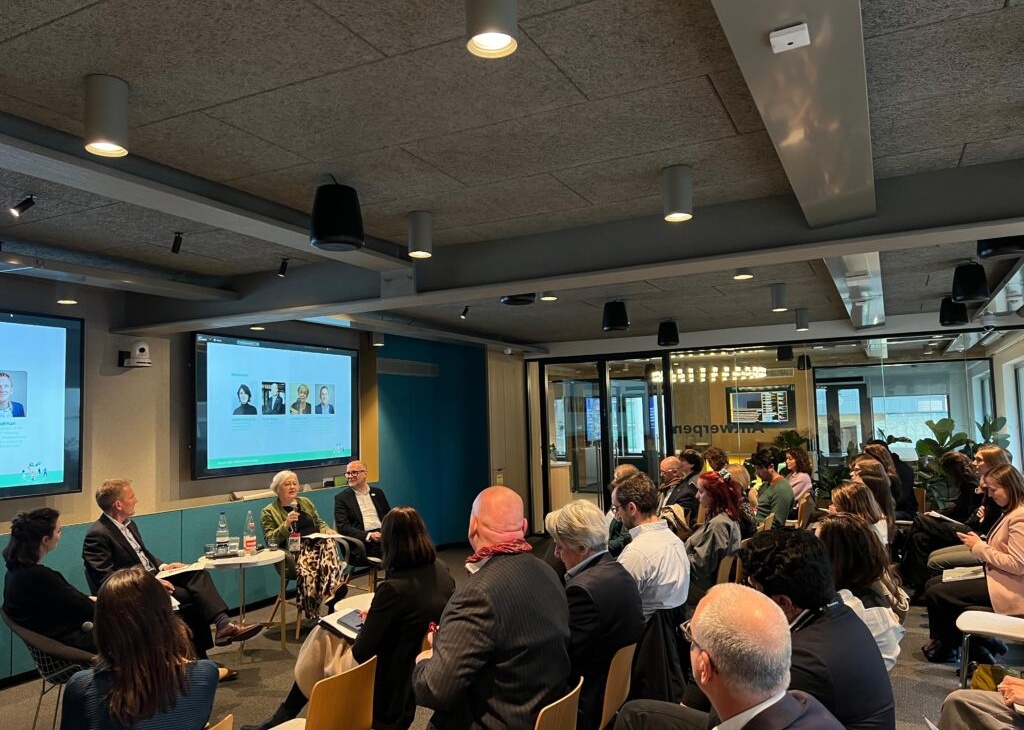
In the corridors of the World Bank Spring Meetings, far from the streets where floods rise and heat intensifies, a different kind of urgency is taking shape. It is not about whether cities will face the climate crisis, but whether they will be financed to survive it.
Inside a high-level roundtable titled “Scaling Sustainable Investment in Cities: The Role of DFIs,” mayors, development finance institutions (DFIs), and global city networks gathered around a shared concern: the money is not moving fast enough, and not reaching where it matters most.
Co-convened by C40 Cities and Global Covenant of Mayors for Climate & Energy, alongside the Multilateral Development Banks Cities Group, the dialogue brought together voices from across continents. However, the message was strikingly consistent: cities are ready to act, yet remain constrained by a financial system that struggles to meet them where they are.
“Cities are where investment becomes impact,” said Juan Pablo Bonilla of the Inter-American Development Bank.
From transport systems to flood defenses, urban infrastructure is where climate ambitions translate into lived realities. Yet for many cities, particularly in the Global South, accessing finance remains a complex, often exclusionary process.
Participants emphasized the need to raise public investment in urban climate finance to at least $800 billion annually by 2030, aligning with global climate goals and commitments under COP processes. Although ambition is rising, access remains uneven, especially for smaller cities that face the brunt of climate shocks without the financial tools to respond.
For Claudio Castro, mayor of Renca in Chile, the answer lies in local action. “In Renca, we did not wait for international finance to solve our climate crisis,” he said.
Instead, the city transformed treated industrial water into a self-sufficient irrigation system for an urban park, expected to quadruple green space per capita and reduce temperatures by up to 4°C.
“For every dollar invested, we estimate a return of 26 dollars,” Castro noted, emphasizing a growing reality that climate action is not just a necessity, it is investable.
From Global Commitments to Local Delivery
For institutions like the European Bank for Reconstruction and Development, the challenge now is scale.
“The challenges cities face demand coordinated action, shared knowledge, and bold innovation,” said Mark Bowman, reflecting on a decade of the Green Cities programme.
As climate pressures intensify, from natural hazards to energy insecurity, DFIs are expanding partnerships and rethinking how finance is delivered, with a growing focus on impact at the city level.
At the same time, national governments are being urged to create stronger enabling environments. Representatives from Germany and Brazil, co-chairs of the Coalition for High Ambition Multilevel Partnerships (CHAMP), emphasized that while policy frameworks are critical, implementation ultimately happens in cities.
“Delivering climate action at scale requires strong and sustained partnerships between all levels of government,” they noted, calling for closer collaboration to remove financial bottlenecks.
Amid these discussions, a new report, “Building the Financial Case for Urban Adaptation”, launched by C40 Cities and the Global Covenant of Mayors for Climate & Energy, offered a shift in perspective.
Rather than viewing adaptation as a public cost, the report positions it as an investment opportunity. “Cities are the front lines of the climate crisis, yet the lack of accessible finance remains the single greatest barrier to action,” said Andrea Fernández.
Drawing on case studies from cities like Dakar, Bilbao, and Kuala Lumpur, the report shows how structured, bankable projects, with clear revenue streams and strong planning, can attract private capital.
Looking ahead to COP31, the focus is increasingly on delivery. As Josué Tanaka noted, closing the climate finance gap is not just about increasing funding, but about building systems that can deliver at scale and where it is most needed.
Beyond the meeting rooms, the stakes are already visible in flooded neighborhoods, rising temperatures, and overstretched urban systems.
Cities are not just part of the climate conversation; they are its frontline. And increasingly, they are its proving ground.
The question is no longer whether solutions exist. From Santiago to Dakar, they already do. The question is whether finance, at the scale and speed required, can finally reach the ground.
Author Profile

-
Seeker.
Inspire AFRIKA.
Latest entries
 Agriculture14 October 2026Africa’s Food Systems Future Depends on Listening to Farmers
 Weather Forecasts13 October 2026Rain and Rising Temperatures Forecast Across the Greater Horn of Africa
 Climate9 October 2026Beyond Negotiations: Africa Expects Concrete Outcomes from Antalya
 Animals7 October 2026In Kajiado’s Drylands, Collective Selling of Small Herds Is Changing the Livestock Trade


