
The world is capable of producing enough food to feed everyone, although hunger is tightening its grip on millions, with Africa, a continent with the largest arable lands, facing heightened food security crises. New United Nations figures show that instead of moving closer to the goal of ending hunger by 2030, the world is drifting further away, with experts warning that another global food price crisis could soon deepen an already fragile situation.
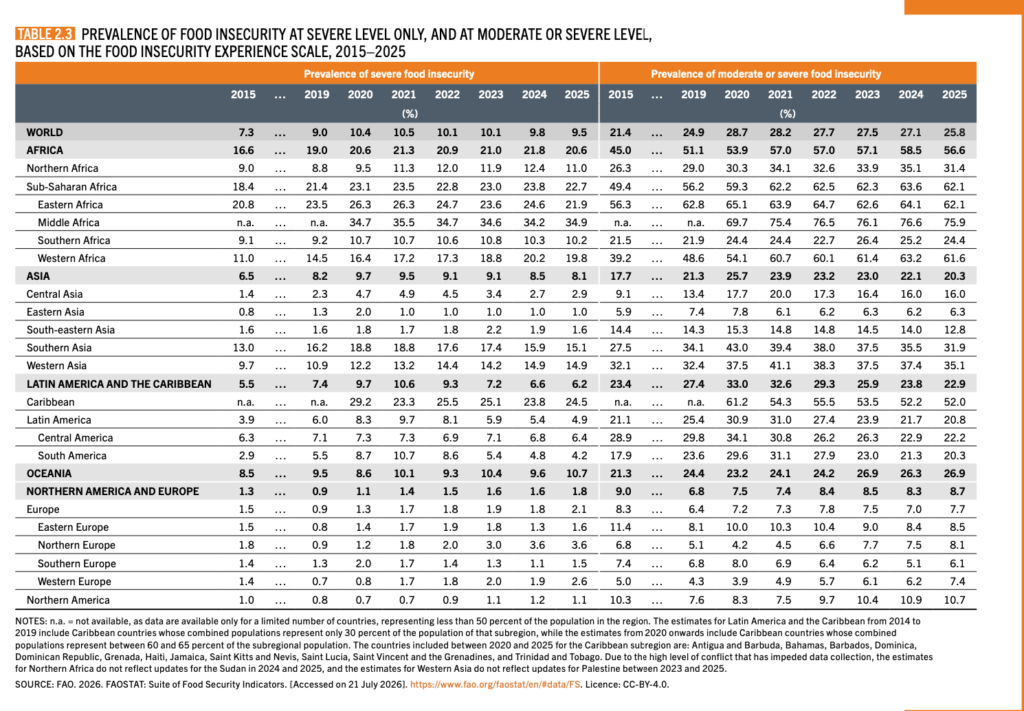
The latest State of Food Security and Nutrition in the World (SOFI) 2026 report reveals that 645 million people experienced hunger in 2025, equivalent to 7.8 percent of the global population and 61 million more people than before the COVID-19 pandemic in 2019. At the same time, around 2.1 billion people, or one in every four globally, lacked regular access to sufficient, safe and nutritious food needed for a healthy life.
Perhaps the report’s most striking finding is a historic shift in the geography of hunger. For the first time, Africa has overtaken Asia to become the continent with the largest number of hungry people.
Across Africa, an estimated 309 million people, one in every five, now face hunger, representing an 81 percent increase since 2010. Conflict, worsening climate shocks, mounting debt burdens and heavy reliance on imported food have combined to create a crisis that continues to outpace efforts to reverse it. Nearly two-thirds of Africans are now unable to afford a healthy diet, more than double the proportion in Asia and Latin America.
The findings come as global food systems face mounting uncertainty. The Independent Panel of Experts on Sustainable Food Systems (IPES-Food) warns that geopolitical tensions, disruptions in fertilizer supplies, trade disputes, aid cuts and increasingly severe climate events linked to El Niño and long-term climate change could push food prices sharply higher in 2026.
Jennifer Clapp, an IPES-Food panel expert and Canada Research Chair at the University of Waterloo, said the warning signs are already visible.
“Global hunger remains stubbornly high. And the outlook for 2026 is deeply worrying. Geopolitics is increasingly shaping food security, with conflict, fertiliser disruptions, trade tensions, and El Niño-driven climate shocks threatening yet another surge in food prices.”
She argued that greater dependence on volatile international markets is no longer a viable solution.
“The answer is not deeper dependence on volatile global markets, but more resilient, self-reliant food systems that keep food affordable and protect people from future shocks.”
A Food Security Crisis shaped by more than food production
The report suggests that hunger today is increasingly driven less by the availability of food than by access, affordability and the structure of global food systems.
Raj Patel, an IPES-Food panel expert and professor at the University of Texas at Austin, said the persistence of hunger reflects political and economic choices rather than unavoidable shortages.
“When 645 million people are hungry, and one in three cannot afford a healthy diet, this is a failure of political choices.”
He added that while consumers pay increasingly higher prices, farmers continue receiving a shrinking share of the value created within food supply chains.
“Healthy diets are becoming a luxury for billions, while farmers are paid less and consumers pay more. That isn’t an accident; it’s the result of a food system where a handful of powerful traders, processors, and retailers set the prices and pocket the profits.”
Patel argued that making nutritious food affordable requires addressing where profits are concentrated within the global food system.
“You cannot lower the cost of a healthy diet without asking who profits from an unhealthy one.”
The worsening crisis is unfolding alongside escalating humanitarian emergencies. In 2025, the United Nations confirmed famine in both Gaza and Sudan for the first time, exposing millions of people to catastrophic levels of hunger and underscoring how armed conflict continues to undermine food security.
Africa’s untapped potential
Despite Africa becoming the global epicentre of hunger, many food system experts argue that the continent possesses the resources needed to feed itself.
Million Belay, an IPES-Food panel expert and General Coordinator of the Alliance for Food Sovereignty in Africa (AFOSA), said the report validates what farming communities across the continent have experienced for years.
“This UN report confirms what African farmers and communities have long known: hunger is caused by the failure of our food systems.”
He noted that Africa possesses abundant agricultural land, indigenous knowledge and millions of farmers capable of producing sufficient food. Still, decades of dependence on imported food and agricultural inputs have weakened domestic food systems.
“Africa has the land, the knowledge, and the farmers to end hunger. Yet one in five Africans now faces hunger because decades of dependence on volatile global markets and imported inputs have weakened local food systems and left millions vulnerable.”
Belay called for governments to prioritise family farming, agroecological production, farmer-managed seed systems and stronger local markets as the foundation for long-term food security.
“Food sovereignty is not just an aspiration, it is the pathway to ending hunger.”
That message resonates with farmer organisations across Eastern Africa.
Elizabeth Nsimadala, President of the Eastern African Farmers Federation, which represents 25 million smallholder farmers, said the findings should serve as a wake-up call for policymakers.
“The news that Africa is now the hungriest continent on the planet is a shock – but not a surprise.”
She noted that although smallholder farmers produce approximately 80 percent of Africa’s food, investment in agriculture has consistently fallen short of political commitments.
“Smallholder farmers produce 80% of Africa’s food yet have been sidelined for decades, yet few African governments have delivered on the promise to invest 10% of public spending in agriculture.”
Nsimadala also highlighted the unequal distribution of climate finance, saying the farmers most exposed to droughts, floods and changing weather patterns receive less than one percent of the funding needed to adapt.
“Ending hunger in Africa, and across the globe, is possible but only if governments and the international community work with and invest in the smallholder producers who feed us.”
Lessons from countries making progress
The global picture is not uniformly bleak. While Africa’s hunger levels continue to rise, both Asia and Latin America have recorded gradual improvements, demonstrating that policy interventions can make a measurable difference.
The report points to Brazil as one example, where coordinated public investment, including cash transfers for vulnerable households, universal school feeding programmes, public food procurement from family farmers and expanded public food provision, has helped eliminate hunger.
For IPES-Food, these examples reinforce a broader conclusion: ending hunger will require more than emergency food assistance. It demands rebuilding food systems that are locally rooted, climate-resilient and less exposed to global market volatility.
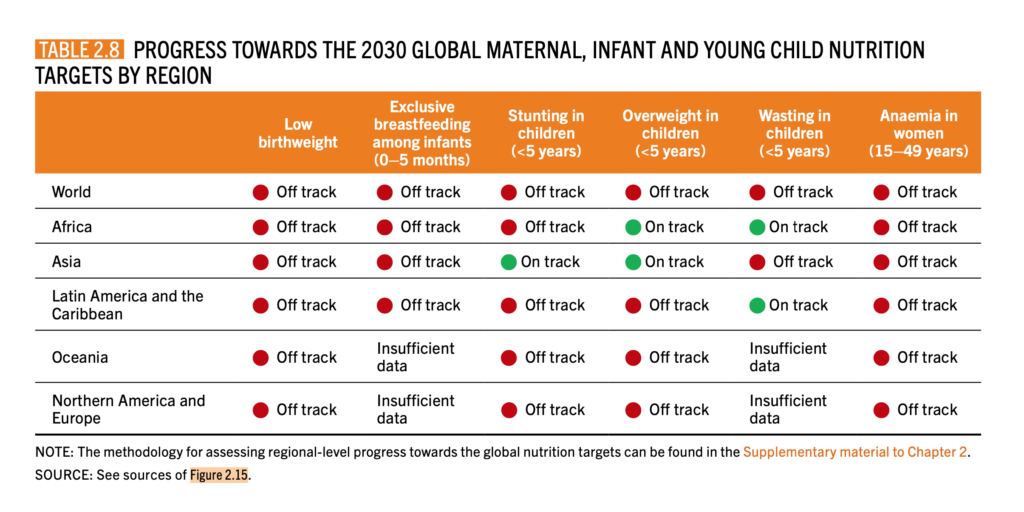
With only four years remaining before the 2030 Sustainable Development Goal deadline, the latest figures underscore the scale of the challenge. The world is not currently on track to eliminate hunger or achieve any of the seven global nutrition targets.
For millions already struggling to afford their next healthy meal, the concern is not simply whether food will be available, but whether it will remain within reach as climate change, conflict and geopolitical tensions continue to reshape the global food landscape.


