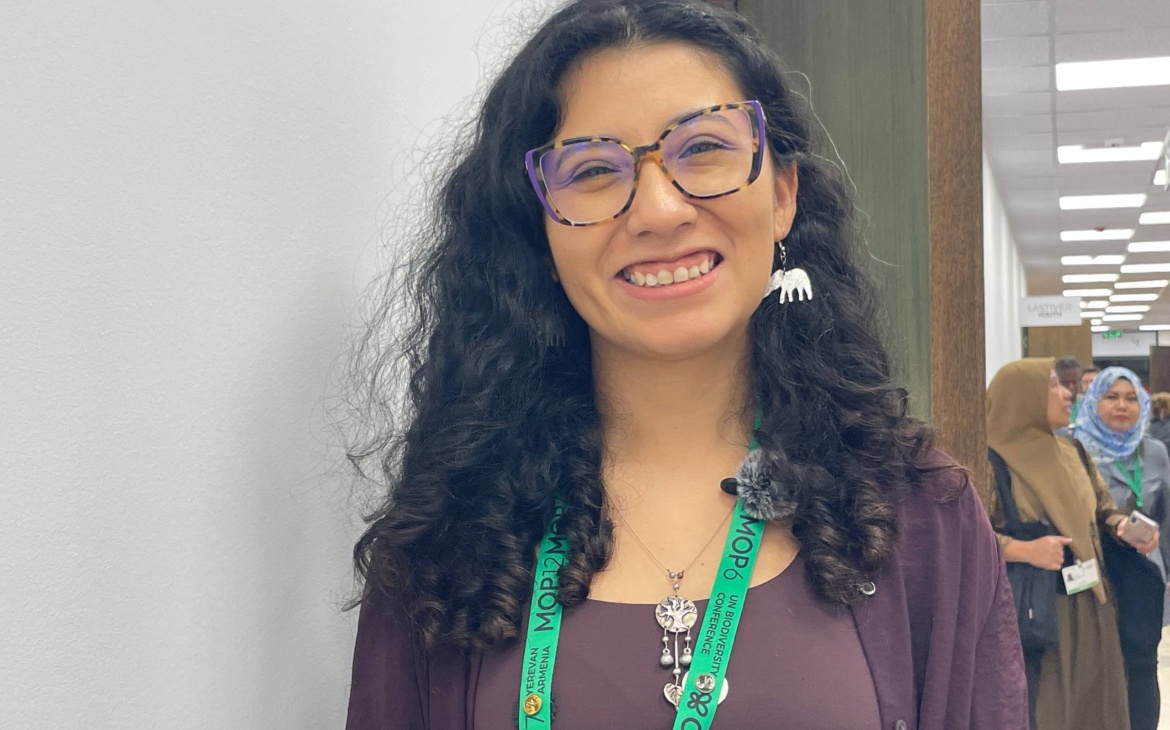
As governments review progress under the Global Biodiversity Framework, Mirna Inés Fernández of Third World Network warns that the debate over implementation and finance risks overlooking the inequalities driving biodiversity loss, urging the addressing of the Justice Gap.
As delegates at the 17th Conference of the Parties to the Convention on Biological Diversity (COP17) examine progress towards global biodiversity targets, Mirna Inés Fernández believes an important question remains largely unanswered: how much money is financing the destruction of nature, and who bears the cost?
A researcher with the Biodiversity Programme of Third World Network (TWN), Fernández argues that the global review of the Kunming-Montreal Global Biodiversity Framework (KMGBF) should look beyond the implementation and finance gaps to confront what she calls the “justice gap” in biodiversity conservation.
At a CBD Alliance side event titled “Are We on Track? A Global Civil Society Review of Biodiversity, Rights, and Justice,” Fernández challenged the assumption that meeting global biodiversity targets would necessarily deliver meaningful ecological and social outcomes.
“We are very worried that false solutions are still being promoted inside the global biodiversity framework,” she said. “Even if we reach the global biodiversity targets, many of these targets are based on false solutions, and then we won’t have real results for biodiversity.”
As she speaks to Climate Lens News at Yerevan, Armenia, her concern is that the policies and financial instruments being advanced to support conservation may, in some cases, allow destructive economic activities to continue while placing additional pressure on the communities that protect ecosystems.
For Fernández, assessing progress therefore requires asking not only whether countries are mobilising sufficient resources, but also whether the approaches being financed address the underlying causes of biodiversity loss.
When market solutions meet the complexity of nature
Fernández’s criticism centres on two areas: the use of nature-based solutions and the growing role of market-oriented instruments in biodiversity finance.
Nature-based solutions can support conservation and ecosystem restoration. However, she argues that the concept has been misused to accommodate activities such as monoculture plantations, allowing polluting industries to present their investments as environmentally beneficial without adequately addressing their emissions or ecological impacts.
“They are justifying the lack of decarbonisation of our economies and giving permits for the industry that is polluting and destroying ecosystems to keep doing what they are doing because they are investing in nature-based solutions,” she said.
She also questions the market-oriented mechanisms associated with Target 19 of the KMGBF, which calls for mobilising financial resources for biodiversity. These include biodiversity credits and offsets, payments for ecosystem services and green bonds, although the instruments differ in how they operate and should not be treated as interchangeable.
Fernández’s concern is that approaches built around pricing, exchanging and assigning economic value to nature can overlook ecological complexity and the differences between ecosystems.
She illustrates the problem through the example of a forest. Losing ten hectares of pristine, biodiverse forest cannot necessarily be compensated for by planting 15 hectares of other trees and declaring a net gain for biodiversity.
“If I have a forest and lose 10 hectares of pristine biodiverse forest and then plant 15 hectares of whichever trees I can find around and call it a restoration project, this doesn’t make sense,” she said.
The example highlights a fundamental distinction between replacing an area of land and restoring the ecological functions, biodiversity and relationships that made the original ecosystem valuable.
For Fernández, nature cannot simply be reduced to economic units that can be exchanged or traded. She argues that market-based approaches can enable destructive industries to continue operating without adequately addressing their environmental impacts or facing stronger regulation.
The consequences, she says, extend beyond ecosystems to the people who depend on them.
The people behind biodiversity conservation
Communities that have long safeguarded biodiversity can face new restrictions when conservation markets and projects enter their territories. Fernández says some are prevented from harvesting resources they previously relied on or continuing customary practices, while disputes over land tenure and human rights can deepen.
“The people on the ground conserving biodiversity cannot access the markets,” she said. “If they can access the markets, the benefits they get are very minimal compared to the benefits the intermediaries make.”
She links these inequalities to the wider global financial architecture, which she believes constrains the ability of countries in the Global South to protect biodiversity.
Debt burdens, unequal currency relationships and the risk of legal action by companies when governments introduce regulations can limit the choices available to countries seeking to strengthen environmental protection.
“Poor people and poor countries in the Global South cannot afford to conserve biodiversity because they are constrained by debt,” Fernández said, adding that governments can also face pressure from companies when they attempt to regulate their activities.
She is calling for the Convention on Biological Diversity to reconsider aspects of the global biodiversity targets and engage with other United Nations processes to address the structural financial barriers affecting conservation.
For Fernández, increasing biodiversity finance alone will not resolve these problems if the wider systems governing how money flows, who controls it and who benefits remain unchanged.

Beyond the finance gap
The global review of the KMGBF is an opportunity to examine whether countries are progressing towards the framework’s targets and what is preventing implementation. But Fernández warns that an assessment focused mainly on unmet targets and insufficient conservation funding risks presenting only part of the picture.
She urges delegates and civil society organisations to remain critical of the narratives emerging from the negotiations.
“Everybody is talking about how little the finance is for biodiversity, but they are not talking about how big the finance is for the destruction of biodiversity and how big the finance is for the implementation of injustice,” she said.
Her argument shifts the conversation from the amount of money available for conservation to the broader economic and political choices that shape biodiversity outcomes.
If financial resources continue to support activities that damage ecosystems, while communities protecting nature face insecure land rights and limited access to benefits, the justice gap cannot be understood through funding shortfalls alone.
Fernández wants the global review to recognise this imbalance, even if it is not fully reflected in the official reports.
“We are saying there is a justice gap,” she said, “and that is something that we need to keep taking into account even if it’s not on the reports.”
As countries assess their progress towards the global biodiversity targets, her message is that success must mean more than meeting numerical commitments or mobilising new sources of finance. It must also involve confronting the economic structures that enable the destruction of biodiversity and ensuring that the people protecting nature are not left to bear its costs.
This story was produced as part of the 2026 CBD COP17 Fellowship, operated by Informed Earth in collaboration with Internews’ Earth Journalism Network.
Author Profile

-
Seeker.
Inspire AFRIKA.
Latest entries
 Biodiversity26 October 2026Beyond Biodiversity Finance, A Justice Gap Governments Must Confront
 Biodiversity24 October 2026Faith Leaders and Civil Society Call for Stronger Partnerships to Restore Nature
 Biodiversity23 October 2026Inside Kobe’s Grassroots Effort to Train the Next Generation of Biodiversity Leaders
 Animals23 October 2026As COP17 Meets, World’s Rarest Great Ape Faces a Make-or-Break Test in Indonesia