At the heart of biodiversity conservation are people whose contributions are not always visible in the data used to measure the state of nature. Women are among them. They farm, fish, manage forests, conserve ecosystems, preserve traditional knowledge, organise communities and defend territories.
Yet much of the biodiversity information used to shape policy continues to tell a more limited story: what is happening to ecosystems, species and habitats, without always showing who contributes to conservation, who benefits from nature, or who bears the costs when biodiversity is lost.
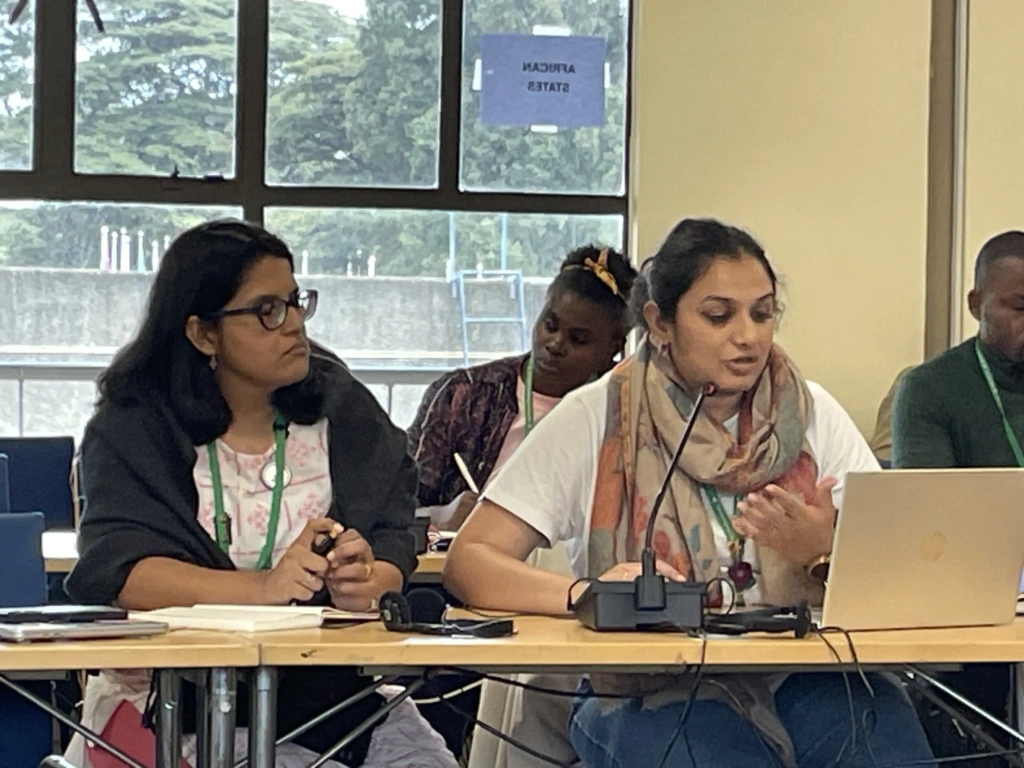
For Shruti Ajit, a Project Officer of the CBD Women’s Caucus, this is a gap that governments can no longer afford to overlook.
“Women are the custodians; they are the knowledge keepers,” Ajit said during discussions on implementing a human rights-based approach to the Kunming-Montreal Global Biodiversity Framework at the 28th meeting of the Convention on Biological Diversity’s Subsidiary Body on Scientific, Technical and Technological Advice (SBSTTA28) in Nairobi.
Her argument is not simply that women should have a greater presence in biodiversity meetings. It is that their participation, knowledge and experiences should influence how biodiversity is planned, financed, monitored and reported.
“Women are central to any kind of conservation, restoration, addressing drivers of biodiversity loss,” she said.
The distinction matters because the Kunming-Montreal Global Biodiversity Framework (KMGBF) already recognises gender equality, human rights and inclusive participation as part of its implementation principles.
Section C of the framework calls for implementation grounded in a human rights-based approach, gender equality and intergenerational equity, while recognising the meaningful participation of Indigenous peoples, local communities, women, youth and persons with disabilities.
Targets 22 and 23 further strengthen the focus on inclusive governance, participation and gender equality. Still, the challenge emerging from Nairobi is how those commitments move from policy language into the systems governments use to make decisions and measure progress.
For the CBD Women’s Caucus, gender equality cannot be treated as an issue confined to one biodiversity target. Ajit argued that it should run through protected-area governance, sustainable wildlife management, restoration, marine and coastal conservation, monitoring, financing, capacity building and reporting.
“Gender equality is not a standalone objective, but a prerequisite for achieving the goals and targets of the framework,” she told participants.
What the data does not show
One of the most significant concerns raised by the CBD Women’s Caucus is the quality of biodiversity data itself.
Biodiversity monitoring can tell policymakers whether ecosystems are declining, habitats are changing, or conservation targets are being met. But it may reveal far less about the human dimensions behind those trends.
Ajit said biodiversity data often does not adequately capture who contributes to conservation, whose knowledge informs decisions, who benefits from biodiversity policies and who carries disproportionate costs.
Without that information, inequalities can remain hidden. This is where gender-responsive and intersectional data becomes important.
The CBD Women’s Caucus is calling for stronger use of sex-disaggregated and intersectional data in biodiversity monitoring, while also recognising Indigenous and local knowledge systems and community-generated evidence.
The argument is straightforward: better data can lead to better policy, but only if the data captures the people and power relationships behind biodiversity outcomes.
For example, knowing that a forest has been restored provides one measure of ecological progress. Knowing who restored it, whose land it is on, whose knowledge guided the restoration, who receives the resulting benefits and whether women were able to participate in decisions provides another layer of information.
That second layer can determine whether an intervention is not only ecologically successful but also equitable.
Ajit said women should not be viewed simply as beneficiaries of biodiversity policies.
“They are rights holders, leaders, scientists, farmers, fishers, forest managers, indigenous knowledge holders, environmental defenders and community organisers,” she said during the Nairobi discussion.
Yet structural barriers continue to affect access to land rights, financing, decision-making spaces and recognition.
The result is a potential mismatch between the contribution women make to conservation and the extent to which that contribution appears in official evidence and policy.

From participation to influence
For Ajit, the question is therefore not simply whether women are present at biodiversity meetings.
It is whether their priorities and knowledge are reflected in decisions made at national and international levels.
“Human rights-based approach also includes gender equality,” she said in her interview. “If you are talking about women’s rights, they are human rights.”
That rights-based framing is important because the biodiversity framework does not envisage women merely as a stakeholder group to be consulted. It recognises participation, equity and rights as part of how implementation should happen.
The CBD Women’s Caucus wants those principles to remain visible as technical recommendations from SBSTTA28 move towards the next stages of implementation, including discussions under the Convention’s Subsidiary Body on Implementation and ultimately the next Conference of the Parties.
The concern is that broad political commitments can become diluted when they move into technical plans, indicators and reporting systems.
For CBD Women’s Caucus, references to women, Indigenous peoples, local communities and youth should therefore remain consistent across biodiversity decisions rather than appearing only where an agenda item explicitly concerns gender or participation.
This is particularly important as countries develop and update their national biodiversity strategies and action plans.
At the national level, Ajit said a human rights-based approach should ensure that communities defending and conserving their territories have space in biodiversity decision-making and that their knowledge and priorities are reflected in national policies.
“More inclusive, more equitable, more rights-based languages” are needed in biodiversity policies, she said, but the real test is how those commitments are delivered and implemented nationally.
That implementation challenge also raises a question for biodiversity reporting: can countries demonstrate not only whether they are meeting ecological targets, but whether they are doing so equitably?
The answer may depend partly on what they choose to measure.
If biodiversity data continues to focus primarily on ecological indicators without sufficiently capturing participation, benefits, knowledge and inequalities, policymakers could be left with an incomplete picture of conservation progress.
As the global community moves towards reviewing progress under the KMGBF, the question is increasingly shifting from what governments have promised to what can be demonstrated. And that means biodiversity reporting may need to count more than species, hectares and ecosystems.
It may also need to count whose knowledge is recognised, whose voice shapes decisions, who receives resources and who is being left behind.
Author Profile

-
Seeker.
Inspire AFRIKA.
Latest entries
 Biodiversity26 October 2026Beyond Biodiversity Finance, A Justice Gap Governments Must Confront
 Biodiversity24 October 2026Faith Leaders and Civil Society Call for Stronger Partnerships to Restore Nature
 Biodiversity23 October 2026Inside Kobe’s Grassroots Effort to Train the Next Generation of Biodiversity Leaders
 Animals23 October 2026As COP17 Meets, World’s Rarest Great Ape Faces a Make-or-Break Test in Indonesia