
Kenyan businesses are overwhelmingly backing clean electrification as a pathway to growth, competitiveness, and energy security. However, they warn that inadequate grid infrastructure and slow policy implementation could undermine the country’s energy transition ambitions.
A new global survey of senior executives across 18 markets finds that Kenyan business leaders are almost unanimous in their view that clean electrification would boost growth. But they also warn that without faster grid investment and targeted government support, that opportunity could slip out of reach.
The findings are drawn from Powering Up: Business Perspectives on Electrification, a survey commissioned by E3G, the We Mean Business Coalition and the Global Renewables Alliance, covering nearly 2,000 executives globally.
In Kenya, the message is particularly strong: business is ready to electrify, but the system is not yet moving fast enough to support that shift.
“Businesses clearly agree that the only way to remain competitive in a global fossil fuel crisis is to electrify energy consumption with clean power,” said Nick Mabey, CEO of E3G.
A Strong Signal From the Private Sector
The Kenya results point to unusually high confidence in electrification as a driver of business growth and stability:
- 98% say electrification would help their business grow
- 96% say it would improve competitiveness
- 95% expect lower long-term operating costs
- 97% link it to protection from price shocks
- 83% say Kenya is too dependent on fossil fuel imports
- 80% expect geopolitical instability to raise energy costs
- 94% say transmission investment is essential
- 97% point to energy storage as a key requirement
- 83% have already delayed or shelved electrification plans due to barriers
- 64% say subsidies or grants are the most important policy support needed
The numbers show a clear pattern: the private sector is not debating direction; it is asking how fast the transition can realistically happen, considering electrification is so crucial for its operability and effectiveness.
Policy Ambition Meets Infrastructure Reality
Kenya’s National Energy Policy (2025–2034) sets out an ambitious target of universal electricity access powered entirely by renewable energy.
The direction aligns closely with business expectations, and electrification is increasingly framed as an economic strategy, tied to jobs, industrial growth, and long-term competitiveness rather than climate commitments alone.
Connection rates have already risen significantly over the past two decades, reaching about 76 percent of the population, driven by sustained investment in grid expansion and last-mile connectivity.
“The transition to renewable energy, and particularly electrification using clean power, is the most pragmatic way to strengthen resilience, improve cost stability and sustain competitiveness,” said Dimitri de Vreeze, CEO of DSM-Firmenich.
Where the Gaps Are Starting to Show
Despite the optimism, businesses describe a system struggling to keep pace with ambition, as the reality is at times quite shaky and doesn’t meet the set goals.
Unreliable grid infrastructure, delays in approvals, and limited transmission capacity continue to affect productivity and investment decisions. For many firms, these constraints have already forced project delays or cancellations.
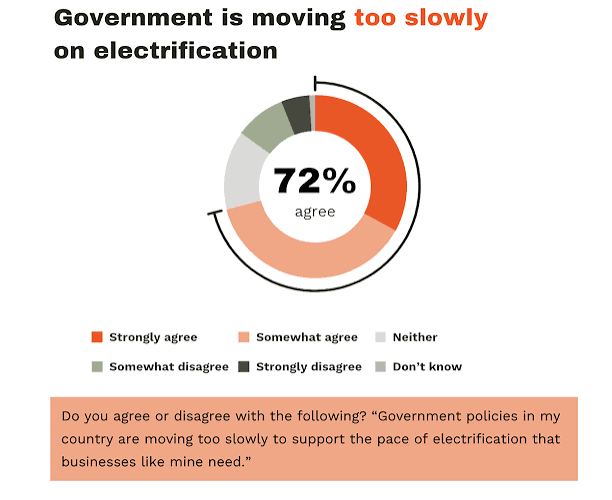
The survey highlights a widening gap between policy intent and implementation readiness, with most executives saying government preparations are not moving in step with private sector plans.
Grid investment (94%) and storage infrastructure (97%) emerge as non-negotiable priorities for unlocking electrification at scale.
At the same time, affordability remains central since many businesses say the upfront cost of switching equipment is the biggest barrier, even where long-term savings are clear.
“What businesses need now are the grids, market structures, and policy frameworks that can match their ambition and unlock the full potential of electrification,” said José Manuel Entrecanales, Chairman and CEO of ACCIONA.
What Business Wants From Government
When asked what would accelerate electrification, three priorities stand out:
- clearer long-term energy policy
- faster grid and project approvals
- financial support to reduce upfront transition costs
The strongest signal comes on financing: 64 percent of Kenyan executives want government grants or subsidies, the highest among all markets surveyed.
Executives also point to regulatory uncertainty and bureaucratic delays as key barriers slowing investment decisions, calling for a more predictable and stable energy policy environment.
“What’s missing is a consistent, long-term policy framework that gives businesses the confidence to invest and scale at speed,” said Dimitri de Vreeze.

A Global Transition Moving Faster Than Policy
Kenya’s experience mirrors a broader global shift. Across all 18 markets, 90 percent of executives expect their operations to be largely electrified by 2035. In emerging markets such as Indonesia and Nigeria, that figure rises to 99 percent.
In South Africa, 98 percent of business leaders say electrification would improve competitiveness. In Brazil, 97 percent say it would support business growth.
The direction is consistent: business is already moving, so the question is whether infrastructure and policy can keep up to bring redress to the challenges at hand.
With COP31 approaching, pressure is mounting on governments to bridge the gap between private sector momentum and public sector delivery.
“Businesses are not slowing down the transition; they are accelerating it. Governments now need to match that pace,” said Maria Mendiluce, CEO of the We Mean Business Coalition.
Kenya’s private sector is sending a clear message: electrification is no longer optional, but the direction of travel is settled, and what remains unresolved is the speed.
Businesses are ready to invest in as much as the grid is still catching up, and the gap between the two will increasingly define Kenya’s competitiveness in the coming decade.
The 98 percent figure is not just a statistic; it is a signal of intent and a countdown on how quickly the system can respond.


