As global floriculture markets continue to tighten pesticide residue requirements and demand more sustainable production practices, growers are under increasing pressure to find new ways of protecting crops while maintaining quality and productivity.
For many producers, the challenge is no longer simply controlling pests and diseases but doing so with fewer chemical inputs and greater precision.
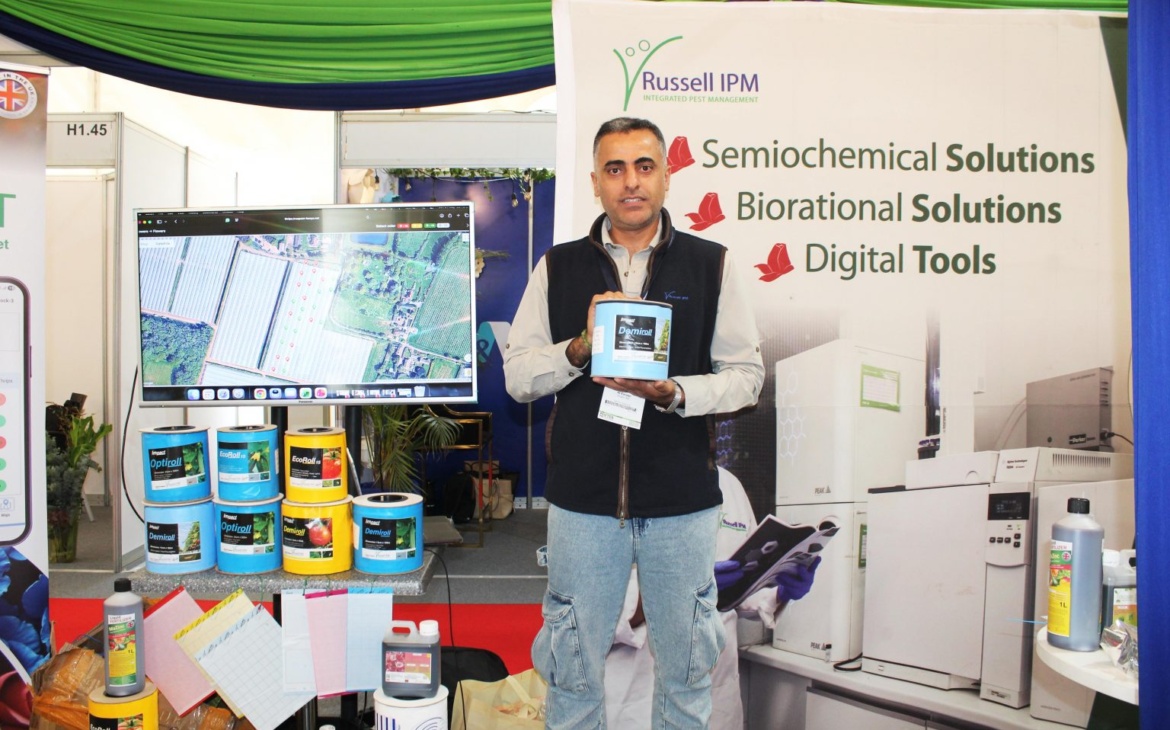
At the International Floriculture Trade Exhibition (IFTEX 2026) held at the Visa Oshwal Centre, Russell IPM Ltd showcased its latest suite of technical innovations based on artificial intelligence, integrated pest management (IPM) products, and advanced biological solutions.
The technologies are specifically curated to assist global growers in navigating a rapidly changing regulatory and environmental landscape.
Speaking during the exhibition, Dr. Dhurgham Al-Karawi, Chief Technology Officer and Marketing Development Manager at Russell IPM Ltd, outlined how the company’s integrated approach combines artificial intelligence, IPM products, biological products, and soil-health management to support more sustainable crop production.
” Russell IPM Ltd is a leading British manufacturer of sustainable, chemical-free pest control products for agriculture, public health, and food processing. We are a global leader in the development and manufacturing of integrated pest management (IPM) products, specialized pheromone lures, and biological crop solutions globally, and one of the largest in Europe,” explained Dr. Al-Karawi.
“We also have specialized divisions within the Russell IPM LTD group:
- Russell Bio Solutions Ltd: A highly specialized sister biotech company dedicated to the manufacturing of biological fermentation, biofertilizers, biopesticides, and microbial crop treatments.
- Russell IOT Ltd: The technological arm focused on building smart, automated, and AI-driven agricultural field hardware and software.
Russell IPM Ltd is at the forefront of technical innovation, product development, and customer support for integrated pest management on a global scale. With over 30 years of experience in the industry, we are an international company with marketing subsidiaries and distributors in more than 50 countries.
We offer a comprehensive range of products that include monitoring, mass trapping, and controlling a wide variety of pests and diseases. All our products are biological and have zero Maximum Residue Levels (MRL).
Bringing Artificial Intelligence into Pest Monitoring
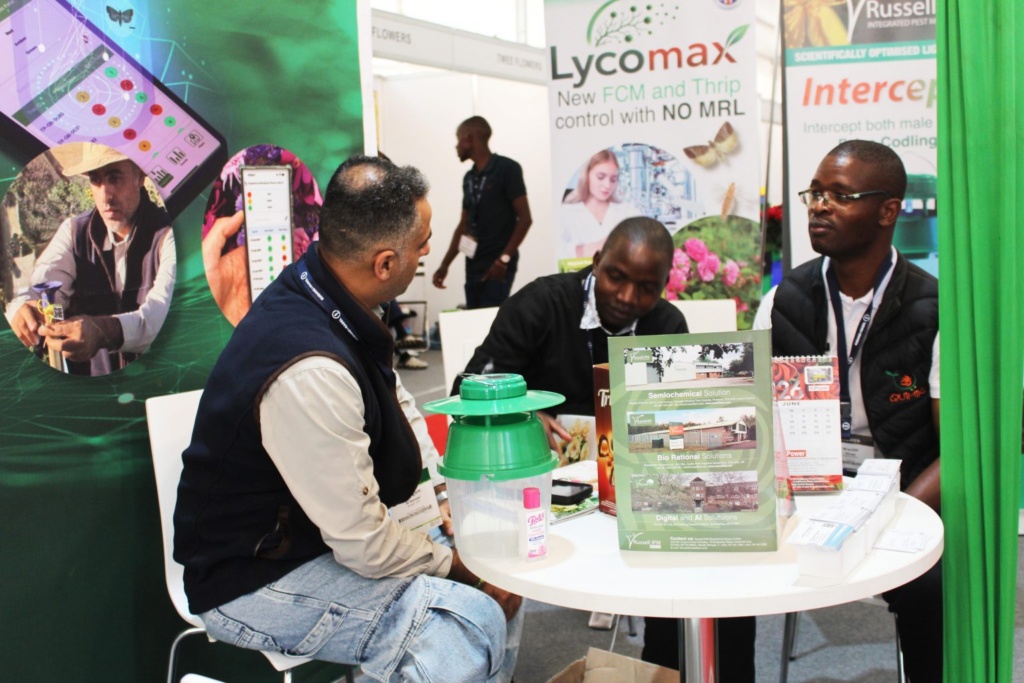
One of the standout innovations at the company’s booth was TruePest, an AI-powered mobile application designed to streamline pest monitoring. Monitoring is a crucial aspect of integrated pest management; however, traditional methods can be labor-intensive, requiring staff to manually inspect sticky traps and identify pest populations across extensive greenhouse operations.
Russell IPM’s solution aims to significantly reduce this workload while enhancing accuracy. “What we have now is a mobile app that uses advanced artificial intelligence to identify and count Western flower thrips, other types of thrips, FCM, whiteflies, and non-target insects in just 30 seconds,” explained Dr. Al-Karawi.
The system enables scouts to use a standard smartphone to take photographs of sticky monitoring boards. Within seconds, the application identifies and counts the insects captured on the trap, generating data that helps growers assess pest pressure across their farms. This information allows them to take appropriate action.
TruePest not only minimizes infestations but also leads to significant cost savings in pest control efforts.
Beyond simple identification, the technology can help growers locate emerging pest hotspots and focus interventions where they are most needed.
“By identifying hotspot areas, you can easily locate issues. Instead of spraying the entire greenhouse, you can target the affected areas, saving time and money for growers.”
The approach signifies a broader shift in global horticulture, where data-driven decision-making increasingly replaces generalized crop protection practices.
Looking Below the Canopy
While pest control often focuses on protecting foliage and flowers, Dr. Al-Karawi believes many growers underestimate the importance of soil health in maintaining resilient crops.
“What I have seen is that the majority of growers take care only of the foliage,” he said. “But when you have healthy soil, that leads to healthy plants, which leads to healthy crops.”
According to him, healthy root systems and balanced soils play a vital role in helping plants withstand environmental stresses that can make crops more vulnerable to pest attacks and disease development.
Kenya’s climatic conditions, with significant temperature fluctuations between day and night, can place additional stress on crops.
“Plants release specific airborne chemicals when they are stressed, which can attract insects. However, these chemical signals serve complex ecological purposes rather than merely leading to diseases,” he explained.
To address this challenge, Russell IPM offers biological soil-health products aimed at strengthening root development and improving overall plant performance.
For growers seeking to maximize flower quality and stem strength, these biological approaches offer an additional layer of support alongside traditional crop management practices.
Preparing for Stricter Market Requirements
Perhaps the most significant message shared by Dr. Al-Karawi concerned the future direction of export markets.
European markets in particular continue to increase scrutiny of pesticide residues, with growers facing stricter compliance requirements each year.
“It seems that the MRL requirements are becoming increasingly strict,” he said.
For exporters, this trend is expected to continue as retailers and consumers demand safer and more sustainable production systems.
Dr. Al-Karawi believes growers should begin preparing now for a future where biological crop protection becomes increasingly important.
“Farmers need to understand that, in the next three to five years, chemical products will be completely banned. When exporting their flowers, they will be required to meet a maximum residual limit (MRL) of zero. To prepare for this change, they should start using Integrated Pest Management (IPM) and biological (BIO) products in advance..”
This preparation, he argues, involves adopting integrated pest management systems that combine monitoring, mass trapping, biological control products and preventative strategies rather than relying primarily on conventional chemical interventions.
The company’s portfolio includes biological solutions targeting pests such as thrips, false codling moths, mealybugs, aphids, mites, and others pests, along with pheromone-based monitoring and trapping technologies. It also offers solutions for various types of diseases.
A Partnership Approach
Unlike traditional sales models that focus on product promotion, Russell IPM says its strategy begins with understanding growers’ challenges before recommending solutions.
“We do not sell products during our initial visit to the farm,” said Dr. Al-Karawi. “We listen.”
The company conducts farm assessments, identifies specific challenges and establishes trials before recommending wider adoption.
“We listen to farmers and understand their concerns. After that, we establish a professional trial so they can observe the benefits of our products.”
According to Dr. Al-Karawi, the company typically offers 20- to 30-day trials covering monitoring systems, IPM products, biological products, pheromones and trapping technologies.
“This is our strategy. We listen to the farmers first and then provide solutions.”
The approach has already gained traction across multiple agricultural sectors in Kenya.
“So far, around 50 to 60 farms, including flowers, vegetables and berries, are using our products,” he noted.
Kenya as a Regional Innovation Hub
Although Russell IPM LTD has maintained a presence in Kenya for more than a decade, IFTEX 2026 marked the company’s first participation in the exhibition.
For Dr. Al-Karawi, the event provided an opportunity not only to showcase technologies but also to learn directly from growers and better understand emerging challenges.
The company has ambitious plans for the country and sees Kenya as a strategic gateway to wider regional expansion.
“We aim to make Kenya the central hub of Africa, allowing us to expand into neighboring countries”
As growers face increasing pressure to produce high-quality flowers while reducing chemical inputs, technologies that combine artificial intelligence, IPM products, biological crop protection and improved plant health may become increasingly important.
Russell IPM LTD believes the future of integrated pest management will rely on a connected system that includes monitoring, prevention, and biological intervention, rather than on a single product.
For Kenya’s floriculture sector, that future may already be taking shape.
Source: Florinews.
Read Also: Inside the Push for End-to-End Traceability in Floriculture