
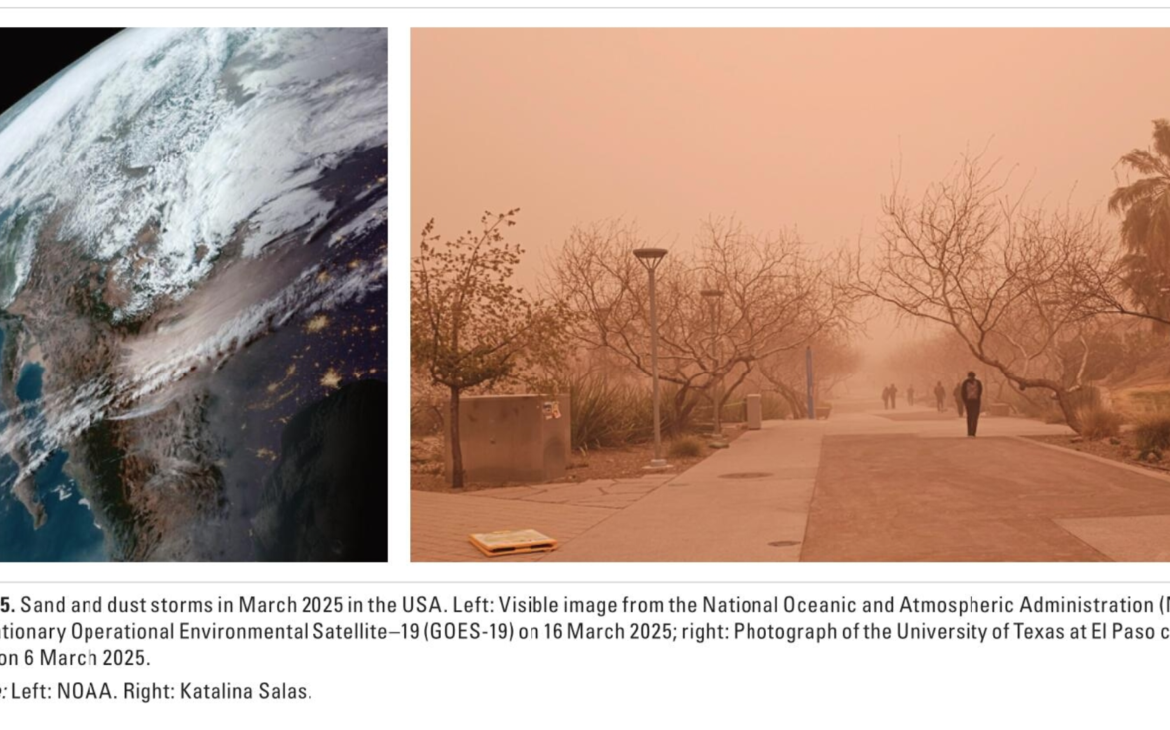
While global dust concentrations remained largely unchanged in 2025 compared to the previous year, devastating sand and dust storms swept across parts of Asia, North America, Africa and the Middle East, disrupting transport, damaging ecosystems, threatening public health and exposing the growing need for stronger early warning systems.
A new World Meteorological Organization (WMO) Airborne Dust Bulletin finds that although the annual global average of airborne dust remained similar to 2024, several regions experienced some of the most severe dust events in recent history. The report also highlights how artificial intelligence (AI) and satellite technology are transforming the monitoring and forecasting of dust storms, enabling faster and more accurate warnings.
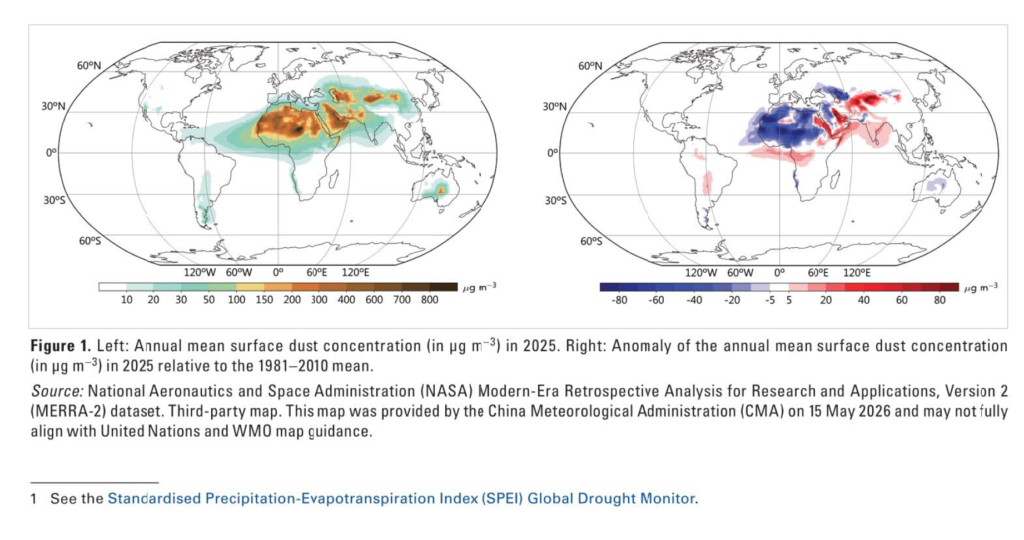
Each year, approximately two billion tonnes of dust are lifted into the atmosphere, where winds transport particles hundreds or even thousands of kilometres across countries, continents and oceans. The largest natural dust sources remain concentrated in arid and semi-arid regions, particularly the Sahara Desert in Africa, the Gobi Desert in Asia and the Arabian Desert.
While dust storms are largely natural phenomena, the WMO says their frequency and intensity are increasingly being influenced by poor land and water management, prolonged drought and environmental degradation. Today, sand and dust storms affect more than 150 countries worldwide.
“Sand and dust storms affect air quality and human health. They reduce agricultural productivity, disrupt transport and aviation, strain water and energy systems, and damage ecosystems. No country is immune to their impacts,” said WMO Secretary-General Celeste Saulo.
Speaking ahead of the International Day of Combating Sand and Dust Storms, observed annually on 12 July, Saulo stressed that tackling the growing challenge requires international cooperation.
“Let’s acknowledge that sand and dust storms and droughts do not respect borders; international cooperation is essential. Strengthening shared observations, data exchange and regional forecasting capacity allows all countries, especially the most vulnerable, to benefit from advances in science and early warning,” she said.
Severe regional dust events expose growing risks
The bulletin identifies the Bodélé Depression in Chad as the world’s most active dust source, with North Africa and the Middle East experiencing repeated dust intrusions throughout 2025 that significantly reduced visibility and worsened air quality.
Among the year’s most severe events was an intense dust storm that swept from Mongolia into China in April, producing the country’s worst sand and dust storm in more than a decade. According to the WMO, the event stood out for its intensity, geographical extent and duration.
Air quality deteriorated dramatically as concentrations of inhalable particulate matter (PM10) exceeded 1,000 micrograms per cubic metre across northern China, while some locations recorded between 3,000 and 4,000 micrograms per cubic metre—many times higher than levels considered safe by the World Health Organization.
Across North America, the desert border region between Mexico and the United States also experienced an exceptional year for dust activity. El Paso, Texas, recorded 50 days of dust weather during 2025, more than double its long-term annual average and the highest number since the devastating Dust Bowl era of the 1930s.
The most extreme event occurred on 18 March, when a sand and dust storm persisted for more than six hours. Daily average PM10 concentrations reached 2,064 micrograms per cubic metre, while hourly levels peaked at 8,142 micrograms per cubic metre—the highest recorded in Texas since continuous hourly monitoring began nearly three decades ago.
The storm forced the temporary closure of schools, highways and airports, led to the cancellation of public events and contributed to multiple fatal road accidents caused by near-zero visibility.
Although the global annual average dust concentration remained relatively stable, the WMO says these regional extremes demonstrate how individual dust events can have devastating social, economic and environmental consequences.
The report also points to significant advances in dust forecasting driven by artificial intelligence. Traditionally, predicting airborne dust has relied on complex physics-based numerical weather models that require substantial computing power. AI is now offering faster and more cost-effective alternatives.
Using decades of satellite observations and atmospheric data, machine learning systems can identify complex weather patterns and improve predictions of dust movement. Once trained, these models require far fewer computing resources than conventional forecasting systems, allowing forecasts to be produced more efficiently.
The WMO notes that different AI approaches perform best under different conditions. Some models are better suited to rapidly developing local dust storms, while others more accurately predict large-scale dust plumes that travel across regions over several days.
Satellite remote sensing combined with ground observations and machine learning has also improved the identification of global dust hotspots, providing governments with better information to target land restoration efforts and strengthen preparedness in vulnerable regions.
To improve international coordination, the WMO continues to strengthen its Sand and Dust Storm Warning Advisory and Assessment System, established in 2007. The initiative brings together scientific institutions and meteorological agencies to improve observations, forecasting and operational early warning services through regional centres serving Asia, the Americas, the Gulf Cooperation Council, and North Africa, the Middle East and Europe.
The organisation also works through the United Nations Coalition on Combating Sand and Dust Storms, which promotes global cooperation to reduce the environmental, health and economic impacts of these increasingly disruptive events.
The 2026 Airborne Dust Bulletin comes as the United Nations observes the Decade on Combating Sand and Dust Storms (2025–2034), with this year’s theme, “From Source to Impact: Protecting Land and Life from Sand and Dust Storms,” highlighting the need for stronger action to address both the causes and consequences of dust storms in a warming and increasingly degraded world.
Author Profile

-
Seeker.
Inspire AFRIKA.
Latest entries
 Weather Forecasts13 October 2026Rain and Rising Temperatures Forecast Across the Greater Horn of Africa
 Climate9 October 2026Beyond Negotiations: Africa Expects Concrete Outcomes from Antalya
 Animals7 October 2026In Kajiado’s Drylands, Collective Selling of Small Herds Is Changing the Livestock Trade
 Oceans6 October 202640 Years of Ocean Cooperation: The Western Indian Ocean’s Next Test Is Implementation


