
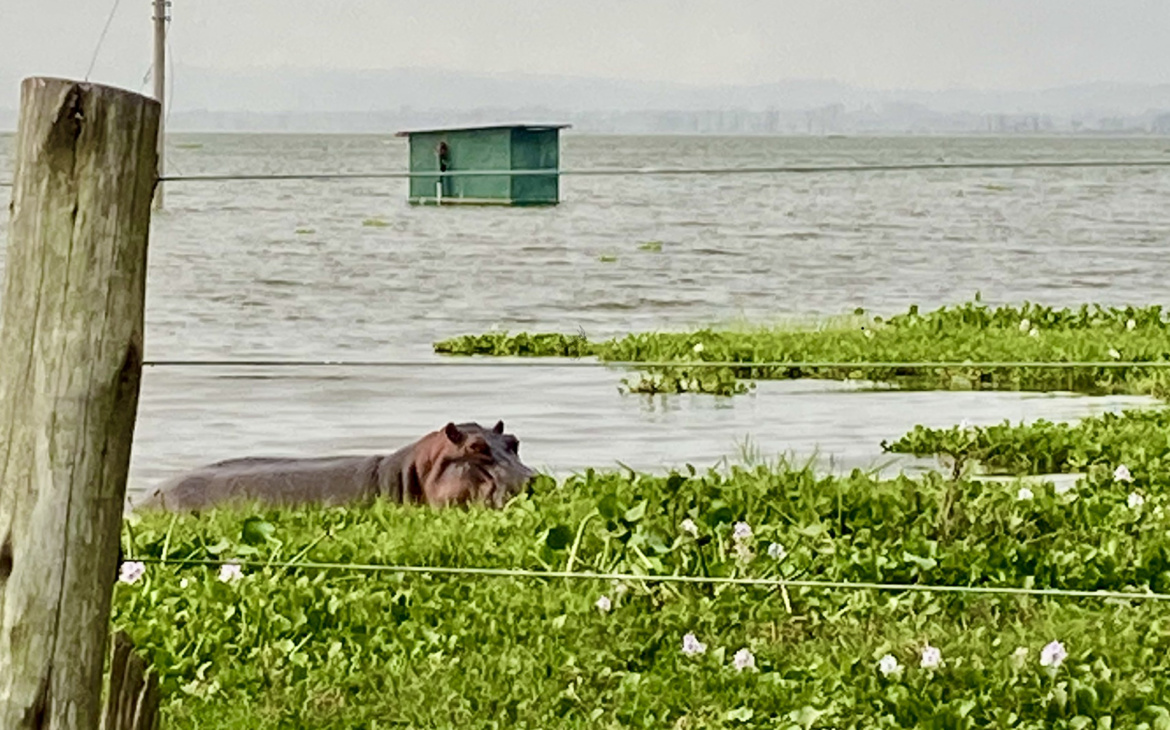
For the last several years, Lake Naivasha has been rising, an occurrence that’s taking a toll not only on residents but also on wildlife. It has been a slow, relentless swell that satellite data shows has added as much as seven meters to the lake since 2010. Entire stretches of riparian pasture have vanished beneath the water.
Crescent Island, once a peninsula, is now functionally an island. Flower farms that used to sit safely back from the shoreline now have greenhouses standing in water.
The story of Lake Naivasha has often been told through the experiences of people. Homes have been submerged, roads damaged, farms abandoned and livelihoods disrupted as rising water levels continue to redraw the shoreline. Last year, much of the conversation centred on whether affected communities were receiving enough support to adapt.
But another story is unfolding alongside the human one. There is a second displacement happening at the same time, in the same water, and almost nobody is asking about it directly: what happens to the wildlife that lived on that land first?
Displaced, not delinquent
The language used to describe what’s happening to Naivasha’s hippos, buffaloes, giraffes and zebras tends to borrow from crime reporting. Animals invade. They stray. They trespass into farms and estates. It’s the language of an intruder, not a refugee.
The animals increasingly seen wandering into farms, hotels and residential areas are not simply venturing into human spaces. They are responding to landscapes that have changed dramatically over the past few years. Areas that once served as grazing grounds, breeding sites and movement corridors now lie underwater, forcing wildlife to search for food, shelter and space elsewhere.
The result is what is often described as human-wildlife conflict. Yet the phrase can obscure an important reality: both people and wildlife are responding to the same environmental change.
Kenya Wildlife Service has said as much itself. Officials have attributed the surge in human-wildlife conflict around Naivasha directly to the rising water levels, which have pushed animals off flooded riparian land and into private farms and homes.
The agency has also pointed to a second, compounding problem: wildlife corridors around the lake have been closing, some fenced off for development, some blocked by new projects, at precisely the moment animals need more room to move, not less.
Put together, that is not a story about wildlife behaving badly. It is a story about wildlife losing the only land it had left, with fewer and fewer routes to anywhere else.
Why this lake, specifically, matters
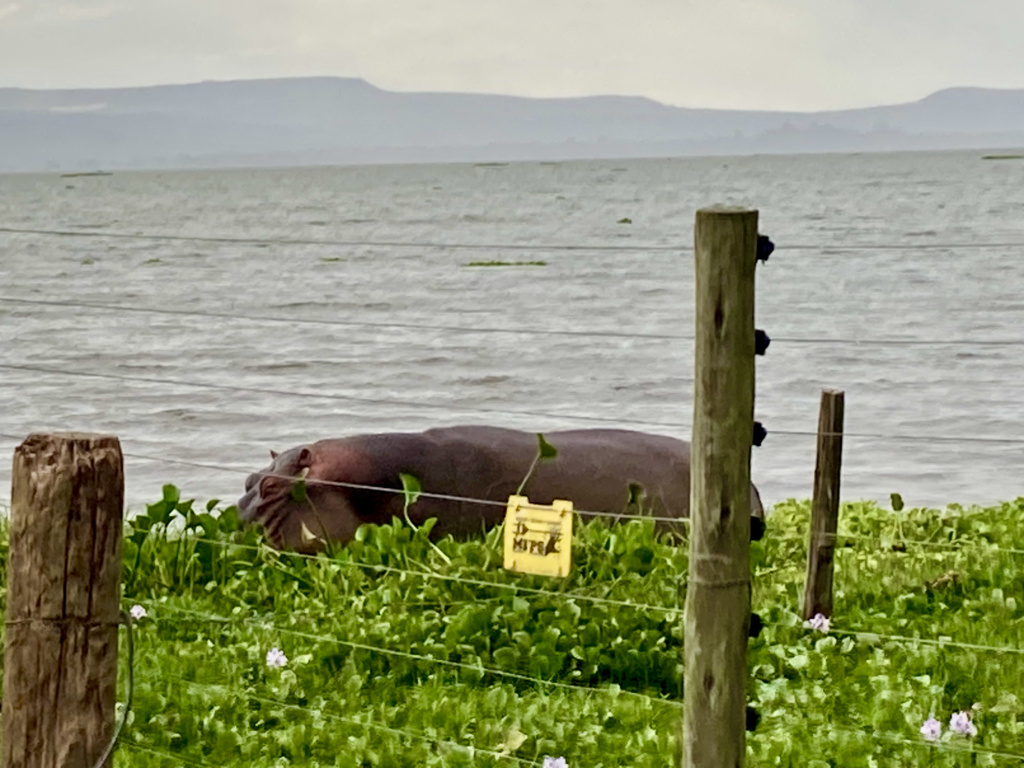
Lake Naivasha is not an ordinary lake experiencing an ordinary flood. It is a Ramsar-listed wetland of international importance. This designation that exists because of what the lake supports: a resident hippo population, buffalo and giraffe on its margins, papyrus wetlands, fish breeding grounds, and hundreds of resident and migratory bird species that depend on the lake as a stopover or a home.
The Ramsar documentation for the site already flags Naivasha’s hippo population as being under mounting pressure from human activity and fluctuating water levels. This means this isn’t a new vulnerability the flooding revealed. It’s an old vulnerability the flooding is now testing at scale.
When a wetland like this shrinks, warps, or floods unpredictably, what are the specific, hard-to-replace functions that made the ecosystem valuable in the first place: feeding grounds, breeding habitat, fish nurseries, natural filtration? Wildlife doesn’t just need enough land somewhere. It needs this land, in something like its old configuration, at a pace it can adapt to.
That pace is the real crisis. The Kenya Wildlife Service has so far responded by translocating some of the animals out of the worst-affected estates, and promising compensation to residents.
However, for the moment, this is triage. It treats the symptom (animals in the wrong place) without addressing the underlying question of where, exactly, the right place still is, if the lake keeps rising and the corridors keep closing.
The questions nobody is asking yet
Most of the coverage of Naivasha’s rising waters has counted displaced families, flooded homes, and lost boreholes, with numbers that matter and that are, rightly, easier to gather. But the wildlife side of this story is still mostly anecdotal: hippos on a specific road, buffalo in a specific estate, a translocation plan announced after a heated community meeting and so on.
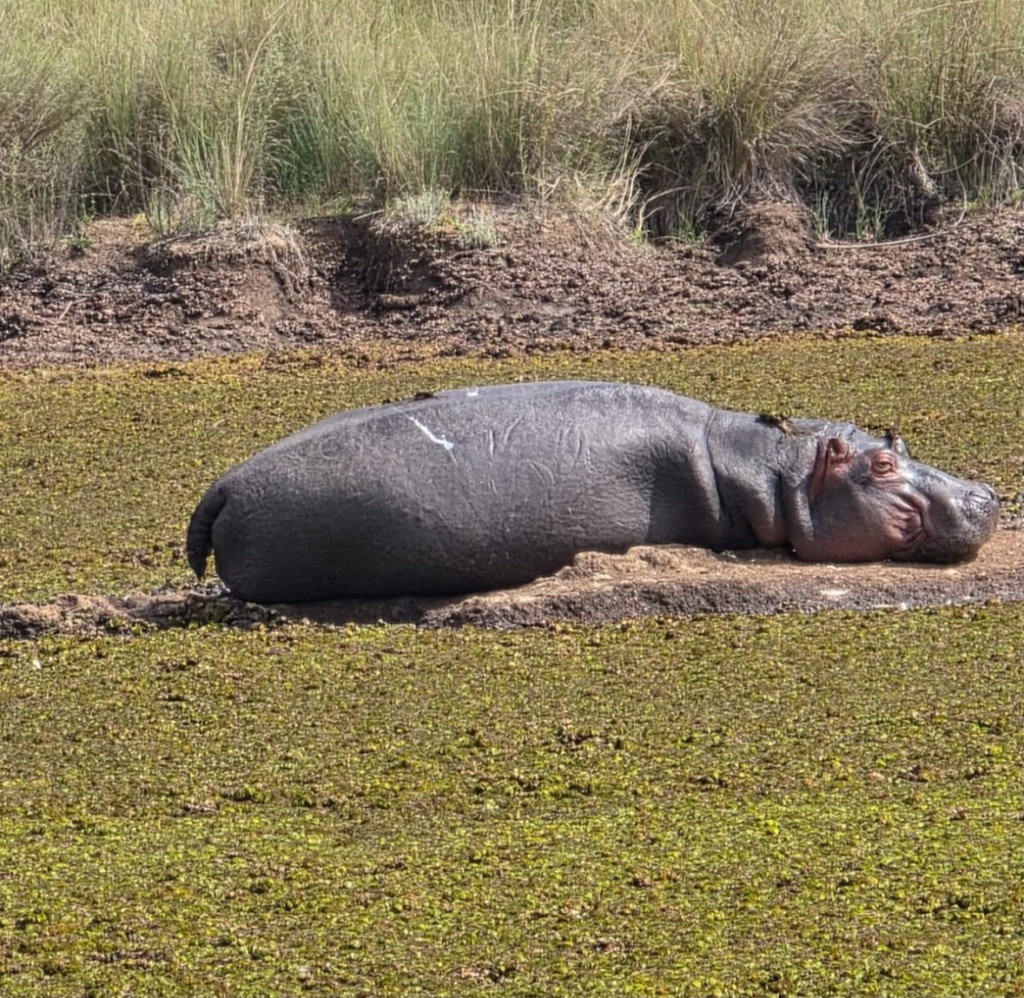
Nobody yet seems to be asking, systematically, which species are actually declining versus simply relocating? Are hippos, which are social, territorial animals with specific grazing needs, finding enough dry ground to sustain their numbers, or just enough to survive month to month?
What happens to breeding areas when a shoreline moves every season? Are Naivasha’s bird populations shifting their nesting or migration patterns in response, and if so, is anyone tracking it? Is conservation planning around the lake adapting on the same timeline as the water is rising, or is it permanently one crisis behind?
While these may sound like rhetorical questions, they’re actually possible research questions. There are people who could answer them, such as the Wildlife Research and Training Institute, ornithologists at the National Museums of Kenya, hydrologists studying the Rift Valley lakes at Egerton and Kenyatta University, the Lake Naivasha Riparian Association’s long-term shoreline records and so on, that exist and are reachable. The expertise is there, but perhaps it’s time these questions start being answered with intentionality.
A different kind of climate refugee
There’s a reason “climate refugee” has, until now, almost always meant a person. It’s a useful shorthand, and an urgent one, but it also implies that displacement is something only humans experience, and that everything else is landscape, backdrop, scenery that either survives or doesn’t while the real story happens to people.
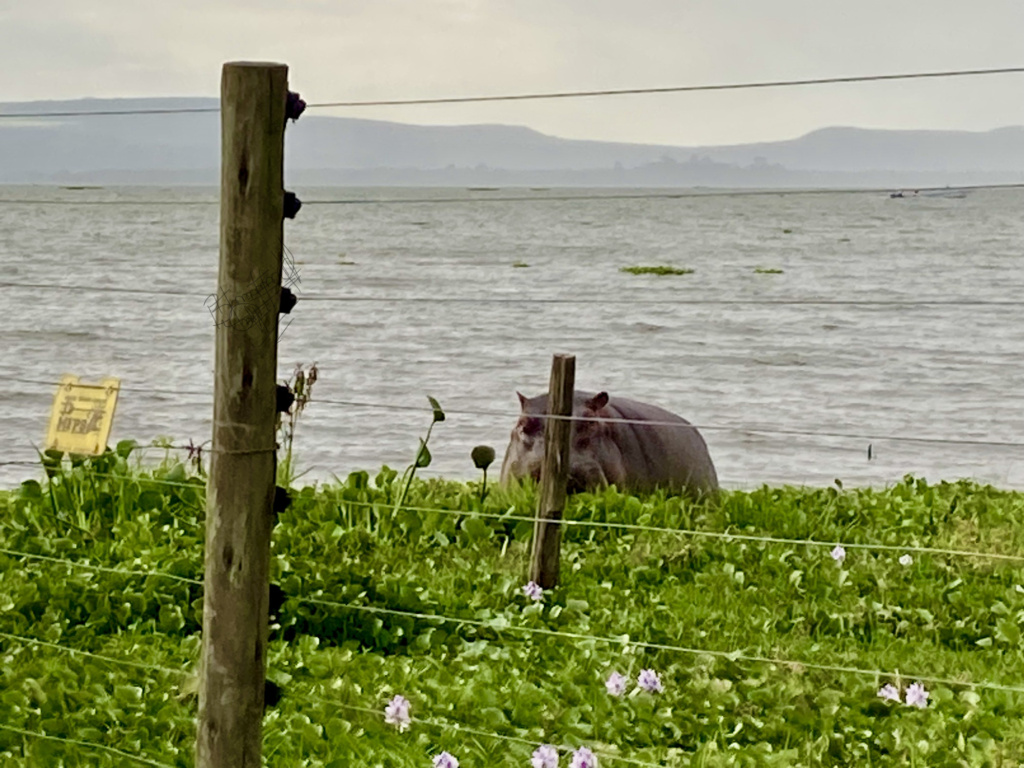
Naivasha suggests otherwise. The hippo pushed onto Moi South Lake Road and the family flooded out of Kihoto estate are responding to the same rising water, on the same timeline, for the same reason. One of them gets counted in displacement statistics. The other gets called an invasion.
Across Kenya, climate change is altering rivers, wetlands, forests and rangelands. As these landscapes change, more communities may find themselves sharing increasingly limited space with wildlife. If Kenya is going to adapt to a climate that keeps rearranging its lakes (sometimes rising, sometimes drying, often both within the same decade), the planning has to account for the fact that people were never the only residents who needed somewhere to go. Right now, wildlife is adapting on its own, with no plan and rapidly closing corridors.
The question worth asking isn’t whether Kenya can manage this crisis for people, but rather, whether it can manage it for everyone who lived on that land before the water came. It is not a debate about who deserves protection between people and wildlife, but rather, a challenge as to whether Kenya’s adaptation strategies can protect both.

