
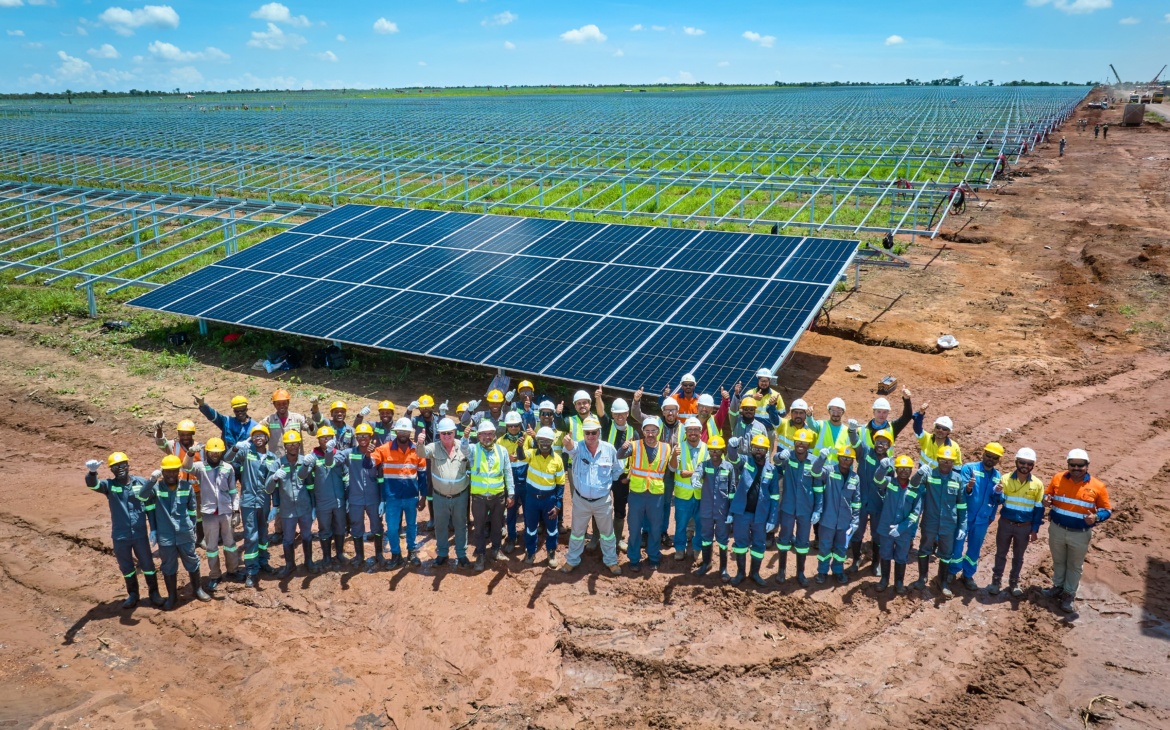
On the red earth outside Kolwezi, in the heart of the Democratic Republic of Congo’s (DRC) Copperbelt, more than 357,000 solar panels now sit beneath the same sun that has long shaped life in the region.
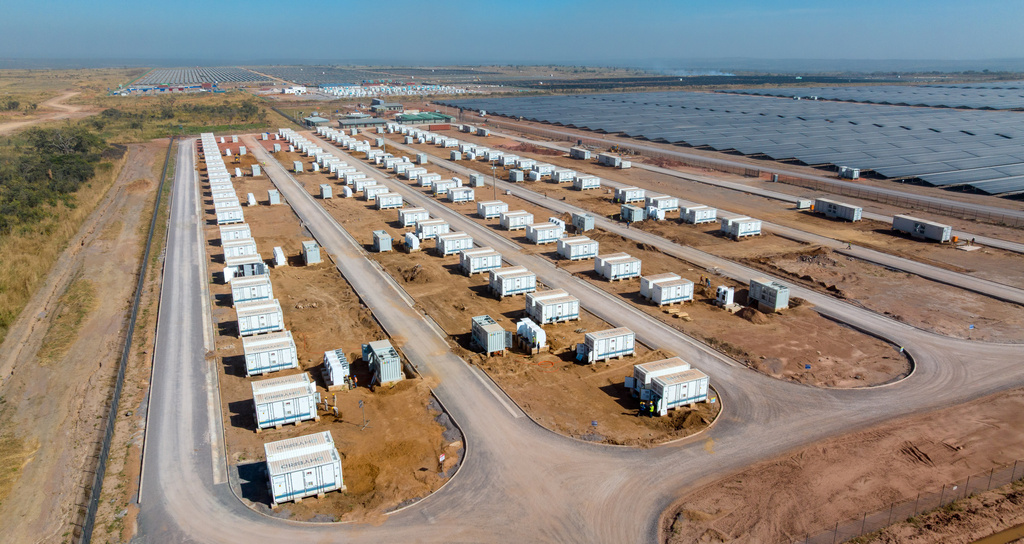
But these panels are doing something different. Their electricity is being stored in 180 battery containers, allowing power generated during daylight to continue serving one of Africa’s largest copper mining complexes after the sun goes down.
On August 12, 2026, the solar-plus-battery facility reached commercial operation, supplying Kamoa Copper with 30 megawatts of firm renewable power around the clock.
The capacity may appear modest against the scale of Africa’s electricity needs. But in a region where reliable power remains a major constraint on industrial development, the project represents an important experiment: whether solar energy, combined with large-scale battery storage, can provide dependable electricity for energy-intensive industries.
For the DRC, where mining is central to the economy and copper is increasingly important to the global energy transition, the experiment carries implications beyond a single mine.
From Red Earth to Round-the-Clock Power
The project was developed, financed, owned and operated by CrossBoundary Energy for Kamoa Copper. The two companies signed a power purchase agreement in April 2025. Sixteen months later, the facility was commercially operational.
According to African Energy, utility-scale solar-plus-storage projects in Africa take about 29 months on average from contract signing to commercial operation. The Kolwezi project therefore moved from agreement to operation in roughly half that time.
Getting the equipment to the landlocked Copperbelt was itself a major logistical undertaking. More than 1,000 twenty-foot containers and 870 forty-foot containers were transported through four countries, with trucks making about 998 journeys from the port of Durban in South Africa.
Each journey covered roughly 3,080 kilometres and took about 18 days, resulting in more than three million cumulative kilometres travelled before the equipment reached the project site.
Construction and commissioning then proceeded rapidly. By December 2025, the project had secured its production and marketing licence from the DRC’s Electricity Sector Regulatory Authority. Construction passed the halfway mark in March 2026, with battery installation underway and solar-module installation beginning.
By June, the plant was exporting its first electricity to Kamoa Copper’s network while testing continued. Two months later, commercial operation was declared.
The project also created 1,200 construction jobs, with 18 permanent local positions and three long-term subcontracting relationships expected to remain after construction.
For Richard Stanford, CrossBoundary Energy’s Chief Technical Officer, the speed reflected close coordination between the developer, mine, investors, contractors, suppliers and public institutions.
“An immense collaborative approach allowed us to overcome obstacles and build this project at an unprecedented pace, without compromising on quality,” he said.
Beyond the Mine: Testing Africa’s Clean-Energy Future
At its core, the facility combines a 233 MWp solar array with a 526 MWh battery energy storage system. The solar installation covers about 163 hectares, expanding to more than 180 hectares when the battery area is included.
The system is designed to provide at least 30 MW of firm power with a 95% availability factor. CrossBoundary estimates that the facility will generate approximately 300,000 megawatt-hours of electricity annually while avoiding about 78,750 tonnes of carbon dioxide equivalent emissions each year.
The plant’s solar generation can also exceed the minimum firm-power commitment. During early operations, the photovoltaic array has been producing more than 150 MW, with about 50 MW going directly to the mine’s network while the remainder charges the batteries. The facility has an expected solar output ceiling of 180 MW.
The significance of the system lies in that combination. Solar panels generate electricity when sunlight is available; batteries allow some of that electricity to be used later. For an industrial operation that cannot simply switch off when clouds gather or night falls, that ability to shift electricity through the day is critical.
Kamoa Copper is part of a joint venture involving Ivanhoe Mines, Zijin Mining Group and the DRC government. The mine has been expanding alongside the country’s growing importance in global copper supply.
Annebel Oosthuizen, Managing Director of Kamoa Copper, said the new facility would support the mine’s expansion while reducing the carbon intensity of its operations.
“Kamoa-Kakula continues to lead the way in sustainable mining, with our copper production being among the lowest carbon-intensive in the world,” she said.
That claim sits within a much larger question facing Africa’s mining industry.
Copper is essential to electrification, renewable-energy infrastructure, power grids and many technologies associated with the global energy transition. Yet extracting and processing the metal requires substantial amounts of energy.
The Kolwezi project therefore illustrates a growing challenge for African producers: how can the continent supply minerals needed for a low-carbon global economy while reducing the environmental footprint of producing them?
For Kamoa Copper, the answer is increasingly being shaped by the energy source itself.
The complex completed construction of its direct-to-blister copper smelter in 2025, producing its first high-purity copper anodes later that year. The smelter is now ramping towards a nameplate capacity of 500,000 tonnes.
Its electricity supply combines hydroelectric power from the grid with the new solar-and-storage system, giving the mine another source of renewable electricity as production expands.
For Gracia Munganga, CrossBoundary Energy’s Development Director for the DRC, the project demonstrates that renewable power can be deployed quickly enough to keep pace with industrial growth.
“Achieving this milestone with Kamoa Copper S.A. is a significant step to mainstreaming round-the-clock renewable power,” she said.
But the broader significance will depend on whether the model can be replicated.
Africa has enormous solar resources, but its industrialisation continues to be constrained by inadequate and unreliable electricity supplies. Mining operations in particular require power that is available consistently, including in remote locations where grid infrastructure may be limited.
Large battery systems could help bridge part of that gap, particularly as the cost of renewable energy and storage continues to fall. CrossBoundary says firm renewable electricity has become increasingly competitive with conventional thermal generation in some markets, although the economics vary significantly by location, financing conditions and available grid infrastructure.
The Kolwezi project also demonstrates that deploying renewable energy for industry involves more than installing panels. It requires financing, long-term power agreements, regulatory approvals, logistics and partnerships between governments, utilities, mining companies and independent power producers.
That may ultimately be the project’s most important lesson.
The facility was built in one of Africa’s major mining regions, but its significance reaches beyond the Copperbelt. It offers a practical test of whether renewable energy can support the continent’s industrial ambitions without locking new growth into fossil-fuel dependence.
For the workers who built the facility, the transformation is visible in the landscape: thousands of panels stretching across more than 160 hectares, batteries standing in rows beside them, and electricity flowing into a mine whose output feeds a global appetite for copper.
For Africa’s energy transition, however, the bigger test is still ahead.
If solar-plus-storage can reliably power large industrial operations in the DRC, the question is no longer simply whether the sun can provide enough energy. It is whether the continent can build the financing, infrastructure and partnerships needed to capture that energy at the scale its industries require.
Kolwezi may be an early answer. The real story will be whether others follow.
Read Also: Kenya Filed It’s Climate Plan on Time


