
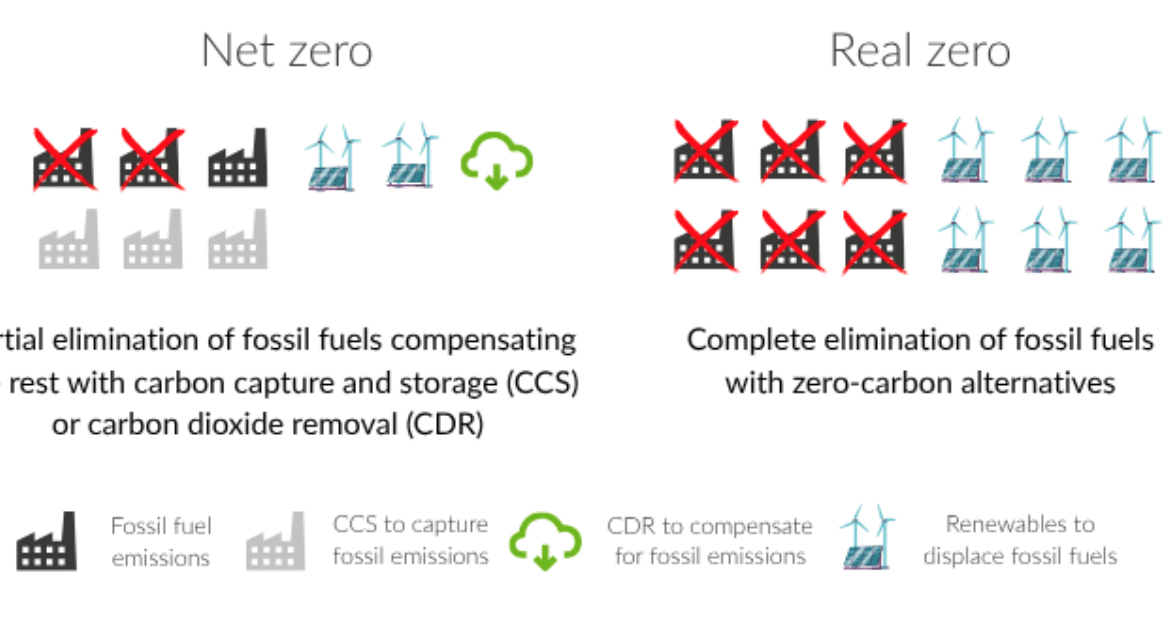
Forget “net zero.” A new rallying cry is electrifying the climate conversation: “Real Zero.” Based on the latest groundbreaking research, it’s not a distant dream but a goal within our grasp this century.
A new report from Climate Analytics, “Real zero: delivering a fossil-free future,” maps out how major economic sectors can eliminate fossil fuels, not just balance them out with offsets.
The findings offer a startlingly optimistic timeline: Europe’s road freight could be fossil-free by 2040, with global steel and shipping following suit by 2050.
So, what exactly is “Real Zero”? Well, it’s a line in the sand that is, it basically means a complete replacement of oil and gas with zero-carbon alternatives like renewable electricity and green hydrogen, rather than compensating for continued emissions with carbon capture or distant promises of carbon dioxide removal.
According to Michael Petroni, the report’s author, the transition to real zero is not a distant aspiration, but an immediate and tangible possibility. “The viability of real zero is only growing over time as zero-carbon technologies rapidly advance and mature, and their costs fall,” added Petroni.
The Front-Runner: Europe’s Electric Trucks
Notably, the report singles out trucking as a sector poised for a rapid transformation in as even though it might seem delayed in the present times. He opines that Europe’s road freight could hit the real zero finish line as early as 2040.
which raises the question of how the consumer costs will be perceived and received, one that is rather more about economics. Based on the report, Battery electric trucks are almost at the threshold of beating out the current diesel BAU model when assessed on total cost of ownership (TCO).
Battery electric trucks in Europe are expected to achieve cost parity with diesel as soon as next year. By 2030, they are projected to be 15-20% cheaper to own and operate. Add to this the EU’s new emissions trading system, which will soon make sticking with diesel a more expensive choice than going electric.
The report reveals that by 2040, battery electric trucks could be up to 24% cheaper, depending on the truck type.
A Global Opportunity, Not a Cost
A companion report, “Real zero: an opportunity, not a cost,” argues that this transition is an economic imperative. Emphasizing that for those companies that lead the charge, there is an opportunity to secure a competitive advantage in the emerging green economy.
The frontier of real zero-mitigation options is expanding due to the rapidly declining costs of renewables and electrolysers, increases in battery storage and efficiency, and accelerating innovation in reducing process-related emissions across so-called “hard-to-abate” sectors.
The evidence is in the case studies:
- In Japan, producing “real zero” steel in the 2030s is a viable option. Steel made in renewables-powered electric arc furnaces is already cost-competitive.
- In India, greening fertiliser production by switching to green hydrogen-based ammonia cuts emissions at the source, shields the industry from volatile gas prices, and reduces import dependence, all with a negligible impact on food prices.
The message from the research maintains a certain clarity that enforces an urgency further urged on by the CEO of Climate Analytics, Bill Hare.
“To keep 1.5°C in reach, we must drive as many sectors as possible to real zero before mid-century. That reduces over-reliance on negative emissions and delivers durable decarbonisation,” urged Hare.
The race is on, and the finish line for a fossil-free future is now in sight, yet the question remains about whether a just energy transition will be accorded. This is an instrumental perspective to fully focus on as it’s a path to attaining climate justice and an equitable, affordable, just transition.
Author Profile

-
Seeker.
Inspire AFRIKA.
Latest entries
 Biodiversity19 October 2026Yerevan Declaration Calls for Faster Action on Global Biodiversity Targets
 Changemakers19 October 2026How Earth Wise Storage Plans to Expand Smallholder Poultry Farming in Rwanda
 Corporate15 October 2026Water, Sanitation and Digital Learning at the Centre of Garissa School Upgrade
 Agriculture14 October 2026Africa’s Food Systems Future Depends on Listening to Farmers


