
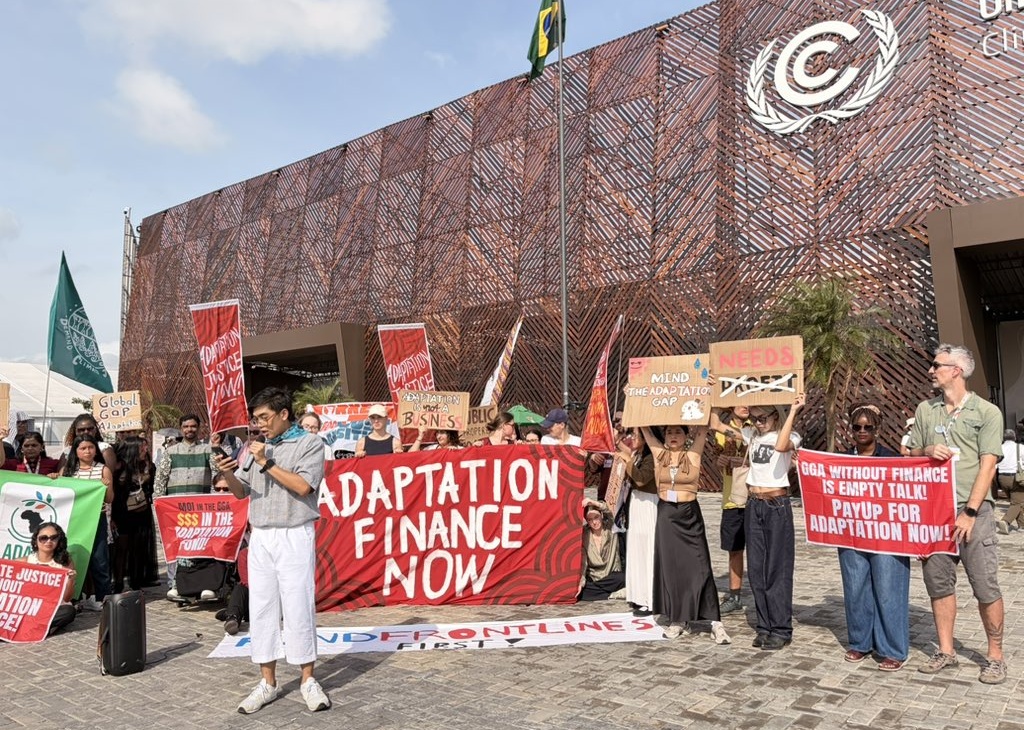
In Belém’s humid halls, where delegates moved between packed rooms and marathon-length sessions, one truth kept echoing louder than any speech: COP30 is stuck, and the blockage has a name. Finance.
For all the technical language, the politics, and the carefully worded interventions, the core of the impasse remained painfully familiar: justice and responsibility, expressed through money even more accurately, the lack of it.
Whether in the Global Goal on Adaptation (GGA) room, the National Adaptation Plan (NAP) discussions, or the Just Transition Work Programme (JTWP) sessions, the conversations circled back to one point: developing countries simply cannot implement their climate ambitions without predictable, grants-based finance.
Yet, several developed countries continued pushing back against any language that suggested obligation. A move that places the developing nations who being on the frontline are facing the most severe and frequent climate impacts.
The result? A widening trust gap, aggravated further by the Paris Agreement’s own finance architecture and the International Court of Justice Advisory Opinion on the Obligations of States in respect of Climate Change (ICJAO) advisory ruling being brushed aside or diluted in negotiations.
Environmental Non-governmental Organization (ENGO) observers didn’t mince their words either: the implementation gap is the finance gap. Until that is resolved, no amount of diplomatic choreography will convince developing nations that further promises mean anything.
Even the Loss and Damage Fund, celebrated at its operationalization, exposed the contradiction as the analysis would reveal a limited or unavailable financing, yet it’s the crucial step to the actualization of the fund itself. Its first Call for Funding Requests was launched, a milestone, but the pot of money behind it tells the deeper story.
This was apparent as only USD 250 million is allocated for 2025–26, a drop compared to the scale of climate-fuelled disasters facing vulnerable communities. Even though it was deemed a step forward, yes, it is, although experts argue that it leads to nowhere near a lifeline.
Adaptation: Clarity in Need, Uncertainty in Delivery
If finance was the wall, adaptation was the echoing corridor where the wall kept appearing in every room. Week one saw adaptation dominate discussions, with the first draft of the Global Goal on Adaptation (GGA) text introducing an option that many in civil society have long demanded: a concrete adaptation finance target.
The proposal would triple adaptation finance by 2030 and set a minimum threshold of USD 120 billion annually. Notably enough, a proposal is not an agreement yet.
According to UN Climate Change Executive Secretary Simon Stiell at today’s High-Level Ministerial Dialogue on climate finance, Climate finance is the lifeblood of climate action, for it’s what turns plans into progress, and ambition into implementation.
Parties remain sharply divided on whether the GGA indicators should be adopted, welcomed, or merely noted, distinctions that carry massive implications.
“I know that resources are constrained in every part of the world, and delivery isn’t easy. But climate finance is not charity, it’s smart economics. Because climate action, underpinned by climate finance, is the growth story of the 21st century,” said Stiell.
In developing countries, the current indicator list still overlooks the guidance given at the 62nd Session of the Subsidiary bodies (SB62), particularly around Means of Implementation.
Their message throughout GGA, National Adaptation Plan, and agenda consultations was unwavering: “Adaptation without finance is not adaptation. It is rhetoric.”
The clarity of need is undeniable, with witnessed climate change impacts that continue to lead to the loss of livelihoods, lives, and massive infrastructure, causing devastating impacts on economies, especially those of developing countries.
The uncertainty in delivery is undeniable, with more Global South nations having limited representation and having most of their demands go unheard or unaddressed.
The question that lingers on minds now is, will the last week of the COP of Truth stay true to its course and deliver concrete results for the most vulnerable who are on the frontlines?


