
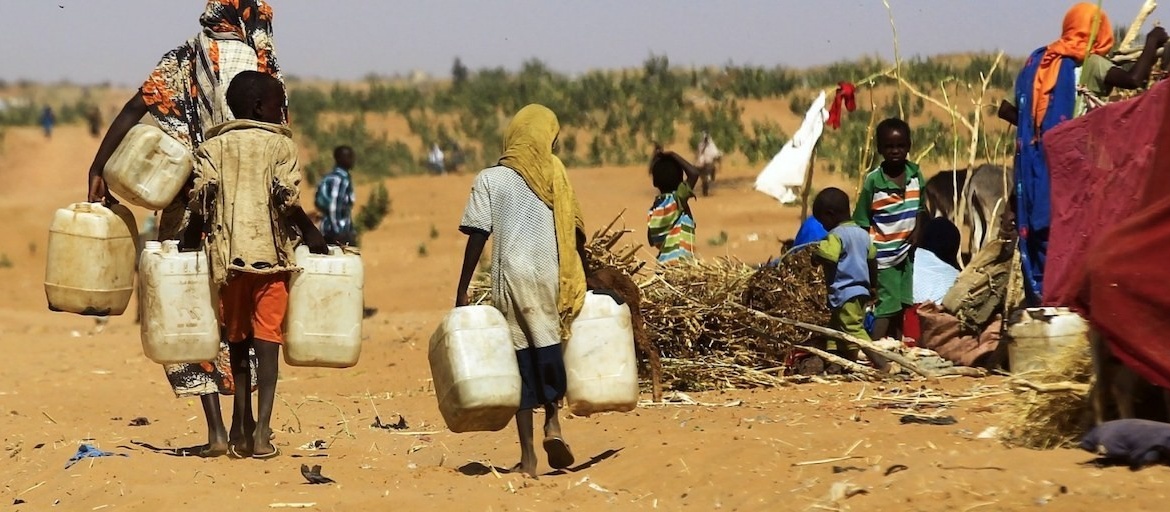
At a major COP30 side event, African leaders and analysts warn that the climate crisis has become a direct driver of instability, forcing a critical rethinking of security and development finance that looks into conflicts.
The African continent faces a cruel paradox from diverse edges of food insecurity, with numerous arable lands to conflicts ensuing due to migrations within countries and across borders in search of resources and livelihoods.
Though the continent and the global south contribute least to global carbon emissions, the regions bear the most catastrophic consequences. This is evident when floods, droughts, cyclones, and hurricanes strike, turning more than just environmental crisis issues, as they are now violently reshaping the political and security landscape.
New data and high-level analysis presented at the United Nations Climate Change Conference (COP30) reveal an urgent, undeniable nexus that IOM has consistently pointed us to. This entails how climate change is not just a future threat but a present-day accelerant of conflict, displacement, and fragility.
According to Dr. Al Hamndou Dorsouma of the African Development Bank Group (AfDB), it’s evident that climate change is amplifying conflict and fragility on the continent. This is attributed to the statistics that reveal how, in 2024 alone, climate disasters forced 9.8 million new internal displacements within Africa.
A case that was indepthly looked into at an event, “Adapting for Stability, Scaling Partnerships for Peace and Climate Resilience in Africa,” brought together UN agencies, the African Union, finance institutions, and civil society to confront a stark reality.
The mechanics of this escalation are tragically clear as they are linked to irregular rainfall and severe water scarcity are dismantling centuries-old survival systems.
“Declining rainfall has altered the seasonal migration patterns of African pastoral communities,” Dorsouma explained, “increasing competition… This has led to recurring conflicts in almost every region, from Ethiopia to Darfur, from Kenya to Nigeria, and throughout the Sahel.”
How the Finance Gap is a Catalyst in Fragile Zones
A core challenge, as highlighted by Abdi Fidar of the Intergovernmental Authority on Development (IGAD), is that the areas most torn by conflicts are often those left behind by climate finance, while they are the most vulnerable and eligible for it.

“It is now difficult to separate the security-climate nexus, as fragile areas do not benefit from climate finance,” Fidar noted. This, he notes that ends up creating a vicious cycle of instability that prevents climate adaptation projects, and increasing climate stress then deepens the instability.
This funding gap points to a fundamental operational dilemma, especially in regions that are frequently impacted by climate shocks.
“There can be no implementation of climate projects without peace; we cannot fight climate change without peace,” argued Nazanine Moshiri of the Berghof Foundation, framing peace not as a separate goal but as a prerequisite for effective climate action.
Strategic Pivots and New Financial Instruments
In response, major development actors are fundamentally retooling their strategies. The African Development Bank, described by Dorsouma as the continent’s leading development financier, is centering the climate-peace link in its operations.
Its response, he outlined, is threefold: a fragility and resilience strategy, a Climate Change and Green Growth Strategic Framework for 2030, and, most tangibly, new financial mechanisms.
The most significant of these is the Climate Action Window under the African Development Fund. Launched in 2023 with approximately $450 million, it has already directed $386 million to 59 projects in fragile and climate-vulnerable countries in just one year.
“Every dollar invested in climate adaptation and resilience generates an ROI [Return on Investment] of between two and ten US dollars,” Dorsouma asserted, making an economic case for what he termed a “humanitarian imperative.“
The consensus from Belém was that traditional silos must collapse now since the path forward, according to participants, requires merging humanitarian, peacebuilding, and development efforts.
“Building resilience while addressing fragility requires joint action across the spectrum,” Dorsouma concluded, “but most importantly with an emphasis on climate-resilient development… to prevent climate change from continuing to amplify fragility.”
This integrated approach must also broaden who is at the table. Charles Mwangi of the Pan-African Climate Justice Alliance presented a crucial final argument for inclusion.
“Civil society, often closest to the affected communities, must be included… to avert local risks and injustices that could lead to conflict,” he said. It is a reminder that policies forged in global conference halls will fail if they do not reflect the on-the-ground realities in favor of those living at the intersection of a changing climate and rising conflict.
The message from COP30’s sidelines was a sobering evolution in the climate discourse. For Africa, the debate is moving beyond mitigation and adaptation towards a more complex and urgent imperative of financing stability itself, which has to start with addressing conflicts.


