
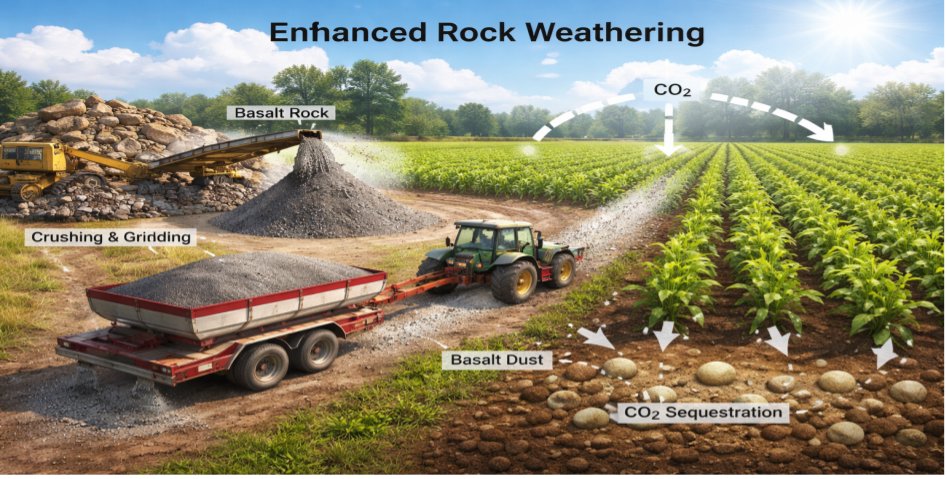
In nature, silicate rocks such as basalt slowly react with CO₂ and water, converting carbon into stable carbonate minerals or dissolved bicarbonates over long time scales. Enhanced Rock Withering (ERW) speeds up this reaction by mining suitable silicate rocks, grinding them into fine particles to increase surface area, and applying them to agricultural soils.
By David Mugendi (PhD), Postdoctoral Researcher on Carbon Removal Technologies, Nuvoni Centre for Research and Innovation
As the crushed rock weathers, it reacts with CO₂ dissolved in soil water, effectively transferring atmospheric carbon into more stable forms. Because this storage is mineral-based, ERW is considered more durable than many biological sequestration pathways.
ERW is part of a broader family of engineering-based carbon dioxide removal technologies, alongside Direct Air Capture (DAC). These approaches emphasize measurable, verifiable, and long-term carbon storage. In voluntary carbon markets, durability influences pricing.
Early-stage ERW credits have reportedly exceeded USD 300 per tonne, significantly higher than many nature-based credits, some of which trade below USD 5 due to concerns around permanence and reversal risks. While price reflects market confidence in durability, it does not automatically guarantee net climate benefit.
For Sub-Saharan Africa, the discussion must move beyond valuation to scientific suitability. The region is geologically promising. The East African Rift system contains abundant basaltic formations suitable for accelerated weathering.
Pilot initiatives, including projects by organizations such as UNDO Carbon in East Africa, demonstrate growing interest. However, scaling ERW across African landscapes requires careful evaluation of energy systems, soil chemistry, and agricultural realities.
One critical factor is energy demand. Mining, crushing, and grinding rock are energy-intensive processes. Transporting large quantities of rock to farms, often over long distances, adds further emissions. If these operations rely on fossil fuels, upstream greenhouse gas emissions could significantly offset the carbon removed through weathering.
In many Sub-Saharan African countries where renewable energy infrastructure is still expanding, this concern is especially relevant. Comprehensive Life Cycle Assessment (LCA) is therefore indispensable. Net carbon removal must be calculated from extraction through application and long-term monitoring.
Equally important is soil chemistry monitoring, particularly soil pH. The stability of carbonate minerals formed during ERW depends strongly on soil conditions. If soils become acidic, carbonate dissolution may occur, potentially releasing previously stored CO₂ back into the atmosphere. Humic acids generated during organic matter decomposition can also influence mineral stability.
In rain-fed agricultural systems, seasonal moisture variability affects mineral dissolution rates and reaction pathways. Without consistent pH monitoring and long-term soil assessment, claims of durable carbon storage may not hold under certain environmental conditions.
This is especially significant in Sub-Saharan Africa, where many soils are already acidic or degraded, and where agriculture depends heavily on rainfall. While ERW may offer agronomic benefits such as nutrient addition and pH buffering, these benefits must be verified under local agroecological conditions.
Continuous monitoring of soil pH, carbonate formation, and bicarbonate fluxes is essential to ensure that carbon remains sequestered rather than re-emitted. The pathway forward is not to dismiss ERW but to strengthen its scientific foundation in African contexts.
Renewable-powered grinding facilities, localized supply chains, transparent LCA methodologies, and rigorous soil monitoring frameworks should form the backbone of any regional deployment.
Engineering-based carbon removal technologies, such as ERW and DAC, have the potential to complement nature-based solutions within a diversified climate strategy. However, their credibility will depend on robust data, transparent accounting, and sustained ecological monitoring.
Sub-Saharan Africa has both geological opportunities and developmental constraints. Harnessing ERW responsibly requires aligning advanced mineral carbon science with renewable energy transitions, soil stewardship, and equitable agricultural practices.
With careful research and sustained monitoring, particularly of soil pH dynamics, ERW could indeed reshape Africa’s carbon future. Without it, high-priced credits risk masking unresolved environmental trade-offs.
Reference
Beerling,D. J., et al. (2020). Potential for large-scale CO₂ removal via enhanced rock weathering with croplands. Nature, 583, 242–248. https://doi.org/10.1038/s41586-020-2448-9
IPCC (2022). Climate Change 2022: Mitigation of Climate Change (AR6 Working Group III). Intergovernmental Panel on Climate Change.
Renforth, P. (2012). The potential of enhanced weathering in the UK. International Journal of Greenhouse Gas Control, 10, 229–243.
Amann, T., et al. (2020). Enhanced weathering and related element fluxes — a review. Biogeosciences, 17, 103–123.
Ecosystem Marketplace (2023). State of the Voluntary Carbon Markets Report.
Climeworks (2024). Direct Air Capture technology overview.UNDO Carbon (2024). Enhanced Rock Weathering field projects documentation


