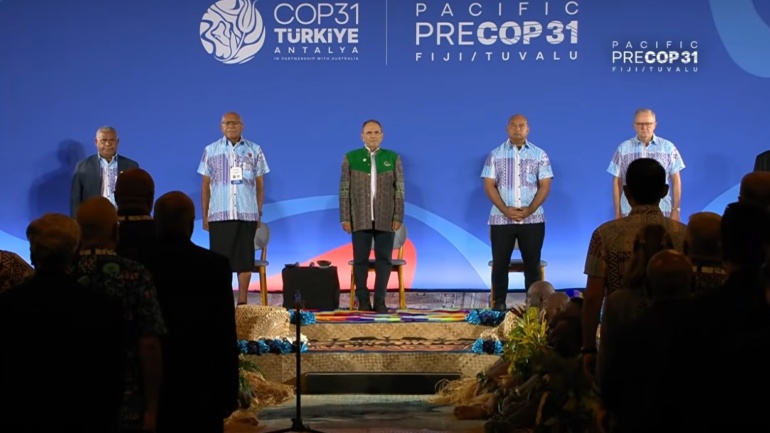
In a world marked by geopolitical tension and economic uncertainty, climate action is emerging as a pillar of global stability rather than a competing priority.
That was the central message from Simon Stiell, Executive Secretary of the United Nations Framework Convention on Climate Change(UNFCCC), speaking in Istanbul ahead of preparations for COP31 in Türkiye.
Addressing ministers and negotiators, Stiell framed the upcoming summit as a turning point, a shift from years of negotiation toward what he called a decisive “era of implementation.”
“We find ourselves in a new world disorder,” Stiell said, pointing to rising instability, trade tensions, and pressure on multilateral cooperation. Yet he argued that climate cooperation offers a practical antidote. “Climate action can deliver stability in an unstable world.”
From Agreements to Delivery
Stiell described the evolution of international climate policy in three phases: discovery, agreement, and now delivery. The second phase produced the landmark Paris Agreement, which he said fundamentally altered the global trajectory by aligning countries around a shared framework.
“That didn’t solve the climate crisis,” he noted, “but it changed our course.”
A decade after Paris, investment trends show accelerating momentum. Global clean energy investment has increased from approximately $200 billion annually to over $2 trillion. In 2025, renewables investment outpaced fossil fuels by more than double, and renewable sources overtook coal as the world’s leading electricity provider.
At COP30 in Belém, governments declared the global energy transition irreversible, with the Netherlands and Colombia taking the lead to host the transition summit. Most countries submitted updated national climate plans aimed at cutting emissions while supporting economic growth. Still, Stiell acknowledged that progress remains uneven and insufficiently fast, particularly for vulnerable developing nations.
He warned that political efforts to expand fossil fuel dependence threaten both climate gains and economic resilience, arguing that such strategies ignore scientific evidence and market signals.

Finance as the Implementation Engine
Turning commitments into results will depend largely on finance. At COP29 in Baku, countries agreed to triple annual climate finance for developing nations from $100 billion to $300 billion, alongside a roadmap to mobilize $1.3 trillion in the coming years.
While many developing countries say the figures still fall short of actual needs, Stiell described the agreement as a critical step toward scaling support. He stressed that multilateral development banks must accelerate reforms to lower borrowing costs, attract private investment, and strengthen financial transparency.
A central priority is rapidly expanding a pipeline of investable climate projects, matching countries with finance and private-sector partners to deliver clean energy, forest protection, and climate resilience at scale. Commitments announced in Belém included trillion-dollar investments in electricity grids and major funding for ecosystem protection and climate health.

Countries retreating from climate leadership, Stiell warned, risk losing access to what he described as a fast-growing source of jobs and economic opportunity.
Climate Action as Economic Self-Interest
During a press conference following his address, Stiell responded to questions about geopolitical tensions, including the United States’ withdrawal from the Paris Agreement. Without singling out any country, he emphasized that economic fundamentals favor climate actions like clean energy, and the trajectory to be taken has to embrace that reality.
“The science and the economics are absolutely clear. Renewables are the cheapest, cleanest mode of energy production moving forward,” he said, noting that last year’s global investment split, roughly $2 trillion for renewables versus $1 trillion for fossil fuels, reflects where markets are heading.
For Stiell, climate action addresses immediate public concerns: lowering energy costs, reducing pollution, and creating jobs. Expanding renewable energy can also extend electricity access to the more than 700 million people worldwide who still lack reliable power, unlocking economic activity and improving living standards.
He argued that climate resilience is inseparable from national security. Rising emissions intensify extreme weather, disrupt food systems, and contribute to displacement and conflict. In contrast, renewable energy strengthens energy sovereignty and shields economies from fossil-fuel price shocks.

Türkiye’s Role at a Diplomatic Crossroads
Looking ahead to COP31 in Antalya, Stiell positioned Türkiye as a bridge between diverse geopolitical interests.
He rejected suggestions that a host country’s fossil fuel profile determines summit outcomes, pointing to recent conferences hosted by major producers that nevertheless delivered significant agreements, including progress on carbon markets and the Loss and Damage Fund.
“There is every opportunity to deliver a very strong outcome signaling what this era of implementation looks like,” he said.
In anticipation of the second global stocktake in 2028, countries are expected to demonstrate measurable progress toward existing commitments, doubling energy efficiency, tripling renewable capacity, and strengthening climate resilience, before adopting more ambitious targets.
For Stiell, the challenge is not only technical but political: sustaining cooperation in a fragmented world.
His message in Istanbul was that climate action is no longer a side agenda. It is increasingly central to economic security, public welfare, and geopolitical stability, and COP31 will test how effectively nations can translate that shared interest into accelerated action.
Author Profile

-
Seeker.
Inspire AFRIKA.
Latest entries
 Corporate15 October 2026Water, Sanitation and Digital Learning at the Centre of Garissa School Upgrade
 Agriculture14 October 2026Africa’s Food Systems Future Depends on Listening to Farmers
 Weather Forecasts13 October 2026Rain and Rising Temperatures Forecast Across the Greater Horn of Africa
 Climate9 October 2026Beyond Negotiations: Africa Expects Concrete Outcomes from Antalya