
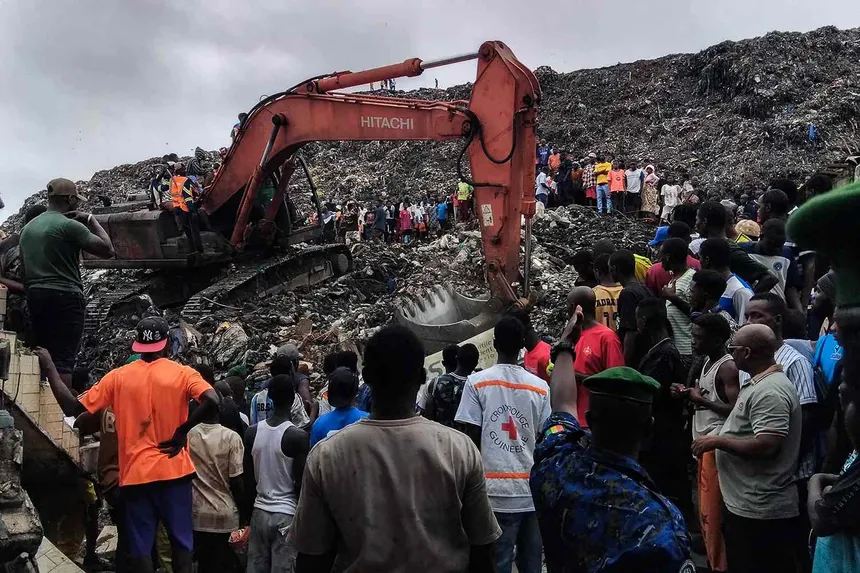
In Conakry, a landfill long regarded by residents as a danger became the scene of a deadly landslide, raising difficult questions about environmental neglect, urban vulnerability and warnings that went unheeded.
At around 2 am, the residents of Dar es Salaam neighbourhood in Guinea’s capital, Conakry, were asleep when they heard a sound loud enough to pull them from their beds.
Mamadouba Bangoura remembers what happened next.
“We were sleeping when we heard a loud noise,” he recalls.
Some members of his family went outside to find out what had happened. At first, the danger did not appear to have reached them. Then another wave of rubbish came crashing down.
“The second wave came and knocked over the house.”
What followed was chaos.
As residents rushed into the darkness to search for people buried beneath the enormous mass of waste, another landslide struck. Those who had gone to help became victims themselves.
“All the people who went there to help ended up being buried,” says Aboubacar Camara, another survivor.
In the hours that followed, the scale of the tragedy became increasingly clear. People were still missing. In some cases, entire families had been buried together.
The disaster unfolded beneath what residents describe as a giant open-air waste site that had for years dominated the landscape and lives of communities living around it.
For the people of Dar es Salaam, however, the landfill was a persistent warning. They say they had lived with the smell, the waste and the danger for years. They had also tried to get authorities to act.
Warnings before the collapse
Abou Hamza, a Conakry resident and activist, says young people in the neighbourhood had repeatedly raised concerns about the landfill.
“We, the young people of Dar es Salaam neighbourhood, did everything we could to prevent this,” he says.
They organised sit-ins and invited officials from relevant government departments to listen to their concerns.
“We invited the officials from the relevant departments, but they didn’t take it seriously,” Hamza says.
For him, the tragedy cannot be separated from those earlier warnings.
“I blame the state because it didn’t take the necessary measures to have the dump closed.”
The government had, according to the account surrounding the disaster, already pledged to close and relocate the landfill because of the danger it posed.
But for residents, the intervention came too late.
The collapse therefore raises a difficult question that goes beyond the immediate search for victims: when does a known environmental hazard become a disaster of governance?
The answer matters because the people exposed to the danger were among those least able to escape it.
Where environmental risk meets poverty
The tragedy in Conakry illustrates a broader problem facing rapidly growing cities: environmental hazards often do not affect everyone equally.
Waste sites, polluted waterways, flood-prone areas and unstable land are frequently located close to communities with fewer resources and fewer options for relocation.
For residents living around Conakry’s landfill, proximity to waste was part of their daily reality. That reality can turn a chronic environmental problem into an acute humanitarian disaster.
The tragedy also highlights the importance of looking at disasters before they happen.
A landslide may occur in a matter of minutes, but vulnerability is often built over years.
It is created through decisions about where waste is deposited, where people are allowed to settle, how infrastructure is maintained and whether warnings from communities are acted upon.
In this case, residents say they did not remain silent.
They protested.
They invited officials.
They asked for the landfill to be closed.
Their accounts suggest that the danger was visible long before the night the mountain of waste came down.
A climate resilience question
Moreover, the Conakry tragedy also raises a wider question about how cities prepare for overlapping environmental risks.
Climate change does not need to be presented as the direct cause of this particular landslide without evidence establishing that link. But climate resilience cannot be separated from the underlying conditions that determine whether communities can withstand environmental shocks.
Poor waste management, inadequate urban planning, weak infrastructure and poverty can all increase vulnerability.
Where extreme weather or changing rainfall patterns add pressure to already unstable environments, those underlying weaknesses can become even more consequential.
The lesson, therefore, extends beyond one landfill.
Climate resilience is not only about responding to floods, storms or rising temperatures. It is also about reducing the environmental vulnerabilities that leave communities exposed when hazards occur.
That means safer waste management, stronger urban planning, early warning systems, enforcement of environmental regulations and meaningful engagement with communities living closest to risk.
The response after the tragedy
Following the landslide, authorities pledged to mobilise resources for those affected.
Guinea’s Prime Minister also visited the site, urging the community to remain calm and show solidarity during the tragedy.
For families waiting for news of missing relatives, such support is critical.
But the response also underscores a painful contrast.
The mobilisation that followed the disaster came after years in which residents say they had been living with the danger.
The question now is whether the tragedy will lead to a fundamental change in how Conakry manages waste and protects communities living near hazardous sites.
For the survivors, the issue is no longer abstract.
They have seen homes destroyed.
They have watched neighbours disappear.
And they have experienced the consequences of a hazard they say they had warned about.
Beyond the landfill
The tragedy in Conakry is ultimately a story about more than rubbish.
It is about who is protected when cities grow, who bears the risks when environmental systems fail, and whether warnings from vulnerable communities are heard before disaster strikes.
For those who survived that night, the mountain of waste is no longer simply part of the landscape. It is a reminder of lives lost and of what residents believe could have been prevented.
The challenge now is to ensure that the tragedy does not become another warning remembered only after the next disaster.
Because environmental resilience begins long before the emergency response, with recognising danger, listening to communities and acting while there is still time.
Read Also: A Mountain of Trash and Reforms that Could Bury a Livelihood


