As more than 350 scientists endorse a global consensus on wildlife and climate, new peer-reviewed research is calling for wild animals and their ecological roles to be recognised in climate action.
For decades, the climate conversation has largely placed wild animals on the receiving end of a warming planet.
Species are losing habitat, ecosystems are being altered and changing temperatures are shifting the conditions on which wildlife depends.
But a growing body of science is asking governments to look at wildlife from another perspective: not only as victims of climate change, but as active participants in the processes that help regulate the planet.
A new peer-reviewed article published in Global Change Biology adds weight to that argument by examining how wild animals influence ecosystem processes that affect carbon storage and greenhouse gas fluxes.
The paper, “Wildlife and Climate: Scientific consensus on the roles of wild animals in the global carbon cycle and natural climate solutions,” was published on September 25, 2026, in the journal’s Science behind the news section. It was authored by 13 scientists who collectively developed the Scientific Consensus on Wildlife and Climate launched in June.
The consensus has since attracted endorsements from more than 350 scientists globally.
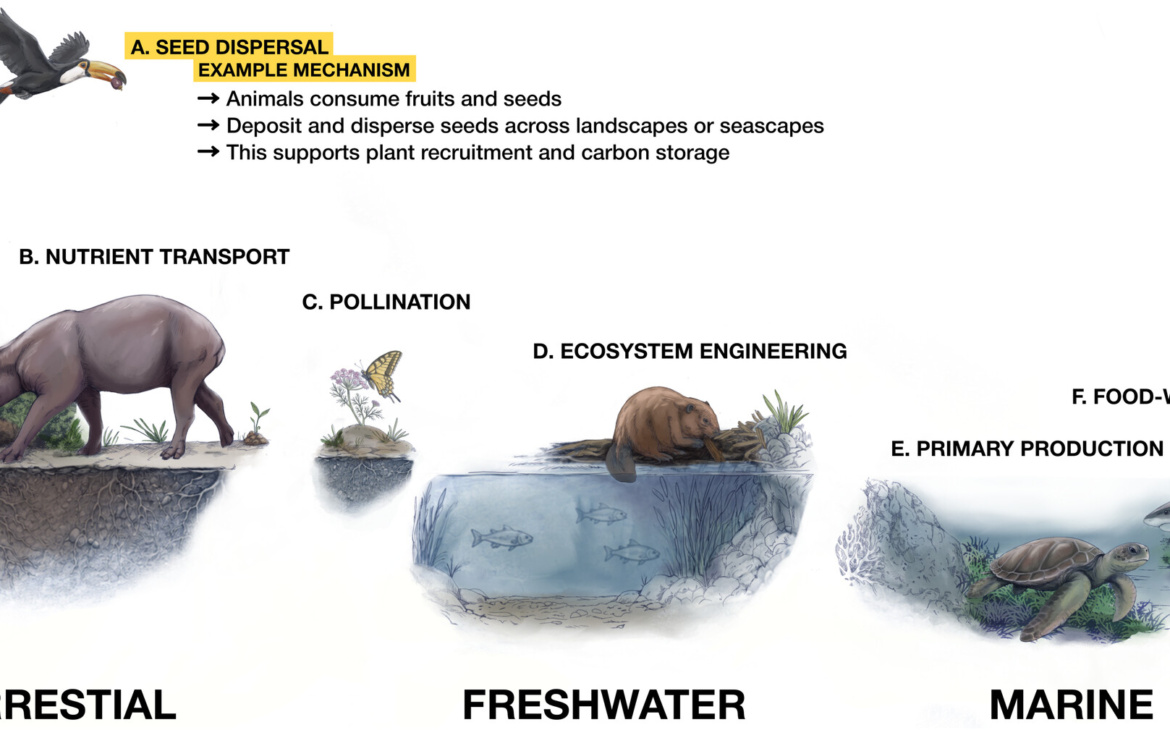
At its centre is a relatively simple proposition: animals are not merely inhabitants of ecosystems. Through their everyday behaviours, they help shape how those ecosystems function, and, in turn, how much carbon they store and how greenhouse gases move through them.
“Every day, trillions of wild animals naturally support ecosystem functioning through their natural behaviours,” the Scientific Consensus notes.
Those behaviours can be easy to overlook because they often happen far from the centres of climate policy.
Dugongs, for example, recycle nutrients and disperse seeds in seagrass ecosystems. Predators such as Asian tigers can regulate herbivore populations, creating cascading effects that influence forest vegetation and the amount of carbon stored in those landscapes.
The implication is that losing wildlife can mean losing ecological processes that contribute to healthy, functioning ecosystems.
From wildlife conservation to climate action
Nathan Roberts of Northeast Forestry University in Harbin, China, who coordinated the new article, says the growing scientific recognition of these relationships could broaden how climate solutions are understood.
“The endorsement of the Scientific Consensus on Wildlife and Climate by over 350 global scientists marked a huge step in the collective recognition of the role of wild animals in ecosystem functioning and the need to better incorporate wildlife in nature-based climate solutions,” Roberts said.
For Roberts, the publication in Global Change Biology represents another step in moving that understanding beyond scientific circles and into policy discussions. He argues that the timing is particularly significant as countries prepare for COP31.
“With COP31 just a few months away, it is encouraging to see the acceptance, openness, and new conversations being had in this area,” he said, adding that scientists are now looking to see how countries carry the evidence forward into “their climate actions, plans, and dialogues.”
The emerging argument does not suggest that wildlife conservation should replace other climate mitigation measures. Rather, it points to an ecological dimension that climate strategies can overlook when they focus primarily on emissions, forests, soils, oceans or technological interventions as separate components.
Wild animals interact with all of these systems as they move nutrients, disperse seeds, influence vegetation, alter food webs and affect the functioning of marine and terrestrial ecosystems. Through these relationships, their presence or absence can influence ecosystems’ capacity to store carbon and withstand environmental change.
Ed Goodall, Climate Policy Specialist at the World Federation for Animals, says this changes the way wildlife’s place in climate discussions should be understood.
“Wildlife have been viewed for too long as passive participants in the Earth system and victims of a changing climate,” Goodall said.
He argues that the ecological relationships driven by animals are part of what has helped create and maintain habitable ecosystems.
“Losing animals and the roles they play is not unrelated to the dysregulation of our planet,” he said. “Removing threats and returning land and ocean to them will increase resilience and help drive more carbon into ecosystems.”
That perspective places wildlife conservation within a wider climate and ecosystem-resilience conversation.
It also raises a policy question: if animals contribute to ecological processes that influence carbon and resilience, should those roles be reflected more explicitly in national climate plans, biodiversity strategies and investments in nature-based solutions?
The scientists behind the consensus believe they should.
Bringing wildlife into climate policy
Matt Collis, Senior Director of Policy at the International Fund for Animal Welfare (IFAW), says climate policy has largely overlooked wildlife as a potential component of climate action.
“Climate policy has largely overlooked a powerful ally in tackling climate change, wild animals,” Collis said. He argues that the science increasingly points to benefits that extend beyond preventing species extinction.
“Protecting wildlife isn’t only about preventing species loss; it’s also about keeping the ecosystems we depend on healthy, resilient, and storing carbon,” he said.
The challenge now is translating that scientific understanding into policy without oversimplifying complex ecological relationships.
The Scientific Consensus calls on governments to recognise the ecological functions of wildlife within climate frameworks and consider animal-mediated processes where appropriate. This could include stronger consideration of wildlife populations in nature-based climate solutions, ecosystem restoration and climate adaptation planning.
The discussion is gaining momentum ahead of COP31, where a global, African-led, voluntary Wildlife for Climate Declaration is expected to be launched in November.
The proposed declaration could allow countries to acknowledge wildlife as part of the functional foundation of climate-resilient ecosystems, while encouraging knowledge-sharing and consideration of animal-mediated ecological processes in existing policies.
For Africa, where wildlife remains deeply connected to landscapes, livelihoods, tourism, food systems and cultural identities, the conversation could carry particular significance.
It also offers a different way of framing conservation. Instead of seeing wildlife only through the lens of species protection, the emerging science presents animals as part of the ecological infrastructure that keeps ecosystems functioning.
As the climate crisis increasingly becomes a crisis of ecosystem stability, that distinction matters.
The question ahead of COP31 may therefore no longer be simply how climate change is affecting wildlife, but how countries can better recognise the role wildlife already plays in helping ecosystems absorb, withstand and adapt to a changing climate.
Author Profile

-
Seeker.
Inspire AFRIKA.
Latest entries
 Biodiversity22 October 2026One in Five Tropical Biodiversity Sites Overlapped by Mining Concessions, COP17 Report Finds
 Biodiversity21 October 2026COP17 Opens in Armenia with Global Biodiversity Progress Under Scrutiny
 Biodiversity19 October 2026Yerevan Declaration Sets Tone for COP17 as World Leaders Demand Real Action on Biodiversity
 Changemakers19 October 2026How Earth Wise Storage Plans to Expand Smallholder Poultry Farming in Rwanda