
|
Getting your Trinity Audio player ready...
|
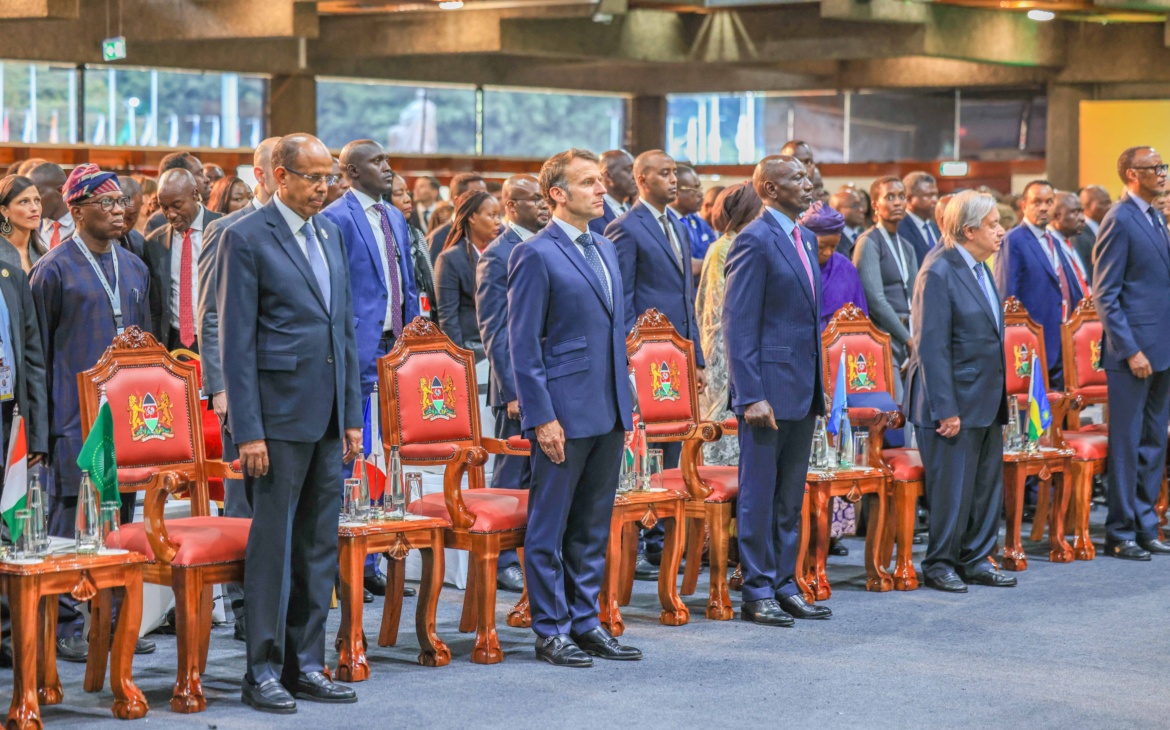
The Africa Forward Summit ended with the Nairobi Declaration, a document that goes far beyond a standard diplomatic communiqué.
The declaration reads as a strategic blueprint for redefining Africa’s relationship with the global system, particularly with France and Europe, around industrialization, sovereignty, financing, technology, climate resilience, and geopolitical influence.
One sentiment repeated throughout the summit was that Africa must avoid becoming merely the extraction site for the global green transition.
Speaking to delegates during the final day of the event at the KICC yesterday, Kenya’s President William Ruto said, “Africa does not want to power the global green transition while remaining poor,” calling out what he described as unjust global financial systems that continue to throttle Africa’s growth through expensive loans and unfavorable business terms.
Sovereign Green Resources
The global electric vehicle boom has intensified competition for lithium, cobalt, and other rare earth minerals as battery demand rises. Many of these resources are abundant across Africa.
Africa has seen this story before with oil, gold, copper, and diamonds, where the continent exported raw wealth while much of the value creation happened elsewhere. Now, African leaders say critical minerals must not become another extractive chapter.
The Nairobi Declaration signals a shift from exporting raw minerals toward building industries, processing minerals locally, manufacturing green technologies, and controlling more of the value chain.
“Africa is a strategic partner in its own right, considering the young population and abundant natural resources,” President Ruto said.
What “Beneficiation” Actually Means
African countries have historically exported crude oil, raw cocoa, unprocessed coffee, copper ore, and rough diamonds, while refining, manufacturing, branding, and high-value exports largely happened elsewhere. Leaders now fear the continent could once again export raw lithium while battery wealth is created abroad.
Beneficiation means that instead of exporting raw ore, minerals are refined and processed locally, intermediate products are manufactured domestically, and eventually batteries and green technologies are produced closer to the source.
Raw lithium, for instance, can move through a chain from processed lithium chemicals to battery cells, EV batteries, and eventually electric vehicles. The question is how much of this chain Africa can realistically capture.
The declaration repeatedly references green industrialization, regional value chains, “Made in Africa” production, and industrial transformation.
Several African countries already hold resources critical to the global energy transition:
- Democratic Republic of the Congo — cobalt
- Zimbabwe — lithium
- Namibia — uranium and rare earths
- Zambia — copper
- South Africa — platinum group metals
- Madagascar — graphite
Consequently, the continent stands to benefit from direct investment in battery assembly plants, fertilizer production, renewable energy component manufacturing, EV assembly, and clean energy infrastructure.
Competition Over Africa’s Minerals
Africa’s minerals are increasingly becoming central to US-China competition, EU strategic autonomy, and broader global energy security concerns.
African governments are also pushing for better deals, local jobs, technology transfer, and industrial partnerships, not merely extraction contracts.
However, industrialization remains expensive, and the continent continues to face weak power grids, financing gaps, transport bottlenecks, technology limitations, and high borrowing costs.
The declaration therefore, emphasizes financial architecture reform, infrastructure investment, blended finance, and public-private partnerships.
The larger question remains whether Africa can industrialize fast enough before global supply chains become locked in elsewhere.
According to the United Nations, Africa contributes only a small share of global emissions despite facing disproportionate climate impacts and persistent energy poverty. Yet the continent holds many of the minerals essential for global decarbonization.
Critics and analysts alike argue that if the world needs Africa’s minerals for a green future, then Africa should also gain industrial prosperity from them.
The Nairobi Declaration is ambitious and suggests that African leaders understand what is at stake. What happens next, however, will determine whether Africa truly industrializes or merely rebrands extraction.
Read Also: AFS: Why Africa Needs Concessional Finance for Green Industrialization.


