
Global temperatures are expected to remain at or near record-breaking levels over the next five years, with the Arctic continuing to warm at a pace far exceeding the global average, according to a new report released by the World Meteorological Organization (WMO).
The Global Annual-to-Decadal Climate Update, produced by the United Kingdom’s Met Office on behalf of WMO, paints a sobering picture of a warming planet edging closer to critical climate thresholds outlined in the Paris Agreement.
The report projects that annual global temperatures between 2026 and 2030 will likely range between 1.3°C and 1.9°C above pre-industrial levels (1850–1900 averages). Scientists say there is an 86 percent chance that at least one year during this period will surpass 2024 as the warmest year ever recorded.
The findings also indicate a 91 percent likelihood that at least one year before 2030 will temporarily exceed the 1.5°C warming threshold. In 2024, global temperatures already reached approximately 1.55°C above pre-industrial levels.
Beyond individual years, the report warns there is now a 75 percent chance that the average warming across the entire 2026–2030 period will exceed 1.5°C.
However, WMO clarified that temporary breaches do not mean the Paris Agreement goals are permanently out of reach. The 1.5°C target refers to long-term warming measured over decades rather than single years. Still, scientists caution that these exceedances are becoming increasingly frequent as global temperatures continue rising.
The report also highlights the growing influence of El Niño conditions in shaping future temperature records. Forecasts suggest warming in the central tropical Pacific Ocean could intensify in 2027 and 2028.
“There is an El Niño predicted for the end of 2026, which increases the chances of the following year, 2027, being the next record-breaking year,” said Dr. Leon Hermanson, the lead author of the report.
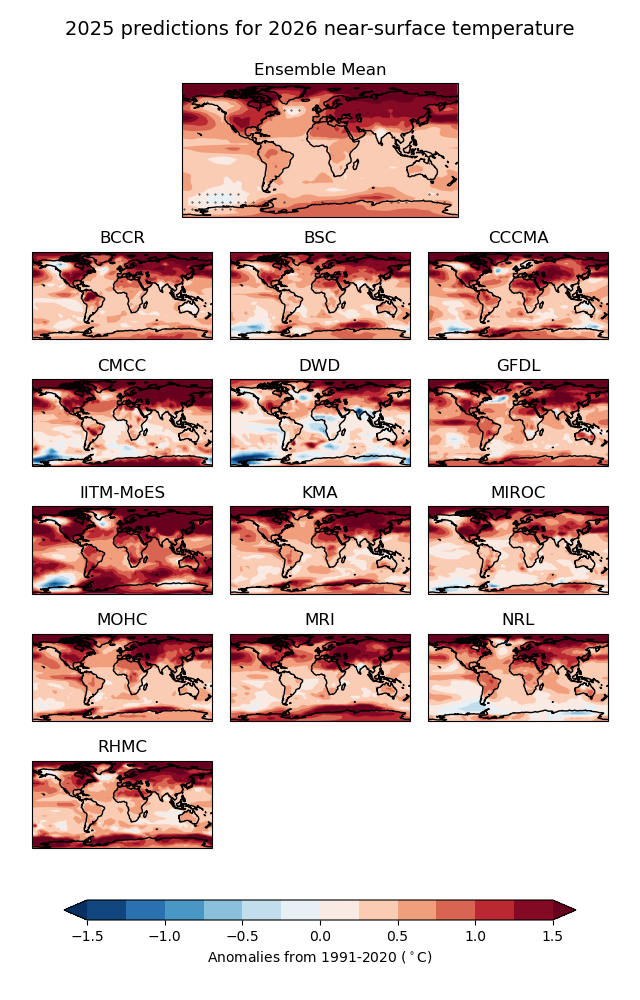
The climate outlook further underscores the disproportionate warming unfolding in the Arctic. Temperatures across the region during the next five northern hemisphere winters are expected to average 2.8°C above the 1991–2020 baseline, more than three times the projected global average anomaly.
Scientists also project continued reductions in Arctic sea ice, particularly in the Barents Sea, Bering Sea, and the Sea of Okhotsk.
At the same time, changing precipitation patterns are expected to reshape weather systems across multiple regions. Wetter-than-average conditions are forecast in high northern latitudes, the Sahel, northern Europe, Alaska, and Siberia, while drier conditions are likely over the Amazon and parts of the subtropics.
The report notes that these patterns are consistent with broader expectations of a warming climate, where wet regions generally become wetter and dry regions drier.
Regional projections also show that South-Eastern Europe, which has experienced unusually dry conditions in recent years, may see above-average rainfall between 2026 and 2030, although forecasters caution that confidence in predictions for the region remains relatively low.
The update draws on predictions from 13 international institutions, including leading climate modelling centres in Canada, Germany, Spain, and the United Kingdom.
WMO says the forecasts are designed to support regional climate centres and national meteorological agencies in improving preparedness for climate-related risks ranging from droughts and floods to heatwaves and food insecurity.
The latest findings arrive amid mounting global concern over accelerating climate impacts and intensifying calls for governments to rapidly cut greenhouse gas emissions before warming thresholds become permanently entrenched.
Author Profile

-
Seeker.
Inspire AFRIKA.
Latest entries
 Climate9 October 2026Beyond Negotiations: Africa Expects Concrete Outcomes from Antalya
 Animals7 October 2026In Kajiado’s Drylands, Collective Selling of Small Herds Is Changing the Livestock Trade
 Oceans6 October 202640 Years of Ocean Cooperation: The Western Indian Ocean’s Next Test Is Implementation
 Adaptation5 October 2026Africa Is Financing Its Own Survival as Climate Adaptation Money Falls Short


