
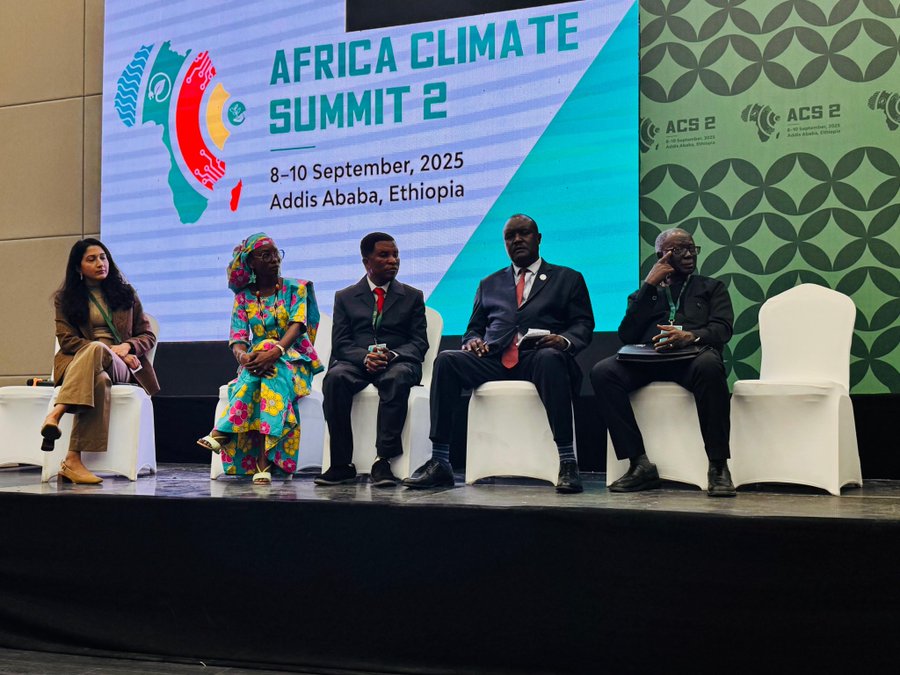
As the global community converges for the second African Climate Summit, a critical assessment of the inaugural summit’s outcomes is essential, and this begins with an analysis of the first African Climate Summit (ACS1). The Nairobi Declaration is remembered as a significant achievement for setting a high bar, one that illustrated a bold, unified African agenda for climate action and finance.
With ACS2 ongoing, a stocktake session broke down the data, from the pledges to characterizing the commitments, evaluating implementation progress, and analyzing the financial support mobilized, offering a clear-eyed view of the journey from ambition to tangible results.
According to Mr. George Manfur, a Technical Expert from Ghana’s presentation, the Nairobi Declaration’s paragraphs 23 to 46 outline a comprehensive set of commitments.
For clear evaluation, these have been categorized into key priority areas that include Mitigation & Green Transition, which focuses on the adoption of clean power through renewables, green industrialization, and green value chains.
The summit also set forth measures to invest in and further improve Adaptation & Resilience: climate-resilient food systems, water security, urban infrastructure, and the blue economy.
Another crucial climate solution presented during the first African climate summit was Nature-Based Solutions and adaptation, which are mainly undertaken by local communities on the frontlines who are the most vulnerable.
The recommendations emphasized nature-positive investments, sustainable land use, biodiversity conservation, and the Great Green Wall initiative.
During the ACS1 stocktake meeting, Dr. Mithika Mwenda, Executive Director of Pan African Climate Justice Alliance(PACJA), pointed out that, aligning with the Paris Agreement, over 60% of the ongoing work falls under Mitigation (Article 4) and Means of Implementation (Articles 9, 10, 11 on finance, technology, and capacity building). Yet it is apparent that progress on standalone Adaptation (Article 7) actions, while critical, has been more limited.
Another imperative outcome was the focus on Cross-Cutting Enablers: Governance, policy, delivery capability, MRV (Measurement, Reporting, and Verification) systems, and skills development for a green workforce that includes women, youth, and people with disabilities.
In addition to this, one of the main priorities remains Finance & Implementation. This is important since the continent suffers from a huge debt trap and higher interest rates on debt.
Consequently, leaders led by Kenyan President William Ruto were vocal during ACS1 about the need to reform the global financial architecture and build delivery capacity to ensure fairness, which would mean the continent is able to develop and pay back sustainably.
President Ruto has consistently urged for the architectural design to be reworked to fit new global advancements and for a re-evaluation of the continent’s worth regarding its natural resources.
Tracking Implementation Since ACS1: The Challenge of Decentralization
A central insight from this assessment is that real climate action happens at the national and local levels. Consequently, financing must be designed to address grassroots needs.
A significant shift is underway from funding solely through national governments to establishing mechanisms that empower local actors. Key innovations include:
- Municipal Financing Frameworks: Enabling cities and local communities to directly access climate finance, bypassing lengthy central government channels.
- The Africa Climate Change Fund (ACCF): A pioneering instrument providing grants directly to a wide range of stakeholders, including government institutions, CSOs, and local communities. Over the last decade, it has supported numerous local-level projects across the continent.
- The Climate Action Window: This new initiative has selected 41 projects for investment, many of which are specifically addressing local adaptation needs.
This evolution demonstrates a maturing understanding that while direct support to governments is necessary, dedicated finance for local communities is paramount for building effective resilience.
Analyzing the ACS1 Pledges: The $26 Billion Question
The Nairobi Declaration successfully catalyzed significant financial commitments aimed at improving the food insecurity situation on the continent to safeguard lives and livelihoods.

Notably, $26 billion was officially pledged to support the summit’s goals. However, when accounting for pledges made in associated side events and forums, the total figure mobilized approaches nearly $50 billion.
As such, the critical task now is to track the conversion of these pledges into disbursed, accessible, and implemented funding on the ground.
The first African Climate Summit was a decisive step forward, yet it is evident that extra efforts are required to secure its legacy, which would mean also doing an elaborate stocktake of what the journey has been like, with wins and gains getting proper documentation.
Ensuring Dedicated Local Finance is instrumental to continue focusing on developing and scaling financial instruments that channel resources directly to local communities, cities, and non-state actors is non-negotiable.
Dr. Pacifica Achieng Ogola, Director at the State Department of the Ministry of Environment and Climate Change, Kenya, called for a maintained, unified African voice as a major step toward the future of the continent’s climate actions.
In her view, to avoid fragmentation, the African Union Commission needs to continuously work with member states to ensure institutional memory and continuity, especially since the summits happen too frequently, allowing little to no time for a proper stocktake.
This call was further reiterated by Dr. Harsen Nyambe, Director of Sustainable Environment and Blue Economy at the African Union, as he revealed that there has been consideration of a shift from a biennial to a triennial summit.
“The move to go for three years before another summit is aimed to allow more time for implementation, assessment, and strategic planning between gatherings,” said Dr. Harsen.
Another crucial case was the need to strengthen the Adaptation Narrative, which was shown as imperative in the Nairobi Declaration.
Dr. Mithika, Director at PACJA, remarked that it is important we don’t forget how the Nairobi Declaration correctly emphasized the critical balance between adaptation and mitigation; however, the focus by Africa on mitigation is faulty.
Dr. Mithika further illustrated that while the local communities who are the most vulnerable are affected on the frontlines, with some losing lives, this should be a wake-up call for the continent to energize the adaptation case.
“Future efforts must continue to champion adaptation, often delivered through resilient infrastructure, energy access, and food systems, as a cornerstone of African climate strategy,” said Dr. Mithika.
A key measure that also came out strongly was the need for clarifying goals and tracking to ensure there is a record of what to do better. The discussions outlined that establishing clear targets, goals, and a robust monitoring structure is vital for measuring progress and holding all stakeholders accountable.
Based on the discussions during the ACS1 Stocktake side event, it is notable that the Nairobi Declaration built a lasting momentum. The task now is to ensure that this momentum translates into resilient livelihoods and transformative development across the African continent.


