

Africa is assembling one of its largest coordinated pipelines of climate investments to date, more than $3 billion in projects spanning energy, agriculture, circular manufacturing, and infrastructure, signaling a shift from pilot experimentation to industrial deployment. At the center of this momentum is the upcoming Africa’s Green Economy Summit (24–27 February 2026), where investors will review a curated portfolio of deal-ready projects from over 25 countries.
More than a showcase event, the summit reflects a broader market inflection point: Africa’s green economy is moving from fragmented innovation toward scalable industries capable of attracting institutional capital.
With approximately USD 3.09 billion in funding sought, roughly USD 90 million for SMME-stage ventures and nearly USD 3 billion for expansion and infrastructure, the pipeline offers a snapshot of where climate finance is converging with industrial strategy.
Several structural forces are aligning to make African climate ventures more investable. Falling renewable energy and storage costs, tightening corporate decarbonisation commitments, and supportive industrial policies are improving project economics.
Special economic zones and local manufacturing incentives are encouraging on-shoring of green production, while regional demand for energy stability and resilient food systems continues to grow.
The summit’s organiser, VUKA Group, has positioned the event as a transaction platform rather than a traditional conference. Projects entering pitch sessions typically arrive with pilot results, offtake letters of intent, or bankable feasibility studies, indicators of technical validation that reduce early-stage uncertainty.
For investors in the Africa Green Economy Summit, this represents a shift from concept risk to execution risk, a transition that often unlocks larger pools of capital.
As Elodie Ashdown, Investment Project Lead at VUKA Group, notes, the opportunity lies in mobilising blended capital to convert validated pilots into regional industries, particularly in areas such as decentralised hydrogen production, circular industrial solutions, and climate-resilient food systems.
Africa Green Economy Summit: Where the capital is flowing
The project pipeline spans alternative energy, waste and circular economy systems, sustainable agriculture, and blue-economy ventures.

In energy, investments in electrolyser component manufacturing, battery assembly, and decentralised solar mini-grids are aimed at strengthening domestic supply chains while reducing dependence on diesel generation. These projects combine infrastructure characteristics, predictable demand, and long asset lifespans, with technology-driven efficiency gains.
Circular economy initiatives are increasingly structured around revenue from tradable materials and carbon outcomes. Advanced recycling, waste-to-product manufacturing, and industrial reuse platforms are attracting impact-oriented investors seeking measurable environmental returns alongside commercial performance.
Agriculture and blue-economy proposals, from vertical farming to traceable fisheries and bio-based feed systems, are positioned at the intersection of food security and climate resilience. Many incorporate nature-based restoration and carbon finance mechanisms, expanding potential revenue streams beyond primary production.
Financing architecture: blending risk and return
Converting this pipeline into operating assets depends heavily on financing design. Multilateral institutions and climate funds are expected to provide concessional capital and guarantees for large infrastructure and nature-capital projects.
Commercial banks and asset managers are targeting revenue-backed ventures with structured lending, while impact venture funds are supplying equity to scale technology-driven SMEs.
Credit enhancement mechanisms and local-currency intermediaries play a critical bridging role, aligning foreign capital with domestic lending conditions. Strategically sequencing instruments, from pilot grants and concessional tranches to commercial debt and equity, can de-risk projects sufficiently to attract mainstream investors.
Higher-risk technologies, particularly in emerging power-to-liquid and advanced manufacturing pathways, require staged financing models that combine demonstration funding with clear routes to commercial scale. Investors attending the summit are increasingly focused on how risk mitigation structures can accelerate time to market without diluting long-term returns.

Industrial impact and regional ecosystems
Beyond emissions reduction, the pipeline signals growing ambitions to build domestic green manufacturing capacity.
According to Amanda Ganca, Head of Investment at WESGRO, investor interest is translating into tangible prospects for skilled employment and industrial clustering, particularly in the Western Cape and adjacent regions.
Local assembly of energy components, advanced materials processing, and circular manufacturing facilities can anchor supply chains that extend into logistics, maintenance, and services.
For policymakers, these ecosystems represent an opportunity to align climate goals with industrial development strategies and job creation.
Despite improving fundamentals, significant constraints remain. Currency volatility, regulatory fragmentation, and infrastructure gaps continue to elevate project risk.
Many ventures require complex stakeholder coordination and long development timelines, testing investor patience. Access to affordable local financing and technical expertise also varies widely across markets.
Blended finance can mitigate some of these challenges, but scaling successful models across jurisdictions demands consistent policy signals and stronger regional cooperation. Investors are watching closely for frameworks that standardise risk assessment and accelerate approvals.
From commitment to deployment
The Africa Green Economy Summit is emerging as a barometer of how quickly capital can move from climate commitments to deployed assets. Founders will present concise, transaction-focused pitches followed by targeted investor matchmaking, reflecting a growing emphasis on execution over advocacy.
Led by the African Union and supported by partners including Sanlam Investments and Standard Bank, the summit convenes an ecosystem that spans public institutions, private investors, and development partners. Its significance lies less in the event itself than in what it represents: a coordinated effort to industrialise Africa’s green economy at scale.
If the projected pipeline translates into financed projects and operating industries, it could mark a defining phase in the continent’s economic transition, one in which climate investment becomes a central pillar of growth, competitiveness, and resilience.
Author Profile

-
Seeker.
Inspire AFRIKA.
Latest entries
 Corporate15 October 2026Water, Sanitation and Digital Learning at the Centre of Garissa School Upgrade
 Agriculture14 October 2026Africa’s Food Systems Future Depends on Listening to Farmers
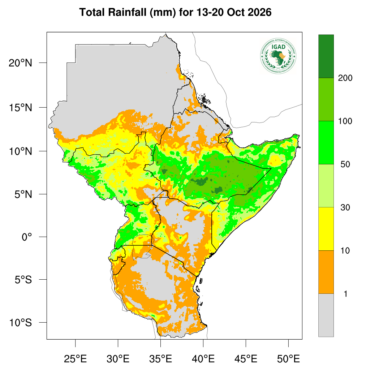 Weather Forecasts13 October 2026Rain and Rising Temperatures Forecast Across the Greater Horn of Africa
 Climate9 October 2026Beyond Negotiations: Africa Expects Concrete Outcomes from Antalya


