
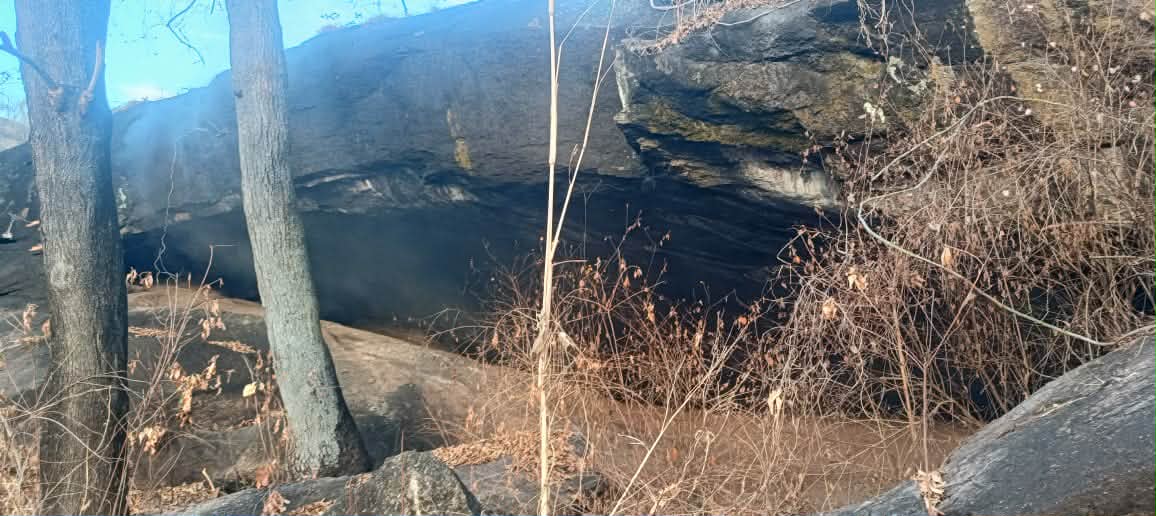
Authorities in Torit County, Eastern Equatoria State in South Sudan, have advised residents living near Obwarak Mountain in Himodonge Payam to evacuate after reports of smoke, fire, and a strong odor emerging from the mountain.
The unusual activity was first observed by residents on Tuesday, February 17, 2026, who reported thick smoke and flames rising from a rocky cave on the mountain, accompanied by a foul smell that affected the surrounding environment.
Following the alert, Torit County Commissioner Lokang Charles traveled to Otese Boma in Himodonge on Sunday, 02/22/2026, to assess the situation.
“I visited the site after the community reported the incident through their chief. I saw smoke coming out of the rock with fire and a strong smell. The mountain is called Obwarak,” the commissioner said.
Recurring phenomenon raises concern
Local authorities and community leaders said it is not the first time mysterious smoke has been seen oozing from Obwarak Mountain. Similar incidents were reported in 1972 and 1981.
Otese Boma Chief Mathew Ohide Taudesio said community members witnessed similar mysterious events from the mountain.
“Smoke, fire, and light were seen coming from the cave of the mountain. This happened in 1972, again in 1981, and now in 2026,” he said.
Some residents said in the past, the mountain discharged water across the ground and killed fish and birds in nearby areas.

Evacuation and precautionary measures
Commissioner Lokang has called on the residents of Otese Boma to move to safer areas as meteorological experts assess the situation.
“I have informed the community living near the site to evacuate and keep a safe distance. We are notifying the national government and partners so environmental and geological experts can conduct an assessment,” he said.
Authorities warned that continued exposure to smoke and toxic gases could pose risks to people, livestock, and farmland. Many residents cultivate crops and harvest bamboo near the mountain, increasing their vulnerability.
The authorities have warned residents to avoid approaching Obwarak Mountain or its cave, asking them to keep children and livestock away from the site.
The state or the national government is yet to dispatch geological experts to determine whether the phenomenon is volcanic, geothermal, or another natural process.
Expert insights and potential risks
The President of the Geological Society of South Sudan, Ajak John Ateng, has said geologists cannot rule out volcanic risks in South Sudan, particularly in Eastern Equatoria State.
“As geologists, we do not speak on issues that have not been confirmed. We provide advisory services to the government on geohazards, and volcanic activity is one of the issues we have highlighted,” Ateng said.
He said South Sudan’s geological setting makes parts of the country potentially vulnerable to volcanic activity.
“South Sudan lies at the intersection of major geological faults. The Rift Valley system, which extends from Kenya through Ethiopia, has structural links that could, in the future, affect areas of Eastern Equatoria,” he noted.
According to Ateng, recent reports of mysterious discharge from a mountain in Eastern Equatoria cannot be dismissed without a thorough scientific assessment.
“As experts, we provide informed insights after conducting field investigations, tests, and analyses to understand what has actually occurred,” he said.
He also linked environmental disruptions in the state to extensive mining activities.
“Eastern Equatoria has significant mining activity, which is causing environmental degradation. Many artisanal miners use substances and methods that disturb mountains and hills, contributing to instability in these areas,” Ateng explained.

The Geological Society has urged the public to avoid settling near mountainous zones, especially in areas suspected of volcanic or geological hazards.
“Living around mountains is not advisable. If communities are located in areas suspected of volcanic risk, immediate evacuation should be undertaken. This requires coordinated action from both the government and affected residents,” he cautioned.
Understanding volcanic activity
Geological experts say volcanic eruptions happen when molten rock, gases, and heat from deep inside the Earth rise toward the surface through cracks or weak zones in the crust.
Beneath the ground, extreme heat melts rock into magma.
As pressure builds, gases trapped in the magma expand, forcing the material upward. When this pressure becomes too strong, it escapes through vents, fissures, or caves—sometimes producing smoke, steam, fire-like glow, or ash emissions.
Early signs that can precede eruptions include smoke or steam emerging from rocks or ground openings, strong sulfur or burning odors, heat or glowing areas on rocks, small ground cracks or tremors, and changes in nearby water or vegetation.
However, experts caution that not all smoke or heat from mountains indicates a true volcanic eruption. Some events are caused by underground gas release, burning minerals, or geothermal activity. Scientific assessment is required to confirm the cause.
Authorities say further updates will be issued once geological investigations are completed. Communities are urged to remain calm but vigilant and to follow official safety instructions.

