

Air pollution represents a profound and preventable public health crisis, yet solutions are often addressed with insufficient urgency. New findings reveal a staggering global injustice: children in the world’s poorest countries face air pollution death rates that are 94 times higher than those in developed countries.
“Children in the world’s poorest countries face air pollution death rates 94 times higher than those in the wealthiest nations,” highlights Joanne Bentley-McKune, lead researcher for a new briefing by Zero Carbon Analytics.
This disparity evidences the deadly toll on children’s health worldwide, a burden that is particularly severe in developing countries. “This isn’t just an environmental issue, it’s a fundamental question of justice, where the youngest and most vulnerable bear the burden of systems they didn’t create,” said Joanne.
The human cost of this crisis is catastrophic, as studies and reports reveal that in 2021, more than 700,000 deaths in children under five were linked to air pollution, representing 15% of all global deaths in that age group.
The briefing, titled “Structural dependencies perpetuate disproportionate childhood health burden from air pollution,” makes it clear that children under five die from air pollution at greater rates than adults.
“Breaking this cycle requires international climate finance and support for clean energy transitions, not the continued subsidization of fossil fuels,” said Joanne.
Why Children Are Most Vulnerable
Children are uniquely susceptible to the harms of air pollution for physiological reasons. One of the main reasons being that their immune systems are still developing, hence they have a higher breathing rate relative to their body size.
Furthermore, children typically breathe through their mouths, which does not filter air as effectively as nasal breathing which is proven to cause more harm for them in turn.
This vulnerability leads to lifelong harm for those who survive. Air pollution is a known cause of chronic and cardiovascular diseases, respiratory illnesses, impaired cognitive performance, and cancer.
According to the State of Global Air 2024 report, air pollution accounted for 8.1 million deaths globally in 2021, making it the second leading risk factor for death overall with over 15% being children under five, thus an acute impact.
Dr. Zainab Yaro, a Pediatrician at the Dr Mims Clinic and Wellness in Nigeria, speaks to the urgency for clean air. She notes that while pediatricians constantly advocate for vaccines, “I believe that clean air is one of the most powerful vaccines we can give a child.”
A Closer Look: Four Country Case Studies
The Zero Carbon Analytics briefing delves into four key case studies, Nigeria, Bangladesh, Brazil, and South Africa, to explore the causes of air pollution and identify context-specific solutions.
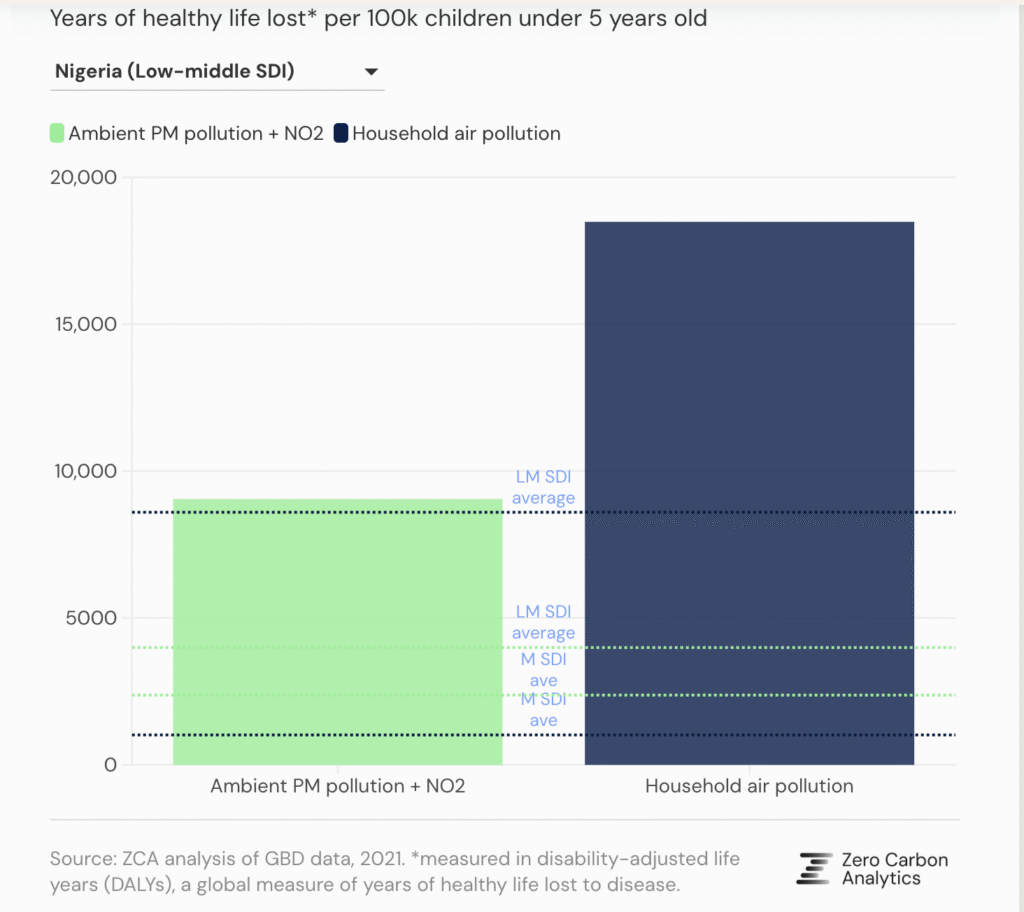
- Nigeria: Here, the health burden is immense, with over 300 deaths per 100,000 children. This is driven mostly by household air pollution from solid-fuel cooking. In 2021, more than 114,000 children under five died from air pollution-related causes, approximately one child every five minutes.
- Bangladesh: Children are also heavily affected, with 133 deaths per 100,000 children. More than 19,000 children under five died in 2021, or two children every hour, predominantly from household sources. Dr. Sajid Hossain Khan, a Medical Officer in Bangladesh, states, “We know that exposure to air pollution contributes to respiratory diseases and more. Clean air is as essential as clean water.”
- Brazil: In 2021, almost 1,600 children under five died from air pollution, nearly four per day. Outdoor air pollution, including from wildfires and biomass burning, is a major contributor. During the particularly bad wildfire season of 2024, hospitalizations for respiratory illnesses rose 27.6% across Brazil compared with 2023.
- South Africa: There were over 68 deaths per 100,000 children in 2021, a rate of nine children under five per day, with most deaths linked to outdoor air pollution exposure.
The Path Forward: Context-Specific Solutions
The research reveals that the solution is not one-size-fits-all but must target the specific structural dependencies in each region.
- In Nigeria and Bangladesh, reducing exposure to household air pollution by adopting cleaner cooking stoves and better ventilation is essential. These actions could save tens of thousands of young lives annually.
- For Brazil and South Africa, the focus must be on addressing outdoor pollution. In Brazil, this means tackling agricultural burning and wildfires.
- In South Africa, a ‘just transition’ away from coal is not only an environmental imperative but also an economic opportunity to reduce health costs and improve outcomes for future generations.
The experts are united in their call for immediate action. Joanne McKune emphasized that over a quarter of all deaths in children under five globally are linked to air pollution. “This is a preventable public health crisis driven by our continued dependence on fossil and other polluting fuels,” she added, “and it demands immediate action.”
Author Profile

-
Seeker.
Inspire AFRIKA.
Latest entries
 Climate9 October 2026Beyond Negotiations: Africa Expects Concrete Outcomes from Antalya
 Animals7 October 2026In Kajiado’s Drylands, Collective Selling of Small Herds Is Changing the Livestock Trade
 Oceans6 October 202640 Years of Ocean Cooperation: The Western Indian Ocean’s Next Test Is Implementation
 Adaptation5 October 2026Africa Is Financing Its Own Survival as Climate Adaptation Money Falls Short


