
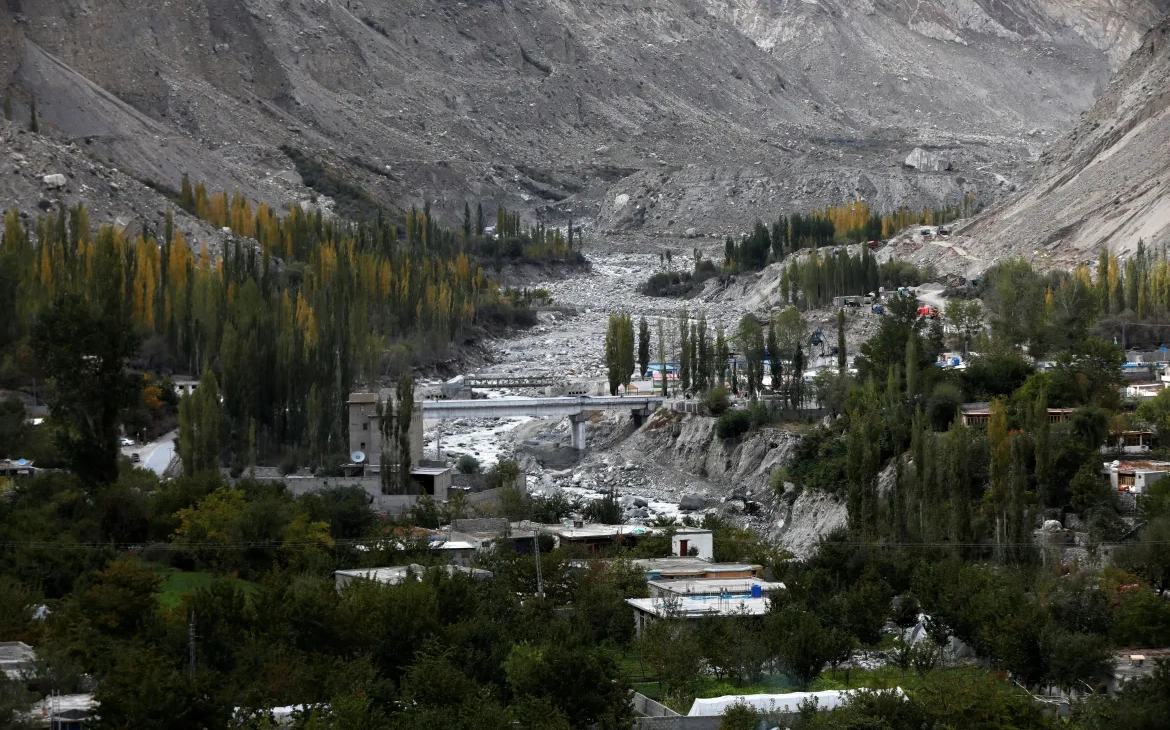
Since late June, 111 people have died following a spell of torrential monsoon rain and flash floods in Pakistan. The country, which is ranked number one in 2025 as the most climate-impacted, is facing an unprecedented heatwave in its mountainous regions of Gilgit-Baltistan. These regions are home to over 7,200 glaciers, many of which are melting in a spate of climate-fueled disasters.
Temperatures have risen as high as 48.5°C (119.3°F), which local officials described as unprecedented in a region that is more than 1,200 metres above sea level and famous for its snow-capped mountains. The previous record was 47 degrees, set in 1971.
“It is like hell,” said Tariq Ali, a resident of Gilgit. “We are only seeing heatwaves, and are witnessing very serious ice-melting. I have never witnessed such summer conditions in Gilgit.”
These extreme conditions have led to the swelling of the local rivers and the formation of unstable lakes that have burst, triggering flash floods and landslides that have washed away villages and roads, cutting off some communities entirely and leaving others without power or drinking water.
According to the United Nations Environment Programme (UNEP), the number of glacial lakes in Pakistan has increased by 40% over the past two decades due to climate change. These lakes are increasingly prone to sudden collapse, putting downstream communities at constant risk.
Pakistan’s vulnerability to such climate-driven disasters became evident during the catastrophic 2022 floods, described as “one of the worst in the country’s history.” Over 1,700people lost their lives, and more than 33 million were affected.
The World Meteorological Organization (WMO) noted that Pakistan experienced over three times its normal rainfall during that monsoon season.
Recent observations from the Intergovernmental Panel on Climate Change (IPCC) indicate that South Asia’s high-mountain regions are warming at nearly double the global average, which accelerates ice loss and disrupts regional hydrology.
The panel warns that continued emissions and warming will result in “unprecedented and irreversible changes” to glacial systems, increasing both the frequency and intensity of Glacial Lake Outburst Floods.
Author Profile

- How can we learn if we don't question?
Latest entries
 Opinion & Analysis8 October 2026Why Africa Must Look to What Already Exists in Its Blue Economy
 Agriculture5 October 2026The Search for a Smarter Way to Feed Crops
 Events30 September 2026The Goat, the Market and the Dryland: Heifer International’s Push for Livestock Resilience
 Agriculture30 September 2026Digital Tools for Export-Ready Farming in Kenya


