
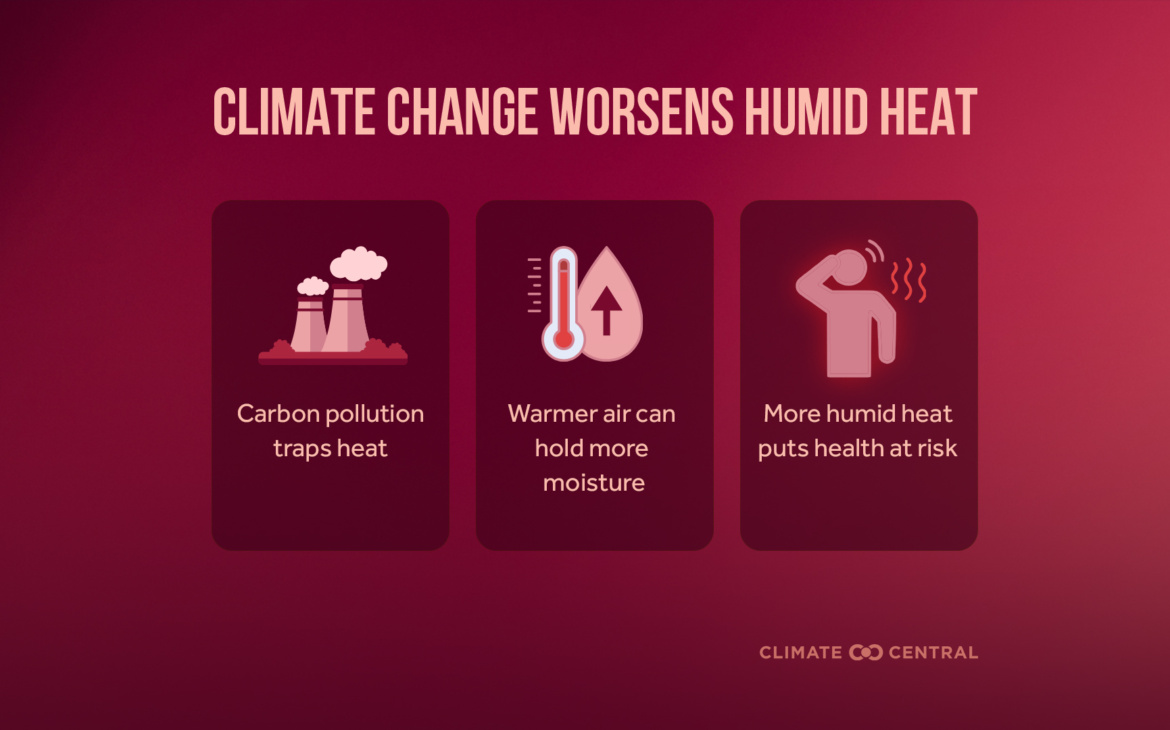
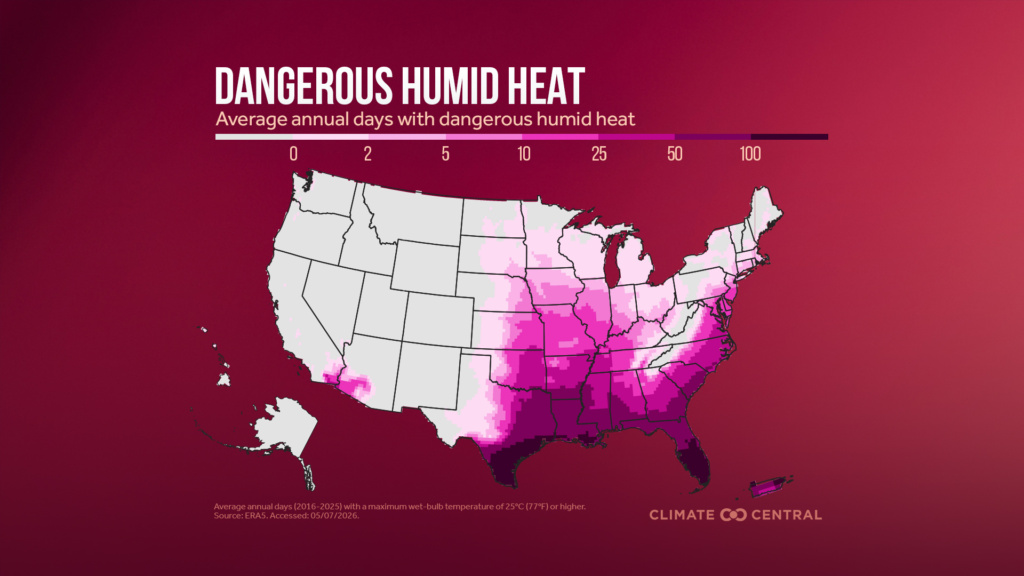
On an afternoon of humid heat in Houston, fans at a World Cup match collapsed in the stands for a reason: players are forced to undertake hydration breaks. The temperature was not extraordinary for summer. The air its apparent, has become a trap.
Heat and moisture had combined to overwhelm the body’s only real defense against overheating: sweat. It could not evaporate. And so people fell. This is no longer a freak occurrence. It is July. It is becoming normal.
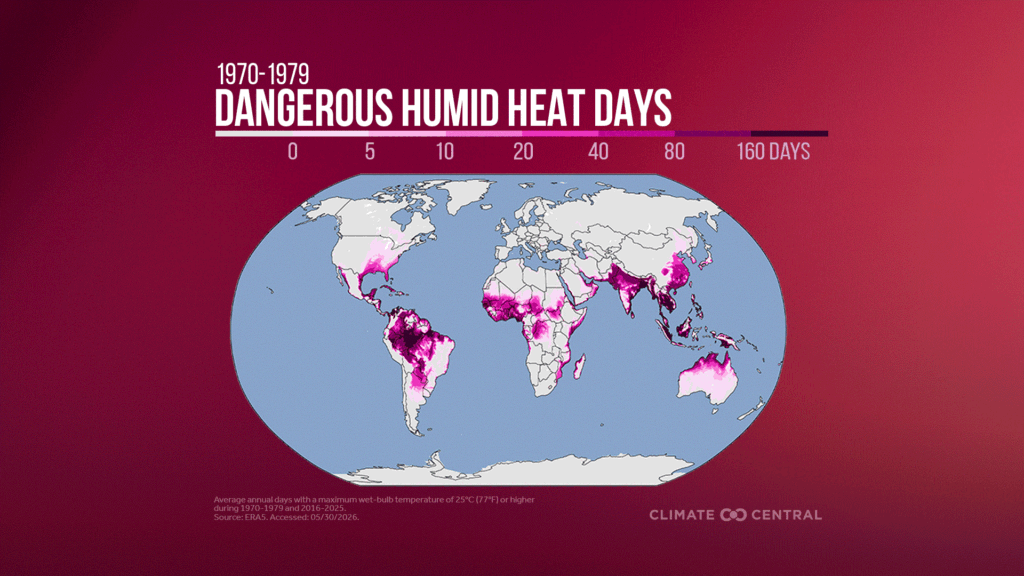
A sweeping new analysis from Climate Central has put hard numbers to what millions of people are already feeling: dangerous humid heat days have more than doubled worldwide since the 1970s, climbing from an average of 10 days per year to 23.
The force behind that shift is not natural variability, not El Niño, not bad luck. Human-caused climate change now drives nearly two-thirds of all dangerous humid heat days worldwide. What began as a climate crisis is fast becoming a public health emergency.
Why Humid Heat Is the Hidden Killer
Temperature alone can deceive. A day at 30°C feels tolerable under dry skies. The same temperature at 85 percent humidity becomes suffocating. That difference in humid heat is not about comfort but about survival.
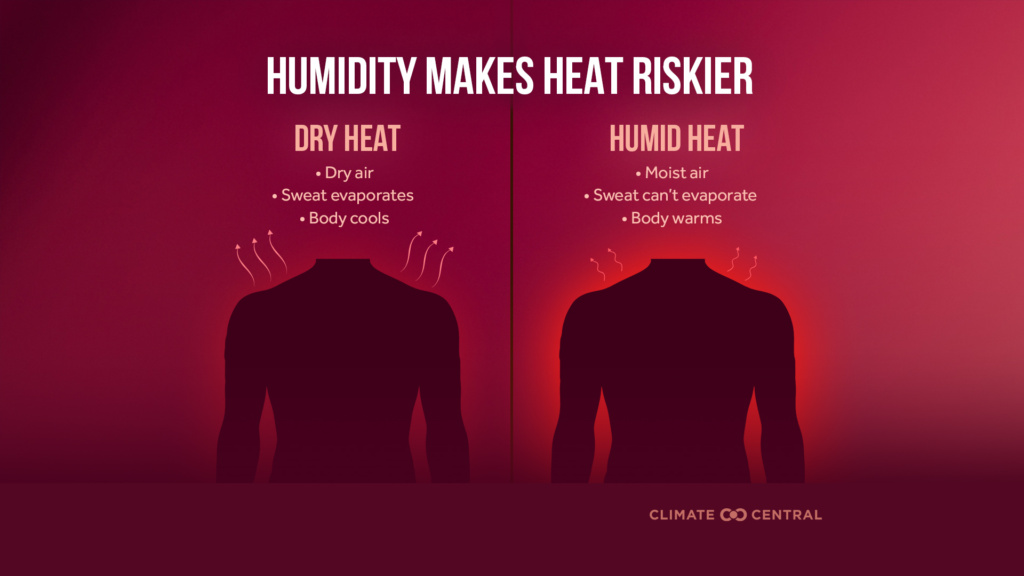
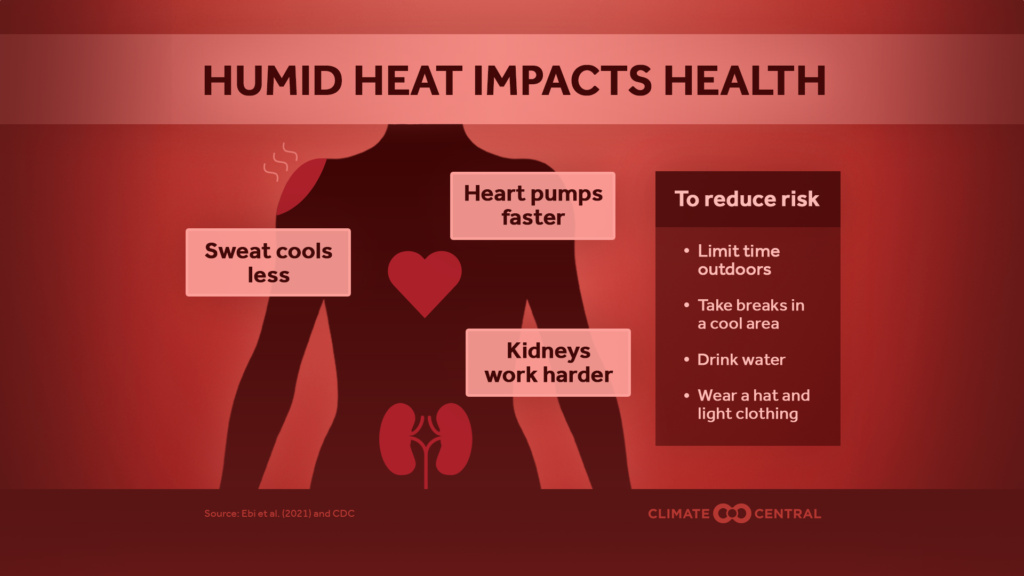
The human body cools itself through sweat. Perspiration evaporates off the skin, drawing heat away from the body’s core. When the air is already saturated with moisture, that evaporation stops. Heat builds internally. The heart works harder. The kidneys strain. In the worst cases, the brain begins to experience severe heat stress.
Scientists measure this combined threat using wet-bulb temperature, a reading that captures both heat and humidity to assess physiological stress on the body.
The Climate Central analysis defines a wet-bulb temperature of 25°C (77°F) or above as dangerous, a threshold at which many people face an elevated risk of heat illness. Above 35°C wet-bulb, the body cannot survive more than a few hours, regardless of fitness or health.
That upper limit is not hypothetical. The historic maximum humid heat record of 34.64°C wet-bulb could occur roughly 120 times more often at 2°C of global warming than at 1°C, and an almost incomprehensible 6,900 times more often if warming reaches 4°C.
The Numbers Behind the Suffering
The scale of change since the 1970s is stark. Climate change is now driving more dangerous humid heat days in 69 percent of the 961 global cities analyzed, an average of 46 additional days per year over the last decade. Globally, climate change is now responsible for six times as many dangerous humid heat days each year as in the 1970s.
In 2025 alone, of the 23 dangerous humid heat days recorded globally, 19 of them, 83 percent, were directly attributable to climate change. Without fossil fuel emissions, most of those days would not have existed.
“Dangerous humid heat has gone from being an uncommon event to a defining feature of daily life in some regions,” said Kaitlyn Trudeau, an applied climate scientist at Climate Central, “pushing conditions closer to the limits of what the human body can safely endure.”
The human cost is immense. Extreme heat has killed more than a quarter of a million people globally since 2000, making it the deadliest form of extreme weather, more lethal than hurricanes, floods, or tornadoes.
That figure is almost certainly a vast undercount. Nine in ten heat deaths go unrecorded, attributed instead to heart attacks, kidney failure, or respiratory collapse, their true cause never officially named.
“Humidity can turn a hot day into a dangerous one by limiting our ability to cool down through sweating. Climate change is causing more dangerous humid heat, and Climate Central’s new tool makes this often-overlooked hazard visible,” added Kaitlyn Trudeau.
Africa on the Frontline
The crisis of humid heat impacts is not distributed evenly. Nowhere is that more apparent than in Africa. The Climate Central analysis reveals a striking concentration of vulnerability across the continent.
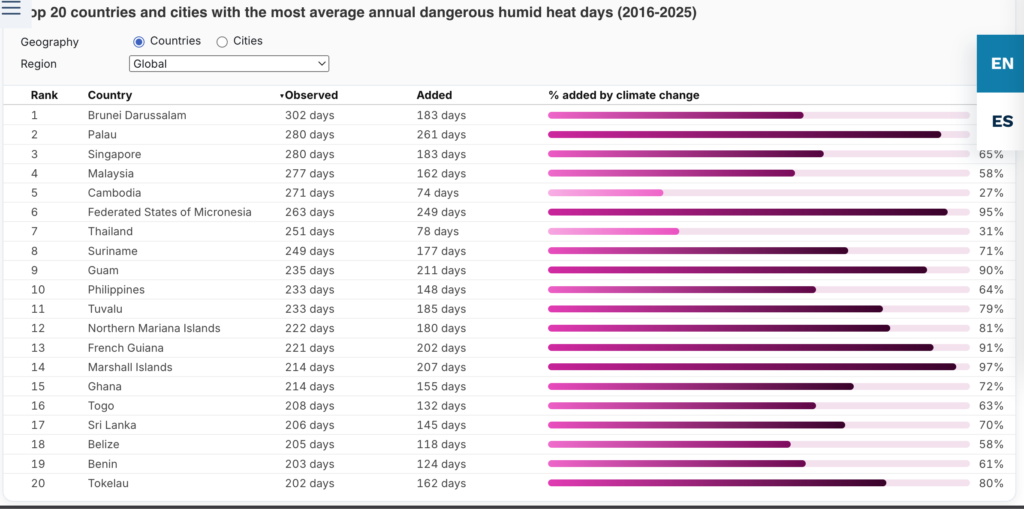
Ten African cities rank among the top 50 globally for the highest average annual dangerous humid heat days. Three West African nations, Ghana, Togo, and Benin, sit within the world’s 20 most exposed countries, ranking 15th, 16th, and 18th, respectively, over the last decade.
What makes these figures particularly troubling is how much of that danger is man-made. Climate change contributed to 72 percent of Ghana’s dangerous humid heat days, 63 percent in Togo, and 61 percent in Benin.
These are countries that have contributed a tiny fraction of the cumulative emissions driving global warming, yet they are absorbing some of its most brutal consequences, in regions where outdoor labour is unavoidable, access to cooling is limited, and health systems are already stretched.
A Crisis That Accelerates
One of the most unsettling features of this heat is that it does not scale linearly. It accelerates. What was once a 1-in-1,000-year heatwave between 1951 and 2019 had become a 1-in-100-year event by 2020. By the mid-2020s, that same event is expected to occur roughly once every 40 years.
Worse still, maximum temperatures do not creep upward gradually. Records can hold for decades, then shatter by several degrees in a single event. Communities cannot prepare incrementally for a danger that arrives in sudden, record-breaking leaps.
The burden does not fall equally. Older adults, young children, pregnant people, those with underlying conditions, and those without access to cooling face disproportionately greater risk. Heat deaths among people over 65 rose 85 percent between the early 2000s and the late 2010s.
Agricultural workers in Central America have died by the tens of thousands from chronic kidney disease, now linked directly to occupational heat stress. In the United States alone, heat-related work accidents number as many as 170,000 every year.
The harm reaches beyond mortality. Heatwaves are linked to increased rates of miscarriage and lasting developmental effects on children exposed to extreme heat in the womb.
Hot nights, which have risen even faster than daytime temperatures, chip away at sleep, suppress the immune system, and impair cardiovascular and cognitive function. Long-term exposure to chronic heat has been shown to accelerate cellular aging at rates comparable to heavy drinking or smoking.
Who Is Responsible
Climate Central’s analysis traces dangerous humid heat days back to their source: the burning of fossil fuels. The 180 largest fossil fuel companies have each individually produced enough emissions to cause multiple heatwaves that would have been statistically near-impossible without human interference.
The Carbon Majors, 78 of the largest oil, gas, coal, and cement producers, could be responsible for emissions that cause 11.5 million heat deaths this century.
In a single early summer heatwave in Europe in 2025, roughly 1,500 of the 2,300 estimated deaths were directly attributable to climate change. The fossil fuel economy tripled the death toll of that one event.
“As a pediatrician, these numbers are a wake-up call,” said Dr. Lisa Patel of Stanford Children’s Health.
“We’re already seeing the consequences play out in real time. Fans are fainting at World Cup matches in cities like Houston, and that’s not a coincidence. This kind of data is exactly the tool clinicians and public health officials need to anticipate where heat-related illness will strike and who is most at risk, before people end up in the ER.”
If warming reaches 2°C, projected to occur within roughly 25 years, 41 percent of the world’s population will face heat that scientists classify as extreme. That is nearly 4 billion people, up from 1.54 billion in 2010.
In Berlin, Germany, authorities turned water cannons on residents in the streets to keep them alive. In Houston, fans fell in the stands. In Accra and Cotonou, the heat simply settled in and stayed.
The body knows how to cool itself. For most of human history, that was enough. The world we are building may no longer allow it.
Author Profile

-
Seeker.
Inspire AFRIKA.
Latest entries
 Corporate15 October 2026Water, Sanitation and Digital Learning at the Centre of Garissa School Upgrade
 Agriculture14 October 2026Africa’s Food Systems Future Depends on Listening to Farmers
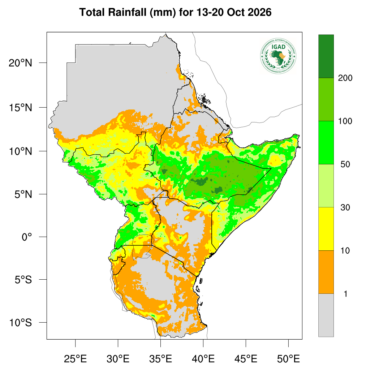 Weather Forecasts13 October 2026Rain and Rising Temperatures Forecast Across the Greater Horn of Africa
 Climate9 October 2026Beyond Negotiations: Africa Expects Concrete Outcomes from Antalya


