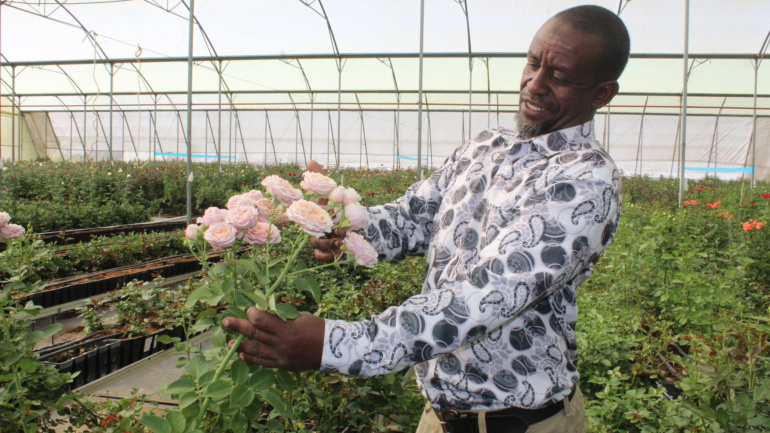
How an irrigation debate in Kigali put water investment, and a $30-billion-a-year gap, at the centre of Africa’s food security conversation
Less than 5% of Africa’s cultivated land is irrigated. The figure framed a discussion in Kigali, Rwanda during the Africa Food Systems Forum 2026 (AFSF 2026), where ministers, bankers, scientists and entrepreneurs gathered to confront one of the continent’s most persistent food-security challenges: how to get water, and the investment needed to deliver it, onto farms.
“Water is crucial in making other agricultural investments deliver,” said Olufunke Cofie of the International Water Management Institute (IWMI), who co-moderated the session with IFPRI’s Claudia Ringler.
Without reliable water, she said, farmers and entire economies remain exposed to erratic rainfall, drought and floods. They are also locked out of opportunities for dry-season production, improved storage and markets, and the production of nutrient-dense crops that can improve diets rather than increase yields.
The scale of the opportunity is substantial. IWMI estimates that about 33 million hectares across Africa could be suitable for farmer-led groundwater irrigation, with another 6 million hectares suited to surface-water systems.
However, that potential cannot be unlocked simply by putting irrigation infrastructure on every hectare. Cofie stressed that decisions must account for actual basin and aquifer conditions, competing water demands and the sustainability of groundwater and surface-water resources.

Abundance, Not Scarcity
If there was a rallying line from the session, it came from Nigeria’s Minister of Agriculture and Food Security, Senator Abubakar Kyari, who described Africa as a continent of “strategic abundance, not scarcity.”
IWMI Director General Mark Smith offered a similar reframe from a water perspective: “Water is an enabler and an unlock for food systems, not a constraint to work around.”
Turning that abundance into food on the table, however, means confronting a stubborn set of blockages.
Decades of under-investment have left Africa facing an irrigation financing gap running into tens of billions of dollars. Agriculture is still treated by many financiers as a risk to avoid rather than an opportunity to back, with only about 2% of bank lending going to a sector that employs roughly half of the continent’s workforce.
Water and agricultural policies also remain fragmented in many countries, while infrastructure is too often designed around short project cycles instead of being treated as a long-term national asset. At the same time, climate variability is putting increasing pressure on the rain-fed systems on which most African farmers still depend.
Kyari’s framework called for water infrastructure to be treated as a permanent national asset rather than a project tied to a five-year funding cycle. It also called for concessional and innovative financing, stronger transboundary cooperation and wider adoption of climate-smart irrigation technologies such as solar pumps and drip systems.

At the centre of the framework is the farmer, with Water User Associations, women and young people expected to have a greater role in managing irrigation systems. Accountability, Kyari said, should ultimately be measured not by commitments made, but by hectares irrigated, yields improved, and livelihoods changed.
That emphasis on delivery was reflected in Rwanda itself.
Innocent Musabyimana of the African Development Bank cited the Muvumba Multipurpose Water Resources Development Program, where the Bank recently approved an additional €45.4 million for a climate-resilient irrigation system covering 3,073 hectares in the country’s drought-prone Eastern Province.
The project offered a tangible example of what the broader discussion was calling for: turning financing commitments into irrigation infrastructure that can change how farmers produce and manage climate risk.
The discussion also connected Kigali to a wider global debate over water and food security. Silke Stallkamp of the German Embassy referred to the outcome of January’s Global Forum for Food and Agriculture in Berlin, where agriculture ministers from 59 countries adopted a communiqué on water and food security under the theme “Water. Harvests. Our Future.”
The message, she said, was that agriculture, the world’s largest consumer of water, needs a stronger voice in global water policy and better, more interoperable data to guide investment and resource management.

Financing the Fix
Financing remained one of the biggest questions.
SunCulture’s Mikayla Czajkowski pointed to emerging mechanisms intended to reduce the risks associated with agricultural lending, including country-led water compacts, programmes such as Africa RISE and Country AgriConnect, carbon markets and blended finance.
The underlying argument was that irrigation should not be viewed simply as an infrastructure expense. Reliable access to water can reduce production risks, allowing farmers to produce more consistently and potentially making agricultural lending more attractive to financial institutions.
Czajkowski also pointed to the use of carbon credits in reducing the cost of irrigation-linked lending, alongside models that bundle water access with finance and advisory services so farmers can adopt technologies that might otherwise remain beyond their reach.
The panel brought together government, development finance and private-sector perspectives, including the World Bank’s Pieter Waalewijn, AGRA’s Tilahun Amede, Kenya’s Irrigation Secretary Vincent Kabuti, AfDB’s Musabyimana and AU-SAFGRAD’s Mure Agbonlahor.

The mix reflected a central message from the session: closing Africa’s irrigation gap will require more than one source of money or one institution. Governments, development banks, private investors and farmers will have to operate within systems that align water governance, agricultural policy and long-term finance.
For all the frameworks and financing instruments, it was Ringler’s plain-spoken warning that distilled the stakes: “If irrigation is not on the table, there will be no food on the table.”
AUDA-NEPAD’s Ildephonse Musafiri put the same urgency in policy terms, saying Africa’s Comprehensive Africa Agriculture Development Programme (CAADP) goals “can’t be achieved without irrigation.”
The Kigali discussion was ultimately less a call for new evidence than for follow-through. The technologies, data and financing mechanisms needed to expand irrigation are already emerging.

The challenge is to build the governance, investment and infrastructure needed to move them from projects and commitments into functioning systems that farmers can rely on.
For a continent seeking to feed a growing population in an increasingly volatile climate, the distance between water on the land and food on the table may increasingly be measured in investment.
Author Profile

-
Seeker.
Inspire AFRIKA.
Latest entries
 Biodiversity23 October 2026Inside Kobe’s Grassroots Effort to Train the Next Generation of Biodiversity Leaders
 Animals23 October 2026As COP17 Meets, World’s Rarest Great Ape Faces a Make-or-Break Test in Indonesia
 Biodiversity22 October 2026One in Five Tropical Biodiversity Sites Overlapped by Mining Concessions, COP17 Report Finds
 Biodiversity21 October 2026COP17 Opens in Armenia with Global Biodiversity Progress Under Scrutiny