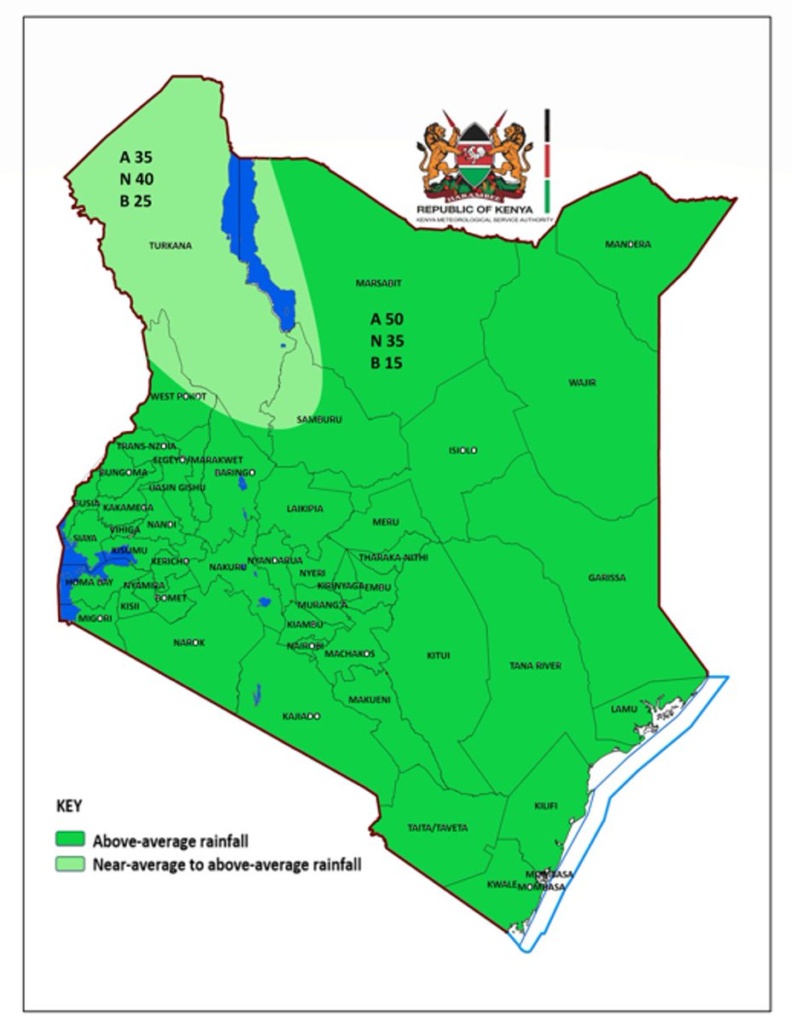
Kenya is expected to experience above-average rainfall across much of the country during the October-November-December (OND) 2026 “short rains” season, according to the Kenya Meteorological Service Authority (KMSA).
The forecast, released following the 13th National Climate Outlook Forum (NCOF13), points to an increasingly wet season as a strengthening El Niño continues to develop over the central and eastern equatorial Pacific.
Above-average rainfall is expected across a large part of the country, including Nairobi, the Coast, parts of the Rift Valley, western Kenya and several eastern and northeastern counties. Turkana, as well as parts of West Pokot, Samburu and Marsabit, are expected to receive near-average to above-average rainfall, although rainfall distribution in these areas is likely to be less favourable.
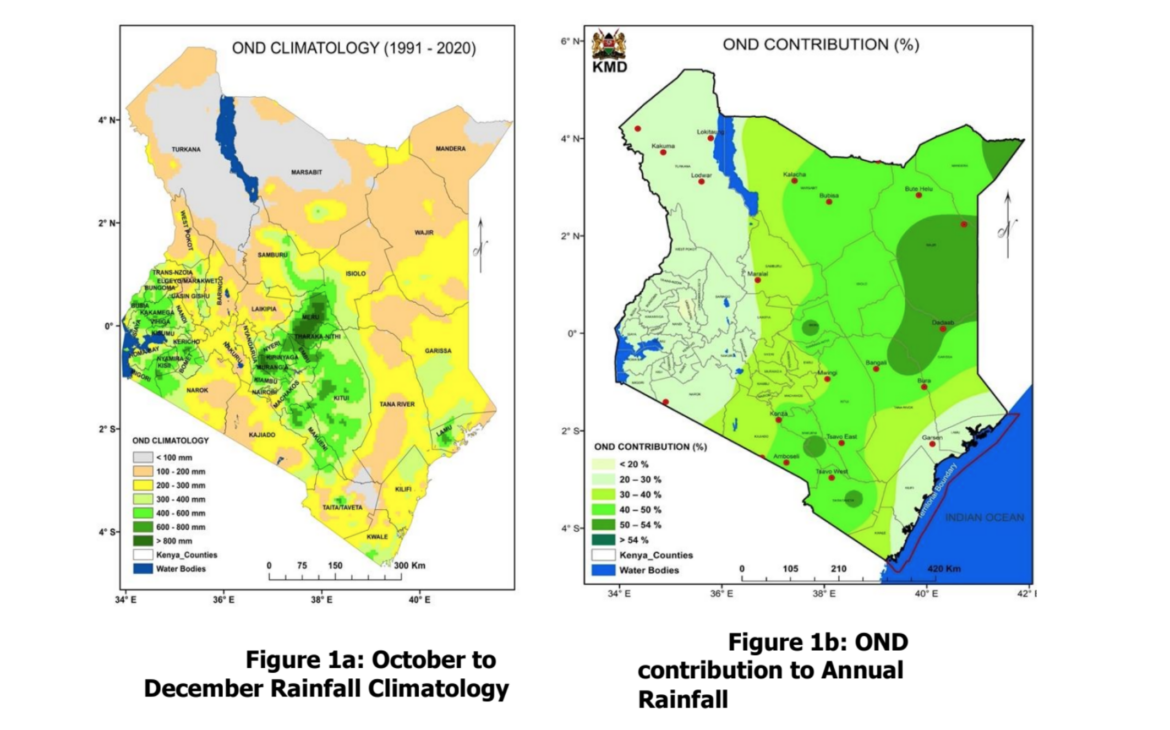
The OND season is particularly important for Kenya’s eastern and northeastern counties, where it can contribute more than 40 per cent of annual rainfall. Some areas can receive more than 700 millimetres during the season.
KMSA expects the rains to be fairly to well distributed across much of the country, although prolonged wet spells and isolated storms are also likely.
The timing of the rains will vary by region. Western counties including Nandi, Kakamega, Vihiga, Bungoma, Siaya and Busia are expected to continue receiving rainfall from September, with rains extending into January.
In the central highlands and Nairobi, including Nyandarua, Nyeri, Kirinyaga, Murang’a, Kiambu, Meru, Embu and Tharaka-Nithi, the onset is expected between the second and third weeks of October, with rainfall continuing into January.
Machakos, Kitui, Makueni, Kajiado, Taita-Taveta and inland parts of Tana River are expected to see the rains begin between the third and fourth weeks of October and continue into January.
Along the Coast, including Mombasa, Kwale, Kilifi and Lamu, the onset is expected between the second and third weeks of October, with the season likely to end during the first or second week of December.
In the northeastern counties of Marsabit, Mandera, Wajir, Garissa and Isiolo, rainfall is expected to begin between the second and third weeks of October and continue into December. Turkana and Samburu are expected to have a shorter season, beginning in the third or fourth week of October and ending in the first week of December.
The rainfall outlook comes as El Niño strengthens. KMSA reports that the Niño 3.4 index reached 2.7°C in the week centred on August 12, 2026, indicating a very strong El Niño event.
The Indian Ocean Dipole (IOD), another important influence on East African rainfall, remains neutral. However, KMSA expects the IOD to strengthen and potentially move into its positive phase from September, although the timing and magnitude remain uncertain.
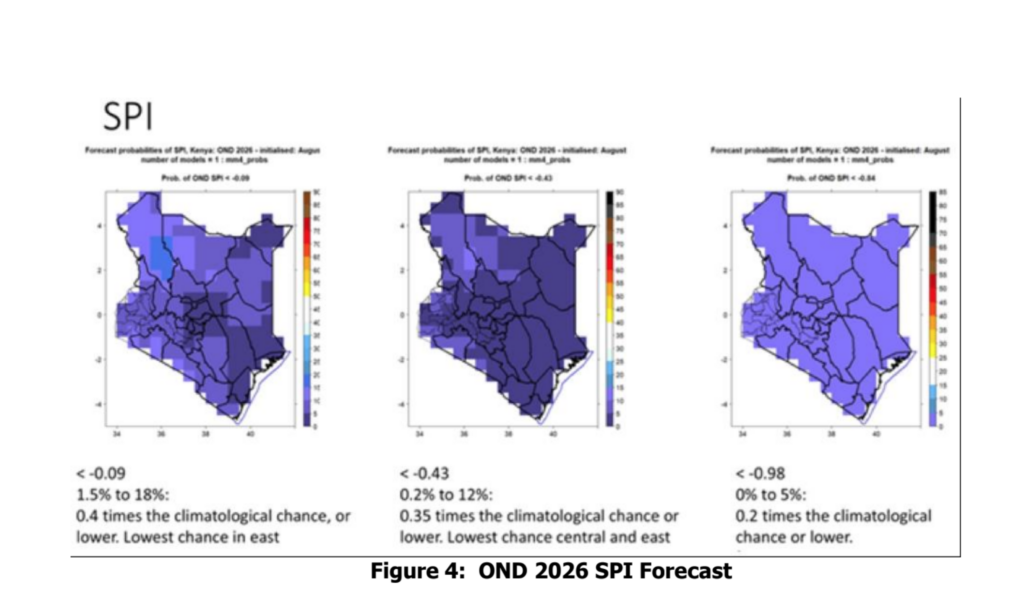
The combination of El Niño and a positive IOD can enhance rainfall over East Africa. However, meteorologists have cautioned that El Niño does not automatically translate into heavy rainfall everywhere, with shorter-term weather systems also influencing rainfall intensity and distribution.
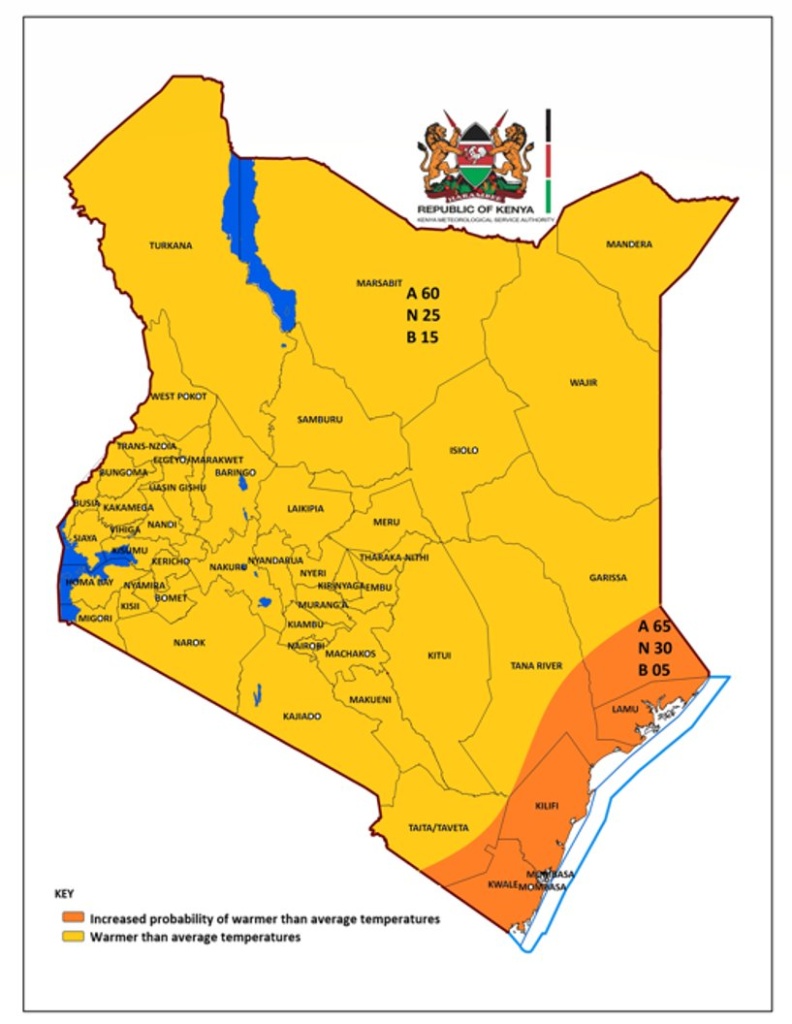
The seasonal outlook also points to warmer-than-average temperatures during OND, with the highest probabilities expected along the Coast and in parts of Tana River, Taita-Taveta and Garissa.
The rainfall could bring benefits to agriculture, pasture regeneration and water resources, particularly in areas that have experienced dry conditions. At the same time, prolonged wet spells and intense storms could increase the risk of flooding, landslides, infrastructure damage and displacement.
Kenya’s disaster authorities are therefore planning for a worst-case scenario. The National Disaster Operations Centre has estimated that, under a severe scenario, as many as 1.5 million people could be affected and about 500,000 displaced. These figures represent preparedness planning rather than a prediction of what will occur.
The emphasis from the climate outlook forum was therefore on acting before impacts occur.
“Climate information must be understandable, relevant and actionable,” said Edward Muriuki, Director of the Kenya Meteorological Service Authority.
Principal Secretary for Environment and Climate Change Festus Ng’eno similarly called for forecasts to guide early decisions across sectors, noting that preparation before disasters occur is more effective and less costly than responding after impacts have already been felt.
For farmers, pastoralists, fishing communities and urban residents, the seasonal outlook is therefore an early planning tool rather than a guarantee of specific weather conditions.
KMSA says the forecast will be updated through weekly and monthly forecasts as the season approaches. These shorter-term updates will be important because weather systems such as the Madden-Julian Oscillation and tropical cyclones can influence rainfall intensity at shorter timescales.
For Kenya, the message from the 2026 OND outlook is clear: more rain is expected across much of the country, but where, when and how intensely it falls will determine whether the season becomes an opportunity or a hazard.