

The natural light-dark cycles are important in the diverse aspects from one species to another, yet our advancements in electricity and lighting have interrupted the natural design. This reality is often unthought of, leaving a perspective unvisited and unexplored as we seek more security at the expense of other natural phenomena, like birds, for example.
While advancements in technology have simplified human life, they often come with a cost to the environment, and for light pollution, the case study we look at is birds. As said by Sacha Vignieri, Science Editorial team, the light pollution causes disruptions to light–dark cues that organisms use as timetables.
An idea that would take us time trying to understand, yet a reality given their world, which is, in most instances, unconsidered by human development and daily activities. It’s now becoming clearer how the increased use of Artificial Light at Night (ALAN) has led to a steep rise in global light pollution, creating a significant threat to flora, fauna, and humans alike.
This growing problem is difficult to track since from 2012 to 2016, Earth’s artificially lit outdoor area grew by 2.2% per year, with a total radiance growth of 1.8% per year. Recent statistics reveal that a staggering 80% of the global population lives under light-polluted skies, with urban areas facing the most severe impact.
As development is embraced in forms of urbanization and the proliferation of artificial lighting, understanding the scope and impact of light pollution has become more vital than ever. Scientists must now work to understand the precise impacts of this pollution. For getting to think of it, birds, which rely on natural light-dark cycles to regulate their behavior, the effects on them must be particularly severe.
Light pollution remains a riddle as some argue that it is a side effect of industrialized civilization, which would make it inevitable. However, it’s also referred to as the human-made alteration of outdoor light levels, which is a poorly understood form of environmental pollution primarily caused by the overuse of artificial light.
Light pollution competes with starlight and moonlight at night, causing skyglow, especially in urban areas. It also interferes with astronomical observatories and, like any other form of pollution, disrupts ecosystems and has adverse health effects.
New research confirms its extensive impact, revealing that artificial light affects the behavior of over 500 avian species.
In addition to this, the pattern can be seen as witnessed by Roger Gorter, the use of ground measurements and satellite data in creating an atlas of a world brightened by artificial lights.
It reveals that the populations of Singapore, Kuwait, and Qatar experience the brightest night skies. Conversely, people living in Chad, the Central African Republic, and Madagascar are least affected by light pollution.
Dr. Christopher Kyba, from the renowned German Max Planck Research Center for Geosciences in Potsdam, shares his thoughts that the artificial light in our environment is coming from a lot of different things.
“Street lights are a really important component, but we also have lights from our windows in our homes and businesses, from the headlights of our cars and illuminated billboards,” he adds.
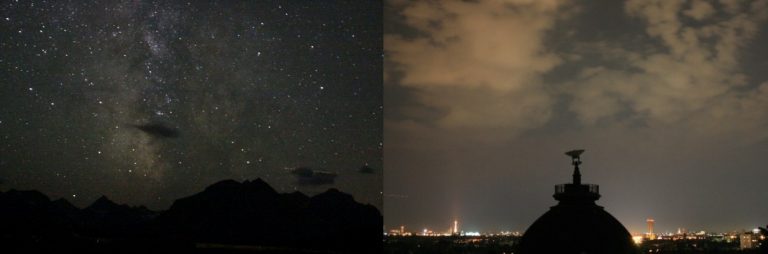
A study by Brent S. Pease, Assistant Professor at Southern Illinois University, and biologist Neil A. Gilbert of Oklahoma State University, demonstrates that bird species are highly integrated to changing light patterns. This alignment affects core behaviors, from breeding to daily activity markers.
“As the study began, we were able to observe in real time which birds were in untouched natural areas,” Pease points out. “This allowed us to identify not only a species’ location but also its 24/7 behavior.”
The researchers analyzed up to 180 million bird vocalizations over a single year, correlating them with global satellite imagery of nighttime light.
Their observations were clear: under the brightest skies, a bird’s day is extended by nearly an hour. Most strikingly, light pollution prolongs the vocal activity of some birds by up to 50 minutes, with the impact varying from one to the other.
The study also revealed that birds with large eyes and those that nest in open areas tend to be the ones most affected. This directly connects us to the possible plights of migratory birds and other diverse species with large ranges who might be immensely impacted by light pollution during their critical breeding seasons.
Author Profile

-
Seeker.
Inspire AFRIKA.
Latest entries
 Agriculture14 October 2026Africa’s Food Systems Future Depends on Listening to Farmers
 Weather Forecasts13 October 2026Rain and Rising Temperatures Forecast Across the Greater Horn of Africa
 Climate9 October 2026Beyond Negotiations: Africa Expects Concrete Outcomes from Antalya
 Animals7 October 2026In Kajiado’s Drylands, Collective Selling of Small Herds Is Changing the Livestock Trade


