Carbon removal has been identified globally as one of the major methods to reduce carbon in the atmosphere and mitigate the ever-worsening climate crisis.
Kenya, in particular, has positioned itself as a pioneer in carbon removal, leveraging its vast geothermal resources in the Great Rift Valley to power direct air capture (DAC) plants that suck CO₂ straight from the atmosphere and lock it underground.
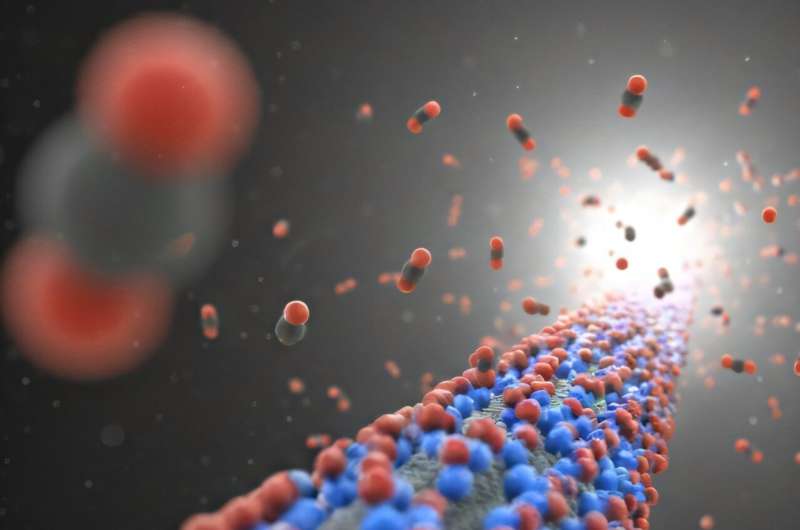
Now, a Japanese research breakthrough offers a game-changing upgrade: “viciazites,” designer carbon materials that release captured CO₂ at temperatures below 60°C, slashing the energy (and cost) barriers that have long held back widespread adoption.
Traditional carbon capture, like aqueous amine scrubbing used in industry, demands massive energy to heat liquids above 100°C just to release the CO₂ and reuse the solution.
This has kept the technology expensive and inefficient at scale. Solid carbon materials, cheap, high-surface-area adsorbents, have shown promise because they can trap CO₂ and release it with far less heat, especially when doped with nitrogen groups.
But until now, those nitrogen atoms were scattered randomly, making it impossible to optimize performance reliably.
The Science
Enter viciazites. Developed by a team at Chiba University in Japan led by Associate Professor Yasuhiro Yamada (Graduate School of Engineering) and Associate Professor Tomonori Ohba (Graduate School of Science), with co-author Kota Kondo, these materials feature nitrogen functional groups deliberately placed next to each other in controlled pairs.
The researchers synthesized three variants, adjacent primary amine (-NH₂) groups, pyrrolic nitrogen, and pyridinic nitrogen, using precise chemical routes starting from compounds like coronene, achieving selectivities as high as 82%.
The team applied the viciazites to activated carbon fibers and verified the exact adjacent positioning with nuclear magnetic resonance spectroscopy, X-ray photoelectron spectroscopy, and computational modeling.
Performance tests were striking: materials with adjacent -NH₂ groups and pyrrolic nitrogen captured significantly more CO₂ than plain carbon fibers, while pyridinic versions showed little gain. Most impressively, the -NH₂ variant released nearly all its captured CO₂ below 60°C.
“Performance evaluation revealed that in carbon materials where NH₂ groups are introduced adjacently, most of the adsorbed CO₂ desorbs at temperatures below 60 °C.
By combining this property with industrial waste heat, it may be possible to achieve efficient CO₂ capture processes with substantially reduced operating costs,” highlights Dr. Yamada.
He adds, “Our motivation is to contribute to the future society and to utilize our recently developed carbon materials with controlled structures. This work provides validated pathways to synthesize designer nitrogen-doped carbon materials, offering the molecular-level control essential for developing next-generation, cost-effective, and advanced CO₂ capture technologies.
Why This Matters for Kenya and Africa
Kenya is already home to Africa’s most ambitious carbon capture projects; many centered on the Rift Valley’s geothermal bounty.
Octavia Carbon, a Kenyan startup and the Global South’s first DAC company, operates Project Hummingbird near Gilgil.

It uses excess geothermal steam, abundant and cheap in a country where geothermal supplies nearly half of the electricity, to power modular DAC units that capture CO₂ and store it permanently in local basalt rock formations.
The company aims to scale to hundreds of tonnes per year by 2026, with plans for much larger deployments.
Climeworks (the Swiss firm behind Iceland’s Mammoth plant) and Great Carbon Valley are also charting large-scale DAC+storage projects in Kenya, drawn by the same geology and renewable energy surplus.
Viciazites align perfectly with this model. Their low desorption temperature means they can run on the low-grade waste heat that geothermal plants already produce in vast quantities—energy that would otherwise go unused.
This could slash operating costs dramatically, making DAC not just feasible but profitable in a developing economy context. Instead of competing for high-value electricity, capture systems could tap “free” heat, accelerating Kenya’s ability to generate high-quality carbon credits for the global market.
Kenya’s policy environment is ready. The country updated its Nationally Determined Contribution (NDC) to cut emissions 32% below business-as-usual by 2030, with carbon markets now regulated under the 2024 Climate Change (Carbon Markets) Regulations.
A new National Carbon Registry tracks projects and initiatives like the Northern Kenya Rangelands Carbon Project (the world’s largest soil carbon effort) and the Kenya Agricultural Carbon Project, which already show how carbon finance can benefit communities.
A New Chapter for African-Led Climate Solutions
For too long, carbon capture has been seen as a rich-nation technology, energy-hungry and capital-intensive. Viciazites flip the script by prioritizing affordability and compatibility with the very resources Africa already possesses: abundant low-grade heat, vast storage geology, and growing carbon-market expertise.
As Dr. Yamada’s team notes, this is a molecular-level design for real-world impact. In Kenya, that impact could mean faster scaling of Octavia Carbon’s pilots, cheaper credits flowing to pastoralist communities, and proof that the Global South isn’t just adapting to climate change, it’s engineering the solutions the world needs.
Read Also: Carbon Credits, A Green Energy Conversation