Nigeria has launched a new Special Agro-Industrial Processing Zone (SAPZ) in Oyo State, marking a major milestone in the country’s efforts to boost agricultural transformation, job creation, and rural industrialization.
The groundbreaking ceremony, held in the Ijaiye community near Ibadan on Saturday, drew national and international dignitaries, including Dr. Akinwumi Adesina, President of the African Development Bank Group, who was making his final official visit to Nigeria in that capacity. Also present were the Governor of Oyo State, Seyi Makinde, and Nigeria’s Minister of Agriculture, Senator Abubakar Kyari.
The Oyo site is the third developed under the national SAPZ program and the first in southwest Nigeria, following earlier launches in Kaduna and Cross River States in April 2025.
According to Dr. Adesina, the move is an illustration that Nigeria can and must be a global powerhouse in agriculture, although there is a need for investments to do that.
He pointed out that there is also a need for industrial platforms that connect primary agricultural production to storage, processing, value addition, and market access. That is what the special agro-industrial processing zones are really about.
The program is financed by the African Development Bank in partnership with the Islamic Development Bank, the International Fund for Agricultural Development, and Nigeria’s federal and state governments. Together, they have committed $538 million to the first phase of the initiative, covering seven states and the Federal Capital Territory.
Covering 3,000 hectares, with 300 hectares designated for immediate development, the Oyo SAPZ is expected to host up to 40 agro-processing industries, create over 100,000 direct and indirect jobs, and benefit more than half a million farmers.
Governor Makinde hailed the launch as a fulfillment of his administration’s promises. He further revealed that the move is a strategic step on the journey of sustainable development, since these hubs will bring producers closer to processors and link farms to markets.
“They reflect our belief that agriculture is not just about food; it is about infrastructure, enterprise, and national relevance. We’re building a future where agriculture nourishes homes and powers industries; where it sustains not just families, but entire economies,” said Governor Makinde.
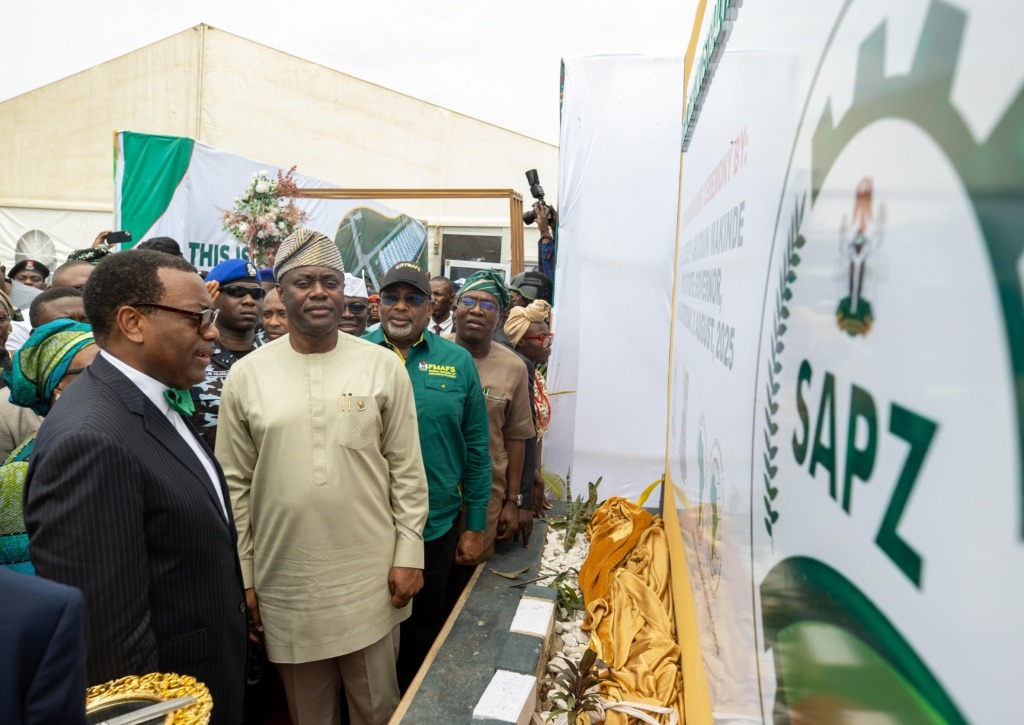
Representing Vice President Kashim Shettima, Agriculture Minister Kyari emphasized the initiative’s alignment with national priorities, emphasizing that it exemplifies the spirit of partnership and shared vision that is vital to our nation’s progress.
“The SAPZ initiative is one of the cornerstones of the Renewed Hope Agenda championed by President Bola Ahmed Tinubu, a vision rooted in restoring Nigeria’s dignity, unlocking our vast potential, and creating opportunities for every citizen,” said Vice President Kashim Shettima, Agriculture Minister Kyari.
Dr. Adesina described SAPZs as transformative platforms essential for unlocking agricultural value chains and lifting millions out of poverty.
“The export of primary commodities is a door to poverty. The export of value-added products is a highway to wealth. It doesn’t matter whether you have cocoa, coffee, or grains; if you’re not adding value, it will impoverish you. What we’re doing here is unlocking that value,” he said.
“Our goal is clear: to reduce massive post-harvest losses, improve logistics, strengthen links between farm production, processing, and value addition, and transform rural economies through job creation.”
He identified three pillars critical to the zones’ success: political will, resource mobilization, and strategic partnerships. “What we are witnessing today would not have happened without intense collaboration,” he added.
Reflecting on his 10-year tenure at the Bank’s helm, Adesina highlighted milestones such as its capital expansion from $93 billion in 2015 to $318 billion in 2024, and its recognition as the most transparent sovereign portfolio among multilateral development banks, twice in a row.
The Special Agro-Industrial Processing Zone initiative is a flagship of the Bank’s Feed Africa strategy, launched by Adesina in 2015. The zones are currently being developed in 28 sites across 11 African countries, with Nigeria’s program being the largest.
The local community expressed optimism about the project’s potential. David Olatunji, chairperson of the Ijaiye Farm Settlers Association, called the groundbreaking a “memorable opportunity” for the state. “We have a lot of unbroken forests around us, and the farmers are ready to work!” he declared.
Dr. Adebowale Adeyeye, an agripreneur specializing in soybean and cashew processing, echoed that sentiment: “The SAPZ project in Ijaiye is a strategic boost for businesses like ours. With targeted government support in areas like power, road access, and security, it creates the enabling environment we need to scale operations, reduce costs, and attract long-term investment.”
Dr. Kabir Yusuf, National Coordinator of Special Agro-Industrial Processing Zone Nigeria, announced plans to expand the program to an additional 10 states beginning September 2025. This second phase will extend the initiative to the remaining states across the country.
Dr. Adesina was joined by senior Bank officials, including Nigeria Country Director Dr. Abdul Kamara; Senior Special Adviser on Industrialization, Prof. Oyebanji Oyelaran-Oyeyinka; and Agricultural Finance and Rural Development Director, Richard Ofori-Mante.
Author Profile

-
Seeker.
Inspire AFRIKA.
Latest entries
 Biodiversity23 October 2026Inside Kobe’s Grassroots Effort to Train the Next Generation of Biodiversity Leaders
 Animals23 October 2026As COP17 Meets, World’s Rarest Great Ape Faces a Make-or-Break Test in Indonesia
 Biodiversity22 October 2026One in Five Tropical Biodiversity Sites Overlapped by Mining Concessions, COP17 Report Finds
 Biodiversity21 October 2026COP17 Opens in Armenia with Global Biodiversity Progress Under Scrutiny