As global temperatures continue to rise, European cities such as Berlin, Paris, and Madrid are facing a dramatic increase in extreme heat events like heatwaves becoming more severe and intense.
New projections highlight a stark divergence in future heatwave frequency depending on whether the world adheres to the Paris Agreement’s climate goals or continues on its current trajectory.
Without accelerated emissions cuts, major urban centers could experience a doubling or even tripling of heatwave days by 2100, with severe consequences for public health, labor productivity, and social stability.
Escalating Heatwave Risks Under Current Policies
If global emissions remain unchecked, leading to an estimated 2.9°C of warming by century’s end, European cities will endure drastically longer and more intense heatwaves.
Madrid, for example, could experience nearly 57 annual heatwave days by 2100, up from 22 in 2020. This translates to 311 unsafe working hours per year, equivalent to 38 full workdays lost to hazardous outdoor conditions.
Similarly, Berlin may see heatwave days more than double to 48, while Paris could face 41 extreme heat days annually, a sharp rise from current levels.
These projections underscore the tangible human and economic costs of inaction. Prolonged heatwaves strain healthcare systems, exacerbate inequality by disproportionately affecting vulnerable populations, and disrupt labor markets, particularly in sectors reliant on outdoor work.
However, the outlook changes significantly if global warming is stabilized near the Paris Agreement’s 1.5°C limit and subsequently reduced to 1.3°C through aggressive emissions cuts. In this scenario, Paris could limit heatwave days to near current levels, while Berlin’s exposure would halve to 24 days by 2100.
Achieving this requires net-zero CO₂ emissions by 2050 and net-zero greenhouse gases by 2070, a challenging but feasible target with rapid decarbonization.

Broader Implications and the Need for Leadership
The urgency of these measures is amplified by the fact that Europe is already grappling with deadly heat at just 1.5°C of warming.
Bill Hare, CEO of Climate Analytics, warns that overshooting this threshold, even temporarily, demands even faster emissions reductions to return to safer levels. Yet recent policy decisions, such as the EU’s diluted 2040 climate target, risk locking in higher warming and greater heat exposure.
Beyond Europe, nearly a quarter of the global population could face lethal heat and humidity at 1.5°C, with risks escalating sharply beyond that threshold. Reliance on artificial cooling is not a sustainable solution, particularly for low-income regions.
The data presents a clear choice: unchecked emissions will transform European summers into prolonged health and economic crises, while decisive action can mitigate the worst impacts.
The window for limiting warming is narrowing, but the tools, renewable energy, urban adaptation, and strengthened climate policies, are available.
European leadership, now more than ever, must realign with 1.5°C pathways to safeguard its citizens from extreme heatwaves and set a precedent for global cooperation. The alternative, a future of unmanageable heat, is a risk no society can afford to take.
Author Profile

-
Seeker.
Inspire AFRIKA.
Latest entries
 Corporate15 October 2026Water, Sanitation and Digital Learning at the Centre of Garissa School Upgrade
 Agriculture14 October 2026Africa’s Food Systems Future Depends on Listening to Farmers
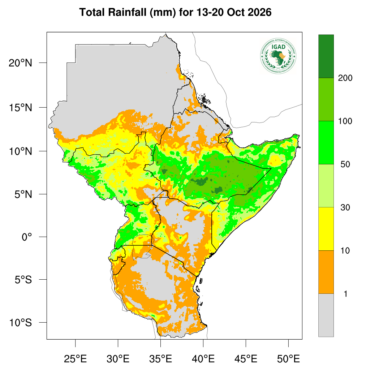 Weather Forecasts13 October 2026Rain and Rising Temperatures Forecast Across the Greater Horn of Africa
 Climate9 October 2026Beyond Negotiations: Africa Expects Concrete Outcomes from Antalya