

As governments prepare to resume negotiations on the International Maritime Organization’s Net-Zero Framework, new research highlights the economic costs of delaying action on emissions from international shipping.
International shipping has cost the global economy an estimated USD 963 billion in climate-related economic damages over three decades, raising fresh questions about the economic arguments against stronger emissions regulations in the maritime sector.
A new study by Zero Carbon Analytics (ZCA) estimates that emissions from international shipping between 1990 and 2020 contributed to economic damages worth USD 962.7 billion worldwide. The findings highlight the growing economic consequences of the sector’s carbon footprint at a time when governments remain divided over the cost of transitioning shipping towards net-zero emissions.
The study comes ahead of renewed negotiations at the International Maritime Organisation (IMO), where member states are expected to resume discussions on the proposed Net-Zero Framework (NZF) from 23 November 2026, with adoption discussions scheduled for December.
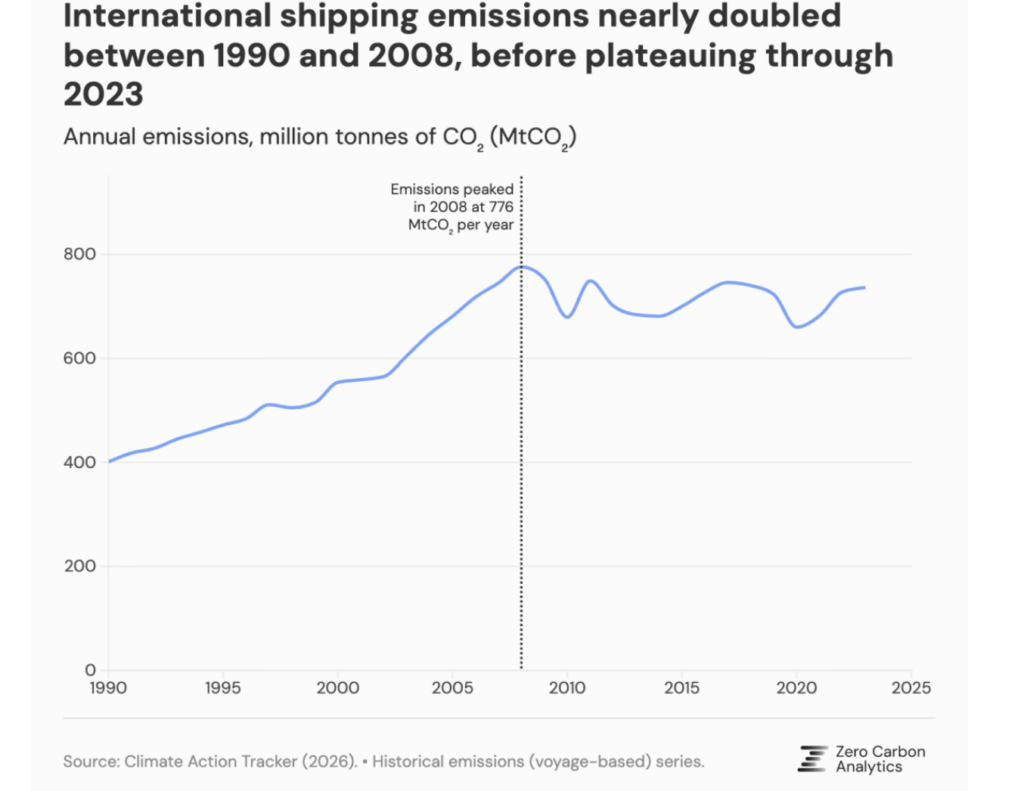
International shipping accounts for approximately 2% of global carbon dioxide emissions. Despite commitments by IMO member states to achieve net-zero emissions from the sector by or around 2050, its contribution to global emissions has continued to grow.
The economic consequences, however, are not distributed equally across countries.
The United States recorded the largest estimated absolute economic damages at USD 280.7 billion, followed by China at USD 113.5 billion and Japan at USD 66.8 billion.
But when measured against national economic output, the burden becomes more pronounced in countries with relatively smaller economies and parts of the Middle East.
The study estimates that international shipping emissions reduced the United Arab Emirates’ 2020 Gross Domestic Product (GDP) by 0.35%, Saudi Arabia’s by 0.34%, Mali’s by 0.32% and Burkina Faso’s by 0.30%.
The findings illustrate how countries can experience significant economic consequences from global emissions even when their economies are not among the largest contributors to the sector.
For African countries such as Mali and Burkina Faso, the figures add another dimension to discussions about climate vulnerability, economic resilience and the unequal distribution of climate-related costs.
The cost of delaying shipping’s transition
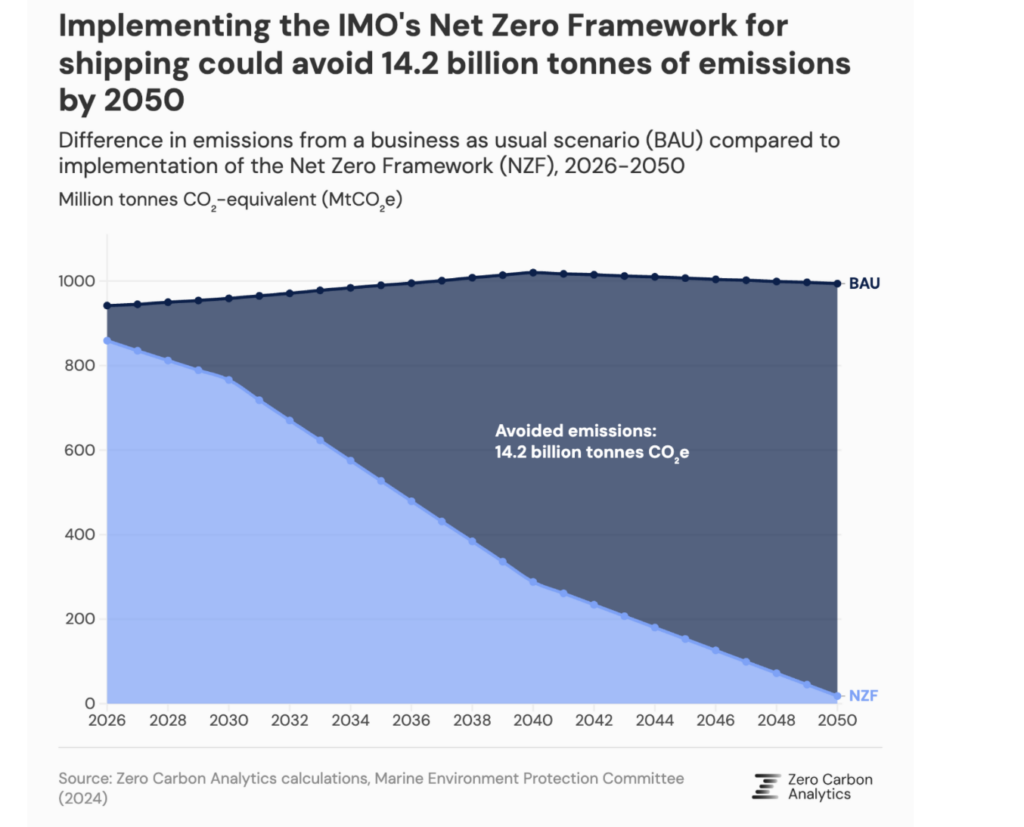
The framework was approved in April 2025 but has yet to be formally adopted, following political disagreements among member states, particularly over its implementation costs and potential implications for international trade.
The disagreement has exposed a wider tension in global climate policy: the costs of reducing emissions are often placed under scrutiny, while the economic consequences of allowing emissions to continue receive less attention.
According to ZCA, implementing the framework and achieving the sector’s net-zero ambition by 2050 could avoid approximately 14.2 billion tonnes of carbon dioxide-equivalent emissions between 2026 and 2050, compared with a business-as-usual scenario.
Although the estimated reduction represents a relatively small contribution to global temperature increases, its wider implications could be significant.
The analysis estimates that the avoided emissions could prevent approximately 0.00641°C of additional global warming by 2050. This could reduce exposure to unprecedented heat for roughly eight million people by 2070 and help avoid an estimated 1.5 million excess heat-related deaths by 2100.
The study also points to potential benefits for nature, estimating that the avoided warming could spare approximately 260 million additional coral colonies from losses associated with severe bleaching events.
Victoria Kalyvas, Senior Research Associate at Zero Carbon Analytics, says improved scientific methods are helping researchers connect emissions to temperature increases and, ultimately, the economic damage experienced by countries.
“Improved methods allow us to calculate the economic impact of emissions by connecting emissions to temperature increase, and temperature increase to economic damage,” Kalyvas explains.
She argues that these estimates reveal costs that are often missing from discussions about the financial implications of climate regulation.
For governments negotiating the future of international shipping, accounting for these damages could provide a more complete picture of the economic consequences of their decisions.
The study further argues that the costs of implementing the NZF should be considered alongside the potential costs of inaction. While implementation would require substantial investment, some of that spending could return to the shipping industry through vessel upgrades and operational improvements.
As IMO member states prepare to revisit the framework, the findings present a difficult economic question for governments: how much longer can the global shipping industry delay its transition while the costs of its emissions continue to accumulate?
For countries already facing the economic consequences of a warming climate, the debate is not simply about what it will cost to decarbonise shipping, but also what continued dependence on high-emission operations could cost the world.
Author Profile

-
Seeker.
Inspire AFRIKA.
Latest entries
 Oceans5 November 2026Shipping Emissions Have Cost the World Nearly $1 Trillion, Study Finds
 Agriculture4 November 2026From Kenya’s Counties to Yerevan, Agroecology Advocates Challenge “False Solutions” at COP17
 Biodiversity2 November 2026Earth on a Hospital Bed: Greenpeace Urges Biodiversity Delegates to Heal a Sick Planet
 Biodiversity29 October 2026From Indigenous Territories to the UN: The Growing Movement for the Rights of Nature


