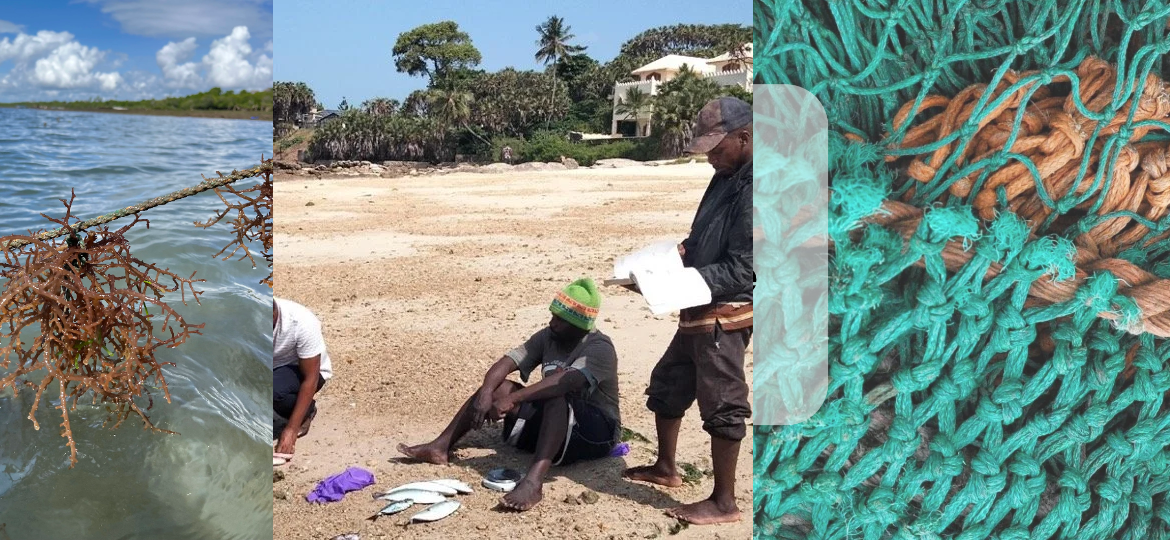
Mombasa’s shoreline was crowded with the kind of people who spend their careers thinking about what happens after the ocean is done being beautiful, after the plastic washes up, after the net snags a reef, after the fishing stops being lucrative with fewer fish.
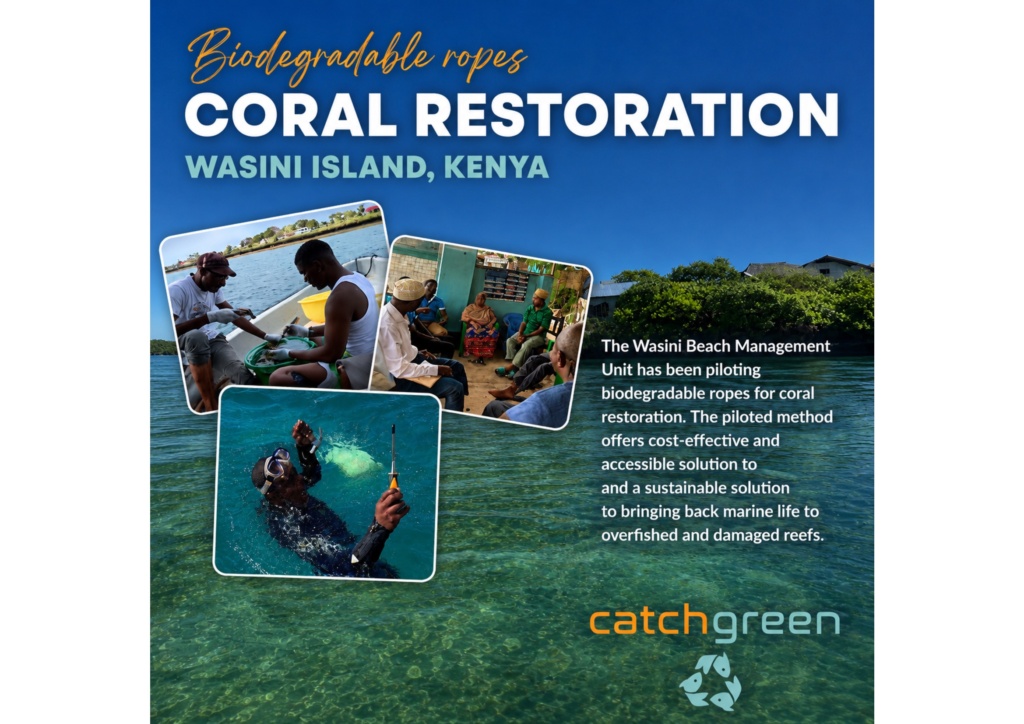
As delegates gathered for the 11th Our Ocean Conference (OOC11), the Catchgreen exhibition table was drawing a steady trickle of curious hands: seaweed soap, coils of rope and fish nets in muted greens and browns, unremarkable to look at, until you learn what they are designed to do. Unlike almost every net and line in the water today, this rope is built to biodegrade over time.
The timing could hardly be more urgent. Marine plastic pollution remains one of the world’s most pressing environmental challenges, driven by the continued growth in global plastic production and use. While it has long been estimated that around 80 percent of marine litter comes from land-based sources, emerging research suggests that sea-based pollution, particularly abandoned, lost or discarded fishing gear, contributes far more to marine plastic pollution than previously understood, especially in offshore and remote waters.
Abandoned, lost or otherwise discarded fishing gear (ALDFG), together with end-of-life fishing gear, can remain in the ocean for decades, entangling marine wildlife, damaging sensitive habitats such as coral reefs and seagrass beds, and gradually breaking down into microplastics that persist throughout marine ecosystems.
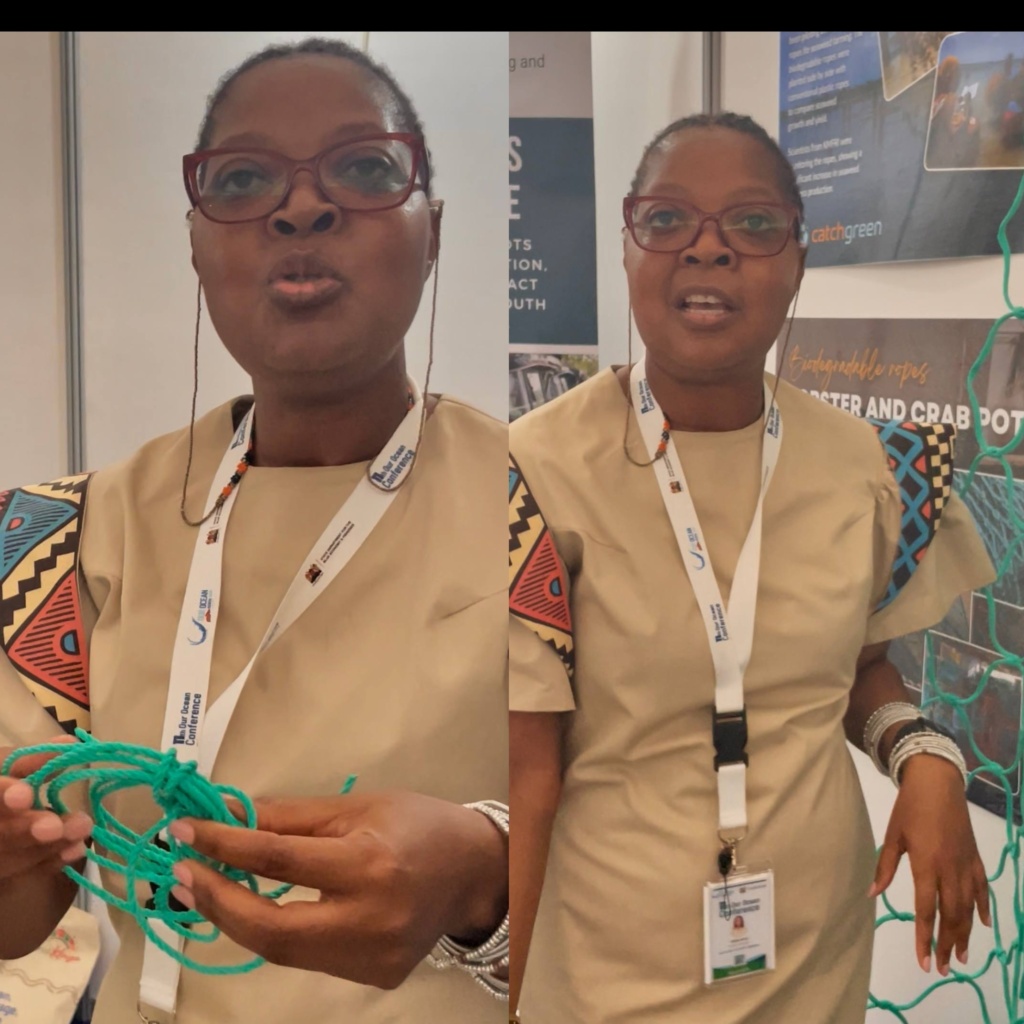
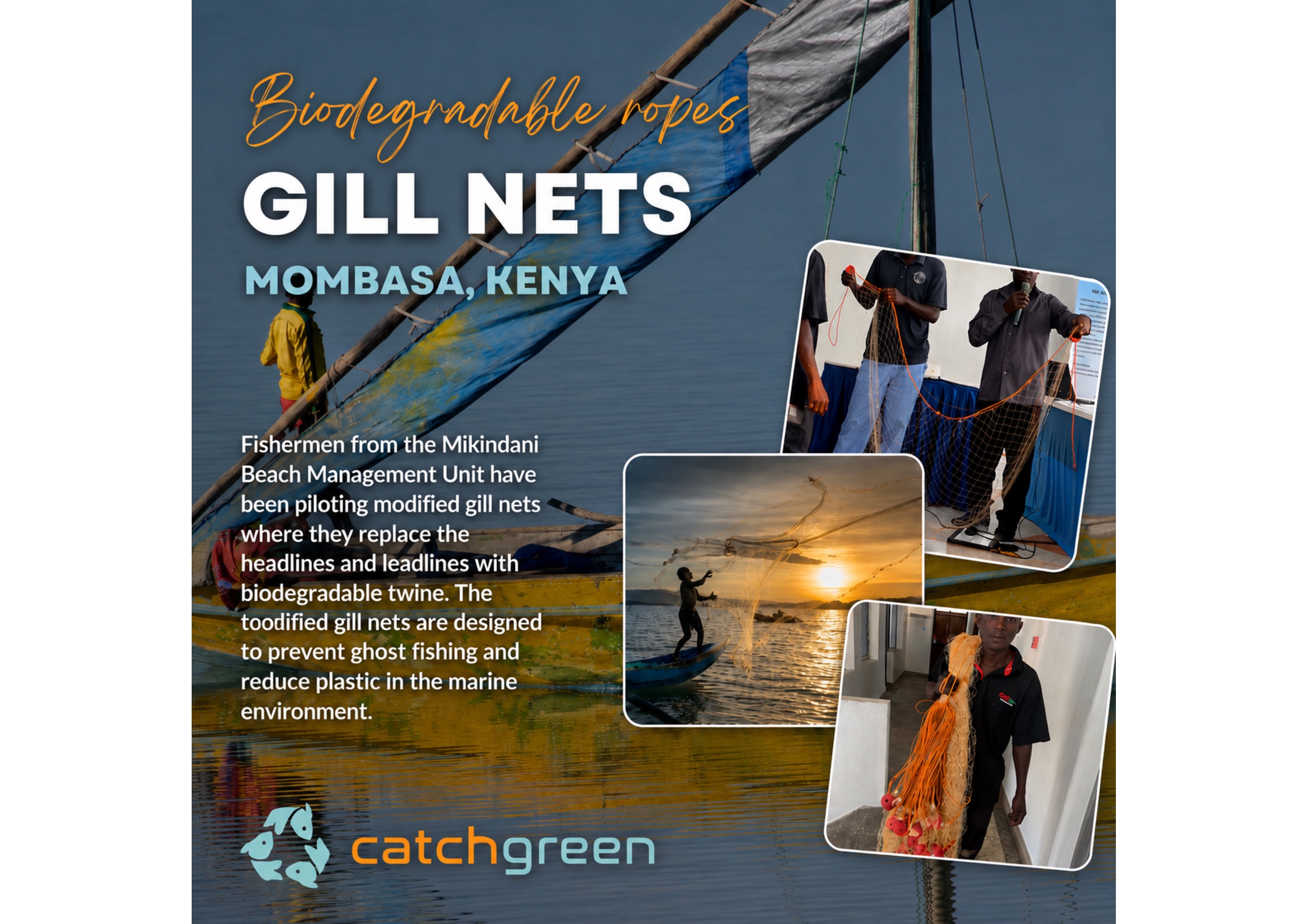
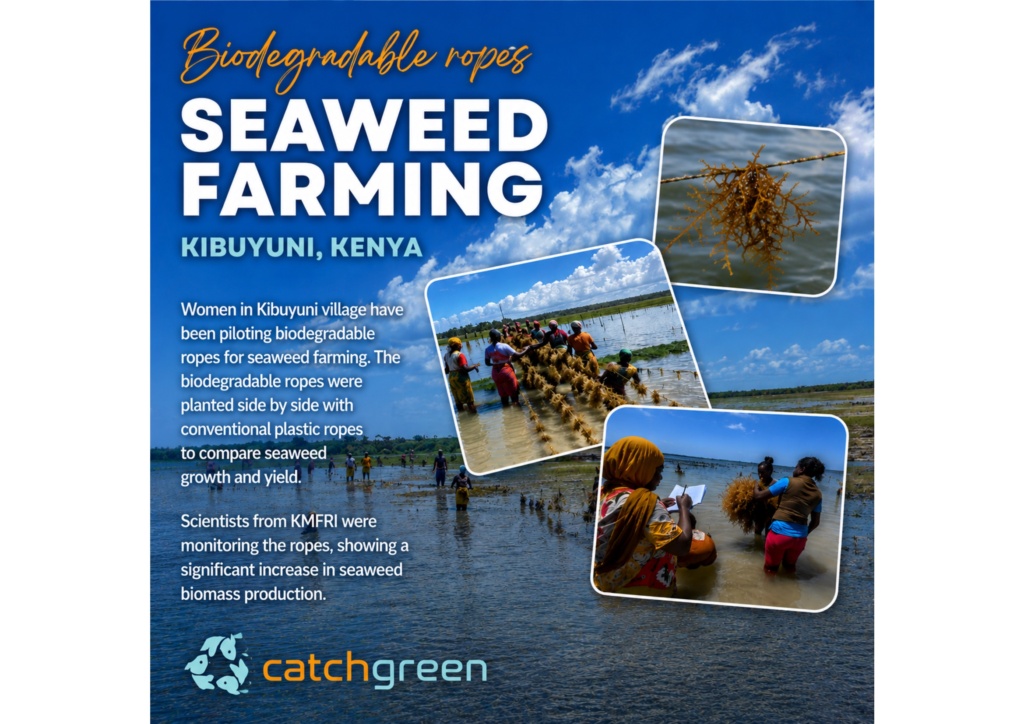
That is the point, says Faith Gara, Project Manager for Gender Equality and Social Inclusion at SouthSouthNorth’s Sustainable Manufacturing and Environmental Pollution (SMEP) Programme, speaking from Cape Town. SMEP funded the Catch Green project in partnership with Kenya Marine & Fisheries Research Institute (KMFRI) in coastal communities such as Wasini Island, Kibuyuni in seaweed farming, and Mikindani fishers testing biodegradable gillnets, where pilot projects were undertaken.
She was at the conference with one of the programme’s grantees, Catchgreen, a Cape Town-based company developing biodegradable ropes and fishing gear while supporting local industry and skills development. Although headquartered in South Africa, Catchgreen’s pilot projects, partnerships and commercial activities span several countries.
“This rope is meant to eventually biodegrade in the ocean with fishing nets, to reduce ghost fishing,” Gara explains, holding up a sample. “It is a small object carrying a large ambition: to break the cycle of ‘ghost gear,‘ the nets, lines and traps abandoned or lost at sea that continue trapping and killing marine life long after fishers have moved on.
Researchers say fishing gear is abandoned or lost for a range of reasons, including harsh weather, enforcement against illegal fishing, limited storage capacity on vessels and the high cost or lack of accessible disposal facilities onshore.
From the Lab to the Open Water
The idea is simple to describe and difficult to prove: build fishing rope from materials that behave like ordinary plastic gear in the water, strong, durable and reliable, but that quietly breaks down once lost or discarded instead of persisting for generations. Getting there required real-world testing, not just laboratory promises.
“We have tried it for seaweed farming,” Gara says, describing pilots that have taken the rope from calm nursery conditions into open, working environments. The gear has also been tested on lobster creel lines in Norway’s cold waters and, closer to home, on gillnets and coral restoration lines off Kenya’s coast.
Each site was chosen to stress-test the rope under different currents, temperatures and sunlight exposure.
“The plan was to test the strength of the rope and how well it does in different conditions, like light conditions, as opposed to the lab,” she says.
That distinction matters more than it sounds. A material that performs well under controlled laboratory conditions can behave unpredictably once it meets real sun, salt and strain, exactly the gap where many marine innovations fail to leap to commercial use.
According to Gara, the project has now cleared that hurdle. “The trials have proved very well,” she says. “Now the project under SMEP is coming to an end, and the trials are done.”
The next step is scale: taking a proven prototype and turning it into a commercial product for fishing that fishermen and women can actually buy and rely on. “They want to go further and expand and scale, and start bringing this into the market.”
The biodegradable fishing rope is one of three new biodegradable plastic alternatives developed under SMEP, alongside innovations for agricultural applications ranging from mulching to fresh food packaging.
One Project Among Twenty-Seven
The rope is a single thread in a much larger fabric. The Sustainable Manufacturing and Environmental Pollution (SMEP) Programme was established by the UK Foreign, Commonwealth and Development Office (FCDO) to tackle the environmental and human health impacts of manufacturing and plastic pollution across sub-Saharan Africa and South Asia.
Funded through UK International Development with a £24.6 million investment, the programme has been implemented by SouthSouthNorth and Pegasys International, with the United Nations Trade and Development (UNCTAD) providing technical assistance on trade and policy.
Running until October 2026, the initiative supports research and pilot projects designed to demonstrate scalable technologies, business models and policy solutions.
Since pilot projects began in 2022, SMEP has diverted more than 1,168 tonnes of plastic waste and over 28,000 tonnes of organic waste from open burning, landfills and the environment, while treating more than 240 kilolitres of wastewater through innovative technologies that prevent hazardous pollutants and microplastics from entering waterways.
The programme has also digitally traced more than 17,600 tonnes of textile waste, reduced greenhouse gas emissions by over 6,600 tonnes of carbon dioxide equivalent, and improved the livelihoods of more than 3,590 beneficiaries.
She rattles off examples that illustrate the programme’s breadth: a project in Bangladesh turning used lead-acid batteries into safer processing streams; one in Uganda extracting fibre from banana waste to produce textiles, “we soften it, cottonise it, and make clothes,” she says; another circular solution of pineapple waste into textile grade fibres at Thika with Mananasi Fibre Limited, and wastewater treatment innovations serving tanneries and textile factories.
What links them all, Gara says, is a deliberately unglamorous mission: closing the gap between a promising idea and one investors are willing to support.
“Banks cannot invest in your idea,” she says plainly. “SMEP came in to support you, since you have to prove concepts. When you prove concepts, you can get more finance.”
In a region where climate and circular economy innovators often possess promising technologies but lack a commercial track record, that de-risking role, funding the expensive work of proving concepts under real-world conditions, may ultimately be as important as any single invention emerging from the programme.
First Ocean Conference on African Soil
For Gara, showcasing biodegradable fishing gear at the Our Ocean Conference in Mombasa goes beyond promoting a single innovation. It marks the first time in the conference’s 11-edition history that the conference has been held in Africa, a continent with one of the world’s longest coastlines and millions of people whose livelihoods depend on healthy oceans.
“I am excited that this is the first in Africa,” she says. “Because it is on African soil, it is easier for many Africans to come, to attend and to share their ideas, and to learn from others as well.”
That exchange, she says, has already extended beyond the formal conference sessions.
Two days before the interview, during the event’s academic symposium, Gara found herself speaking with a delegate from Indonesia about the country’s struggle with marine plastic pollution and the immense logistical challenge of collecting waste scattered across thousands of islands.
The conversation reinforced a lesson shared by many delegates in Mombasa: ocean pollution is a global problem, but its solutions are often built locally, tested patiently and scaled through collaboration.
The biodegradable rope on display at the Catchgreen stand is one such solution. On its own, it will not end ghost fishing or the plastic crisis overwhelming the world’s seas. But it represents a different way of designing products, ones that serve their purpose without becoming a permanent burden on the environment.
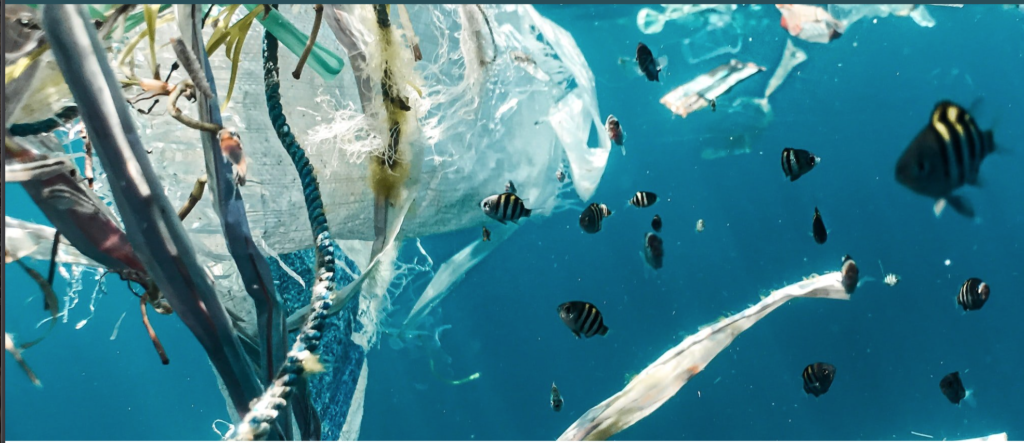
In a world where abandoned and discarded fishing gear can remain in the marine environment for decades, damaging coral reefs, seagrass beds and marine wildlife while slowly fragmenting into microplastics, innovations like these offer something increasingly rare: a practical alternative backed by years of real-world testing rather than laboratory promises.
Yet despite the growing urgency, only about 1.5 percent of fishing gear is currently recycled, with technical, logistical and economic barriers leaving much of it to be landfilled, incinerated or illegally dumped.
The rope was built to disappear. If it succeeds, its greatest achievement may be that, one day, no one notices it at all. Lost at sea, it will quietly return to nature instead of haunting it for decades, a small but meaningful reminder that the best technologies are not always those that last forever, but those that know when to leave.