
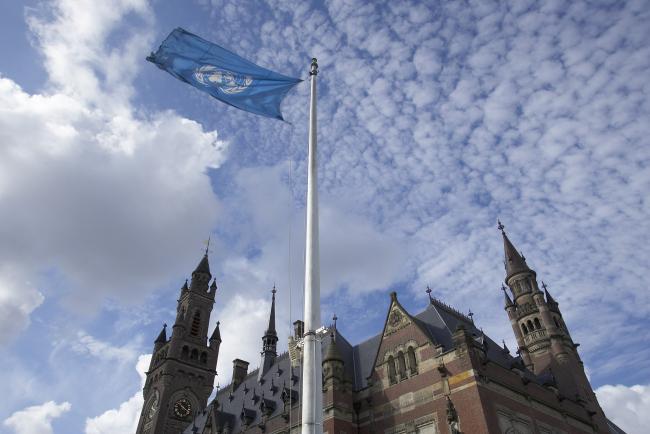
To fully understand why the International Court of Justice(ICJ) has been on the trends currently, we have to first take it back to March 2023, when the United Nations General Assembly (UNGA) unanimously adopted a historic resolution requesting the ICJ to issue an advisory opinion on two critical questions:
- What are states’ obligations under international law to protect the climate system for present and future generations?
- What are the legal consequences for states whose actions or omissions have caused significant harm to the climate, particularly to vulnerable nations and affected communities?
This lately renowned initiative was sparked by a bold campaign led by a group of Pacific Island law students and championed by the government of Vanuatu in a call for climate justice that is embedded in the law.
Let’s remember that Vanuatu, just like many Pacific nations, is facing the existential threat of climate change in a more severe and intensified manner, with devastating losses of infrastructure, livelihoods, and lives. The states are faced with a bitter reality of large areas of land that were once habitable, having become unlivable.
The country, among other small island states, experiences increasingly frequent and intense tropical cyclones, some of the most destructive natural disasters in the region. For low-lying nations like Tuvalu and Kiribati, the rising seas mean the potential disappearance of their lands, leaving them displaced and homeless.
Reflecting on the bold stance taken way back, it’s evident that their message to the world is clear: That is, if the world does not act fast enough to reduce harm and slow global warming, these nations could face irreversible devastation.
As such, from December 2 to 13, 2024, the ICJ held public oral hearings at the Peace Palace in The Hague. These hearings would attract an unprecedented participation, with nearly 100 states and international organizations presenting arguments before the Court’s 15 judges.
Considering this immense public interest, the upcoming advisory opinion could offer much-needed legal clarity on how states are expected to act under international law when it comes to addressing climate change.
It is anticipated to also provide authoritative guidance on pressing issues such as climate finance, loss and damage, human rights obligations, and emissions reduction targets.
According to Joie Chowdhury, Senior Attorney at the Center for International Environmental Law, the case has the potential to “define a new era, where climate justice is not a distant aspiration, but a global mandate for the here and now.”
The UN’s request asks the International Court of Justice to address two fundamental legal questions:
- What must states do under international law to protect the environment from greenhouse gas emissions “for present and future generations”?
- What are the consequences for states whose emissions have caused environmental harm, particularly to vulnerable, low-lying island nations?
Its admissible that this case comes at a pivotal time when the impacts of climate change are visible globally from scenes of floods, to droughts, heat waves and cyclones all around, causing massively destructive outcomes.
The move is going to mark a new era in which courts have increasingly seized and risen to as they become a frontline for climate action, with witnessed frustrations mounting over the slow pace of efforts to cut fossil fuel emissions.
The global scale debate further highlights growing tensions between major industrialized economies and smaller, climate-vulnerable nations, which are bearing the brunt of a crisis they did little to cause, as evidenced by the emissions and development scales.
While the Paris Agreement under the UN Framework Convention on Climate Change (UNFCCC) represents a global commitment to combat climate change, its implementation has been slow and, to some, quite insufficient.
However according to some of the world’s largest polluters their argument is to only rely on the existent legal frameworks under the UNFCCC which they insist contain an adequacy to deliver the answers to some of these questions. Therefore, they urge that the ICJ need not go beyond them.
Even though Vanuatu and its allies are pushing for a broader interpretation which has seen them call on the ICJ to draw not only from environmental law, but also from international human rights law and the Law of the Sea. They argue that the International Court of Justice is uniquely positioned to weave together these legal strands into a coherent global standard.
Central to their contention is a foundational principle of international law: ubi jus, ibi remedium, where there is a right, there must be a remedy. In legal terms, this does translate to cessation of harmful actions, non-repetition, and reparations for damage already done.
Hence, the climate-vulnerable nations are calling for the ICJ’s opinion to recommend:
- An end to fossil fuel subsidies,
- A rapid and drastic reduction of greenhouse gas emissions,
- A formal global commitment and timeline for complete decarbonization.
Though advisory, the ICJ’s opinion could carry significant moral and political weight, potentially shaping how courts and governments worldwide interpret their legal duties in the fight against climate change. This is foreseen as a truly inspiring moment for the course of reducing emissions and heightening the call of climate justice that has remained elusive despite its essentiality being a reality globally.


