
As Africa seeks to position itself within the global green economy, continental and international institutions are increasingly joining forces to address a critical question: how can the continent’s green transition create jobs, build skills, grow enterprises and deliver inclusive economic prosperity at scale?
Jacob’s Ladder Africa (JLA) has announced that the African Union Commission (AUC), through its Department of Education, Science, Technology and Innovation (ESTI), has joined a growing coalition of strategic partners supporting the inaugural GreenWorks 4 Africa Forum, the continent’s Green Skills and Jobs Summit, scheduled for 12–13 August 2026 in Nairobi, Kenya.
The African Union Commission joins partners including FSD Africa, the Center for Global Development (CGD), alongside other institutions working across policy, finance, enterprise development, workforce readiness and economic transformation.
The announcement follows a series of continental pre-convenings that brought together policymakers, development institutions, private sector leaders, researchers, practitioners and youth representatives to examine the systems needed to accelerate Africa’s green economy transition.
Across the discussions, a common concern emerged: while Africa’s green growth ambitions continue to expand, major gaps persist between policy commitments, financing systems, workforce development, enterprise growth and implementation capacity.
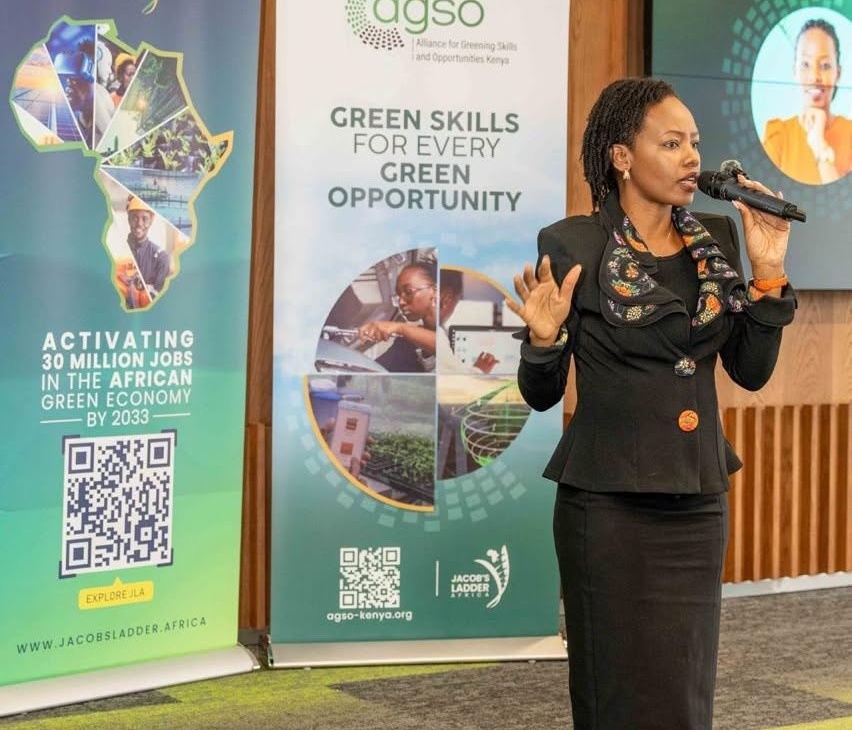
Sellah Bogonko, Co-Founder and Chief Executive Officer of Jacob’s Ladder Africa, pointed out that across the continent, there is growing recognition that Africa’s green transition must ultimately be measured not only by emissions targets or climate commitments, but by its ability to create decent jobs, strengthen skills, support enterprise growth and improve livelihoods.

“Africa has a unique opportunity to shape a green economy that is both environmentally sustainable and economically inclusive. Doing so will require stronger collaboration between governments, development institutions, investors, educators, employers and young people themselves,” she added.
GreenWorks 4 Africa was established to help bridge these gaps by convening leaders and practitioners around practical solutions in six priority sectors: renewable energy, climate-resilient agriculture, e-mobility, circular industries, natural capital and green manufacturing.
Unlike traditional conferences, the forum is designed as a working platform focused on collaboration, problem-solving and the development of practical tools and recommendations that can support workforce development, enterprise growth and green industrialisation across Africa.
Expected outcomes from the forum include the development of an Africa Green Jobs Toolkit, contributions toward a shared understanding of green jobs and green skills through an Africa Green Jobs Taxonomy, strengthened partnerships and actionable recommendations to support policy reform and investment.
The forum’s agenda is also being shaped around three enabling pillars: finance, technology, innovation and market systems; policy, regulation and governance systems; and social systems, reflecting the interconnected nature of Africa’s green economy transformation.
Organisers say the growing coalition of partners signals increasing recognition that Africa’s green transition must evolve into an economic development agenda as much as an environmental one.


