
Above-average rainfall across the Greater Horn of Africa is expected to coincide with warmer-than-usual temperatures, raising concerns over flooding, heat stress and pressure on climate-sensitive livelihoods.
The Greater Horn of Africa is heading into a week of contrasting climate conditions, with above-average rainfall expected across several countries even as temperatures remain warmer than usual across much of the region.
The weekly IGAD Climate Predictions and Applications Centre (ICPAC) climate outlook for 10–17 November 2026 indicates that Kenya, Tanzania, southern Somalia and Ethiopia, alongside eastern parts of Rwanda, Burundi and Uganda, are likely to experience more rainfall than their seasonal averages.
However, the anticipated rainfall comes with a warning. Forecasts indicate a heightened likelihood of flooding in several locations, particularly across Kenya, southern Ethiopia, southern Somalia and central Tanzania, where exceptional rainfall conditions are expected.
The outlook highlights the growing importance of preparedness as communities navigate increasingly complex weather conditions, with implications for agriculture, pastoralism, water management and disaster risk reduction.
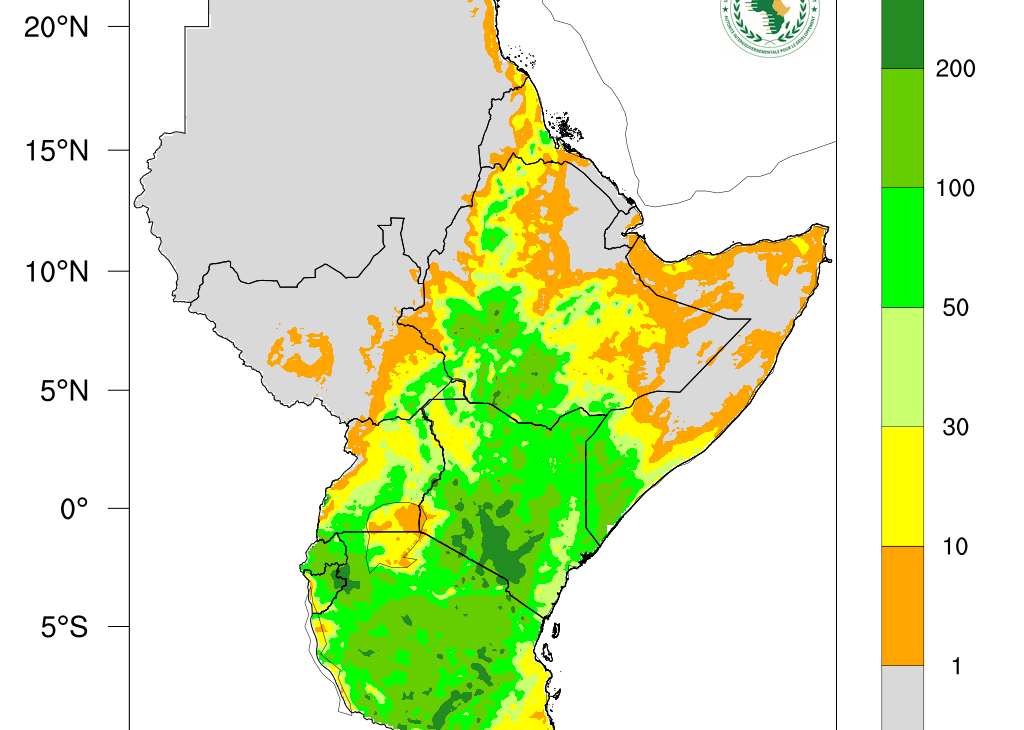
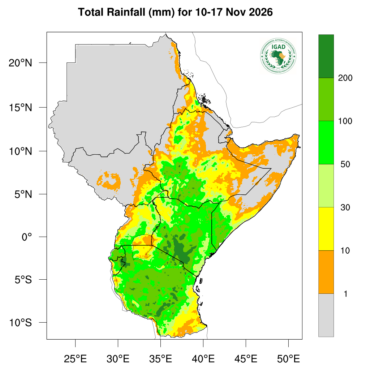
According to the ICPAC forecast, rainfall exceeding 200 millimetres is expected across central and southern Kenya, as well as isolated areas of eastern Burundi and central Tanzania. Other parts of Tanzania, Rwanda, Burundi and Kenya are expected to receive between 50 and 200 millimetres.
Western Ethiopia and southern Somalia are also expected to experience moderate rainfall, while lighter rainfall is forecast across much of central and northern Uganda, parts of Ethiopia and Somalia, and selected areas of Tanzania.
The rainfall distribution, however, is not expected to be uniform.
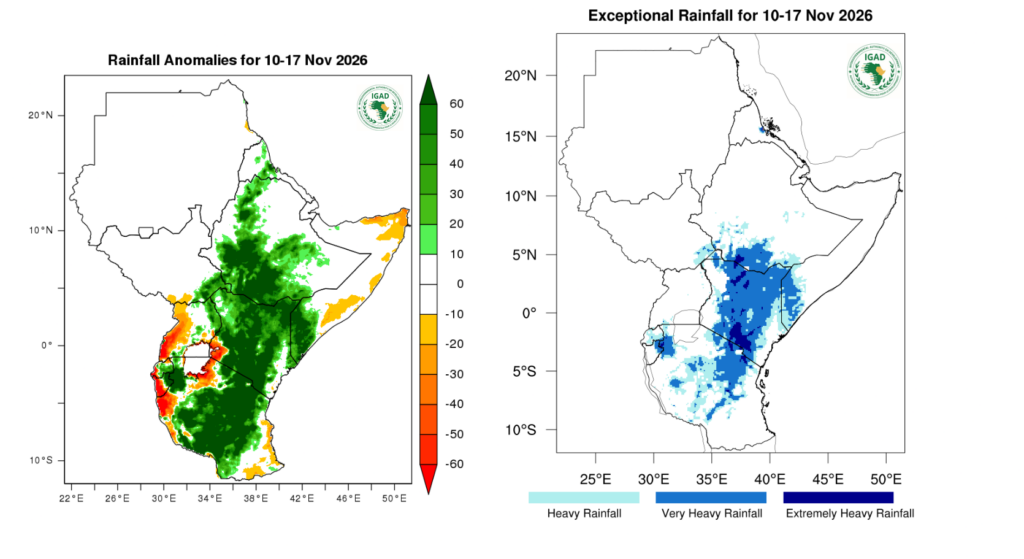
While most parts of Kenya and Tanzania are forecast to receive above-average rainfall, below-average conditions are expected across northern to central Somalia, western Uganda, parts of Burundi, Rwanda and Kenya, and northern and southern Tanzania.
This geographical contrast presents a complicated picture for communities that rely on seasonal rainfall. While some areas could experience excessive water accumulation, others may continue to face rainfall deficits, highlighting the uneven distribution of climate risks across the region.
Flood risks emerge alongside exceptional rainfall
Of particular concern is the forecast of exceptional rainfall, defined in the outlook as rainfall exceeding the 90th percentile of historical observations.
Such conditions are expected across southern Ethiopia, most parts of Kenya, southern Somalia and central Tanzania, alongside isolated areas of eastern Burundi and central Rwanda.
These areas are consequently identified as locations where flooding incidents are expected during the forecast period.
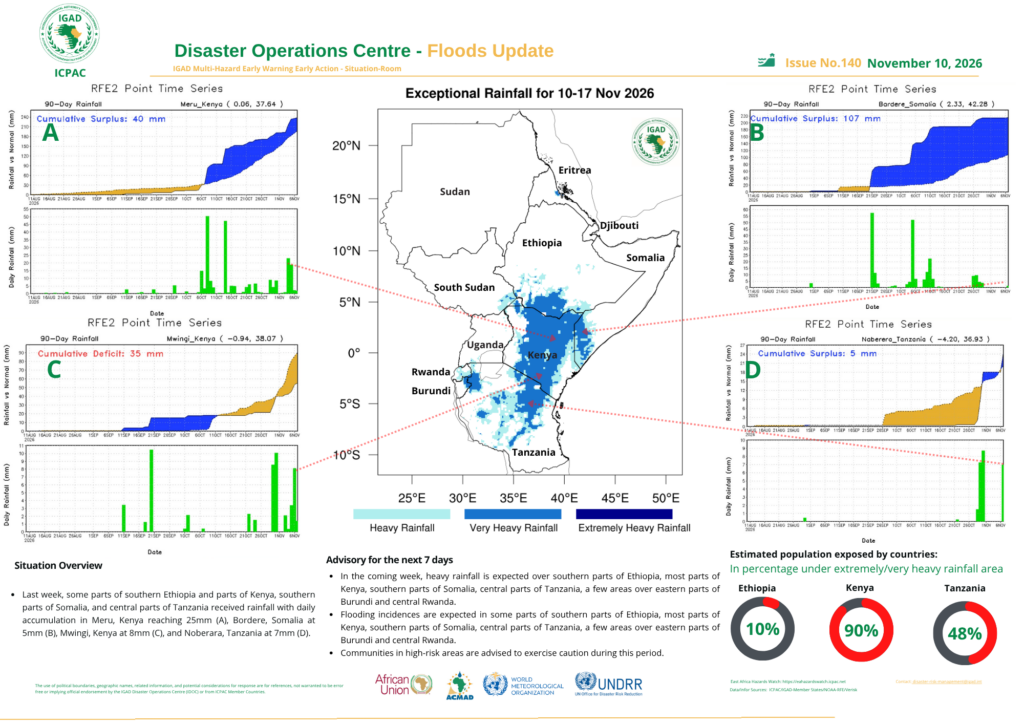
For communities living in flood-prone settlements, the anticipated rainfall could disrupt daily activities, affect transport networks and place additional pressure on infrastructure and essential services.
Agricultural communities also face potential disruptions, particularly where excessive rainfall affects farmland, damages crops or interferes with harvesting and other farming activities.
Pastoral communities could equally face challenges where flooding affects grazing areas, livestock movement and access to water infrastructure.
The forecast therefore calls for communities in high-risk locations to exercise caution, reinforcing the need for early preparedness and timely responses by relevant authorities.
Warmer conditions add another layer of climate risk
Beyond rainfall, the outlook identifies warmer-than-average temperatures across most parts of the Greater Horn of Africa.
Temperatures ranging between 20°C and 32°C are expected across much of the region, although milder conditions below 20°C are forecast in parts of Sudan, Ethiopia, Kenya, Rwanda, Burundi and Tanzania, among other locations.
The temperature anomalies indicate that most countries are likely to experience warmer conditions than their respective seasonal averages. Cooler-than-usual temperatures are expected across much of Sudan, central Tanzania and isolated locations elsewhere in the region.
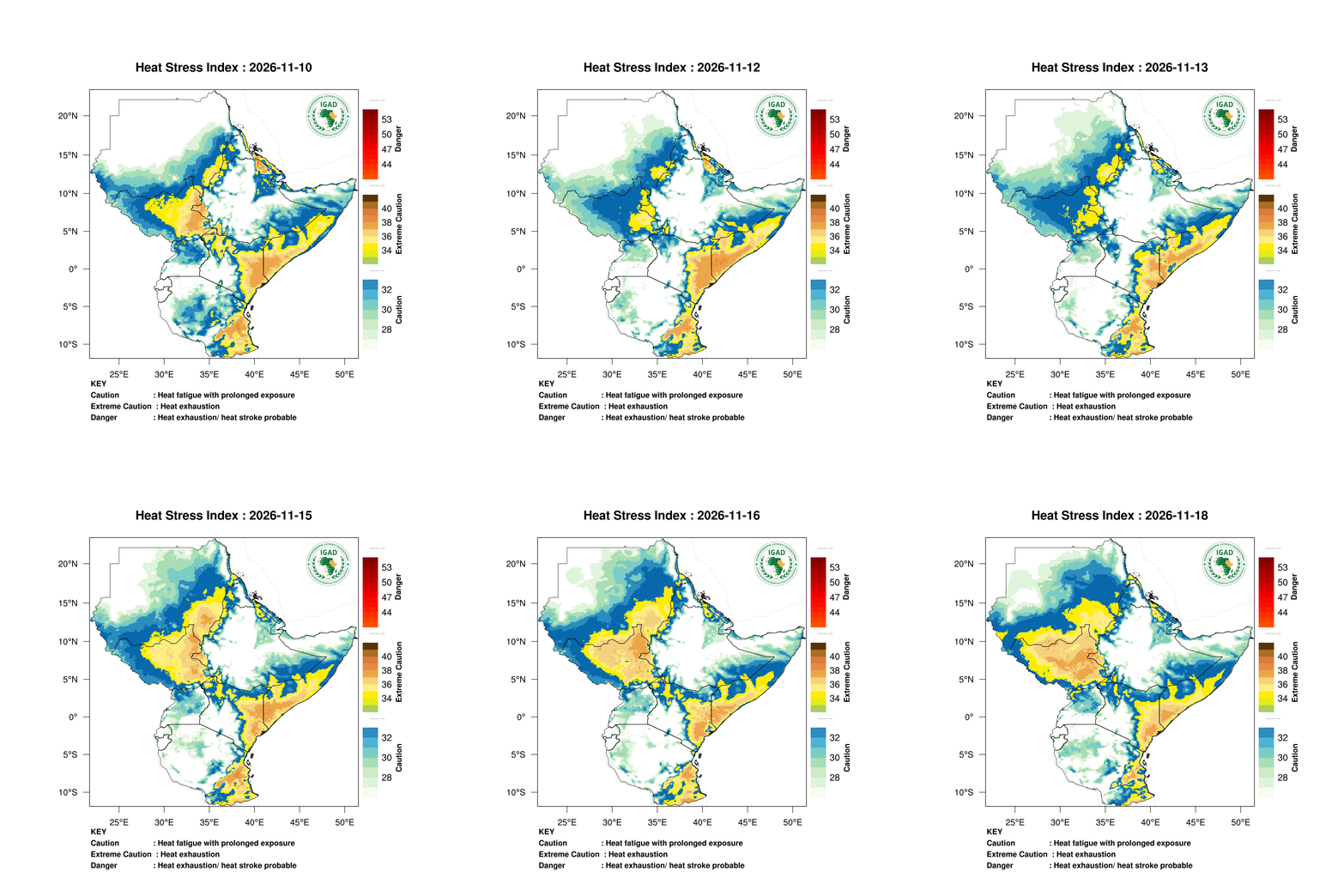
More concerning, however, is the forecast of elevated heat stress within the ‘Extreme Caution’ category.
This is expected across most parts of South Sudan, eastern and southern Sudan, central and southern Somalia, and selected areas of Kenya, Ethiopia and Tanzania.
In Kenya, the areas identified include parts of the eastern, coastal and north-western regions. In Ethiopia, the forecast highlights parts of the north-east and south-west, while southern Tanzania is also expected to experience elevated heat stress.
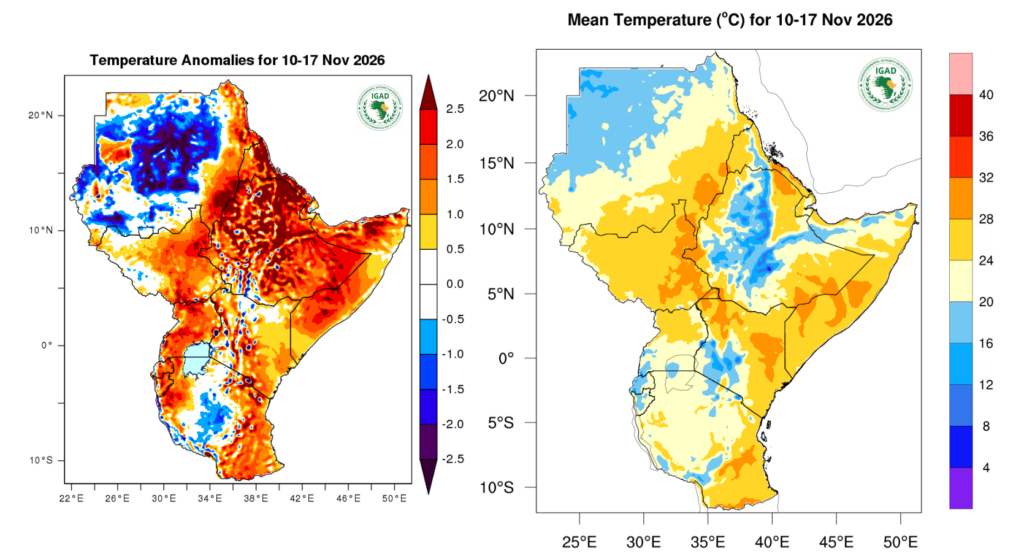
The combination of warmer-than-usual temperatures and uneven rainfall distribution underscores the multiple climate pressures facing communities across the region.
For farmers, pastoralists and other climate-dependent populations, these conditions reinforce the importance of accessing reliable weather information to guide decisions on planting, livestock management, water use and other livelihood activities.
Why interpreting the forecasts together matters
The climate outlook also emphasises that rainfall information should not be interpreted through a single forecasting product.
Instead, users are advised to consider total rainfall, rainfall anomalies and exceptional rainfall forecasts together, as each provides a different but complementary understanding of expected conditions.
Total rainfall indicates the anticipated amount of precipitation, while rainfall anomalies show whether those amounts are above or below normal seasonal conditions. Exceptional rainfall forecasts, meanwhile, identify areas where rainfall could exceed the 90th percentile, providing additional information on potential extreme events.
Combining the three products offers a more comprehensive understanding of expected rainfall conditions and can strengthen preparedness across agriculture, pastoralism, disaster risk management and water resources.
For the Greater Horn of Africa, where livelihoods and economic activities remain closely connected to weather patterns, such information is particularly important.
As the region navigates a forecast period characterised by above-average rainfall in several locations and widespread warmer-than-usual temperatures, the challenge is not simply anticipating how much rain will fall, but ensuring communities and institutions can translate climate information into timely decisions.
The latest outlook reinforces the need for stronger early-warning systems, accessible climate information and coordinated preparedness, particularly in areas where exceptional rainfall and flooding are anticipated.
Author Profile

-
Seeker.
Inspire AFRIKA.
Latest entries
 Climate13 November 2026Greenpeace Africa Calls for Urgent Fossil Fuel Phase-Out in COP31 as 1.5°C Overshoot Looms
 Climate12 November 2026Early Warning Systems Reach 70% of Countries, but Africa and Vulnerable Nations Face Gaps
 Weather Forecasts11 November 2026Heavy Rains, Rising Temperatures Put Greater Horn of Africa on Flood Alert
 COP3111 November 2026300 Million Solar Homes by 2030: Global Coalition Pushes Rooftop Solar as Energy Security Solution


