
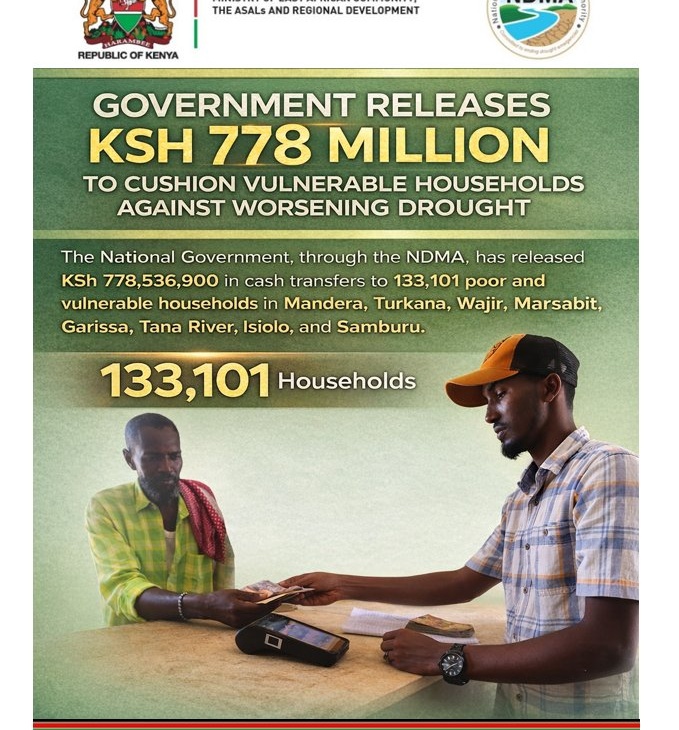
The National Government has released KSh 778.5 million to support 133,101 vulnerable households under the Hunger Safety Net Programme (HSNP), as drought conditions intensify across Kenya’s Arid and Semi-Arid Lands (ASALs).
The disbursement, announced through the National Drought Management Authority (NDMA), covers the December 2025 and January 2026 payment cycles for households in eight arid counties: Mandera, Turkana, Wajir, Marsabit, Garissa, Tana River, Isiolo, and Samburu. It also includes the February 2026 payment cycle for Mandera County, currently among the hardest hit by drought.
The release comes at a critical moment. An estimated 3.3 million people across 23 ASAL counties are facing acute food insecurity, with projections warning of a likely increase if the March–May long rains underperform.
Reduced pasture and browse, declining milk production, rising food prices, and intensifying water scarcity continue to erode household resilience in drought-affected areas.
The announcement followed a high-level meeting chaired by Deputy President Kithure Kindiki, bringing together officials from the State Department for ASALs and Regional Development, NDMA leadership, and representatives from drought-affected counties.
The meeting reviewed the national food security situation and resolved to streamline the last-mile delivery of relief supplies to ensure timely support to affected communities.
Under the HSNP framework, each registered household receives KSh 2,700 per month. The programme provides regular cash transfers to the poorest and most vulnerable households, enabling them to meet essential food and non-food needs during periods of climatic stress.
According to NDMA Chief Executive Officer Hared Hassan, the National Government is working closely with county governments and development partners to cushion communities from the worsening impacts of drought.
He emphasized that relief supplies have already been deployed in affected regions, with additional interventions underway.

County Allocations and Access to Funds
The allocations reflect varying levels of vulnerability across counties:
Mandera County: KSh 179.37 million to 22,145 households
Turkana County: KSh 215.15 million to 39,842 households
Marsabit County: KSh 110.11 million to 20,390 households
Wajir County: KSh 103.52 million to 19,171 households
Garissa County: KSh 49.85 million to 9,232 households
Isiolo County: KSh 36.70 million to 6,796 households
Samburu County: KSh 44.19 million to 8,184 households
Tana River County: KSh 39.64 million to 7,341 households
Beneficiaries will access payments through agents and branches of Equity Bank and Kenya Commercial Bank within their respective counties. Those experiencing delays or discrepancies are advised to contact their nearest bank branch, NDMA county office, or HSNP sub-county office to update their registration details.
Social Protection as Climate Resilience
The HSNP is part of the broader Inua Jamii National Safety Net Programme, a flagship government social protection initiative designed to reduce poverty and cushion vulnerable households against economic and climate shocks.
At a time when food insecurity is rising, social protection remains one of the most effective instruments for safeguarding dignity and stabilizing livelihoods.
By strengthening purchasing power, cash transfers help households avoid negative coping strategies such as distress livestock sales, school dropouts, and reduced food intake. They also stimulate local markets, helping traders and service providers remain afloat during prolonged dry spells.
The current disbursement forms part of a broader multi-sectoral drought response strategy that includes water trucking, livestock feed supplementation, nutrition support, and conflict mitigation in high-risk areas where competition over shrinking natural resources often escalates tensions.
With climate variability increasing the frequency and severity of drought cycles in the Horn of Africa, sustained investment in adaptive social protection systems is becoming central to Kenya’s resilience architecture.
As seasonal forecasts of March to May (MAM)rainfall outlook point to coming rains and a relief from the heat streak, timely and targeted cash transfers may prove critical in preventing further humanitarian deterioration in the months ahead if the rain is below par.
Author Profile

-
Seeker.
Inspire AFRIKA.
Latest entries
 Corporate15 October 2026Water, Sanitation and Digital Learning at the Centre of Garissa School Upgrade
 Agriculture14 October 2026Africa’s Food Systems Future Depends on Listening to Farmers
 Weather Forecasts13 October 2026Rain and Rising Temperatures Forecast Across the Greater Horn of Africa
 Climate9 October 2026Beyond Negotiations: Africa Expects Concrete Outcomes from Antalya


