
Kenya’s floriculture industry has long been synonymous with roses. The country’s ideal growing conditions, skilled workforce, and well-established export infrastructure have helped make it one of the world’s leading suppliers of cut flowers.
Yet as growers seek to diversify their product offerings and respond to changing market demands, attention is increasingly turning to alternative crops that can complement traditional flower production.
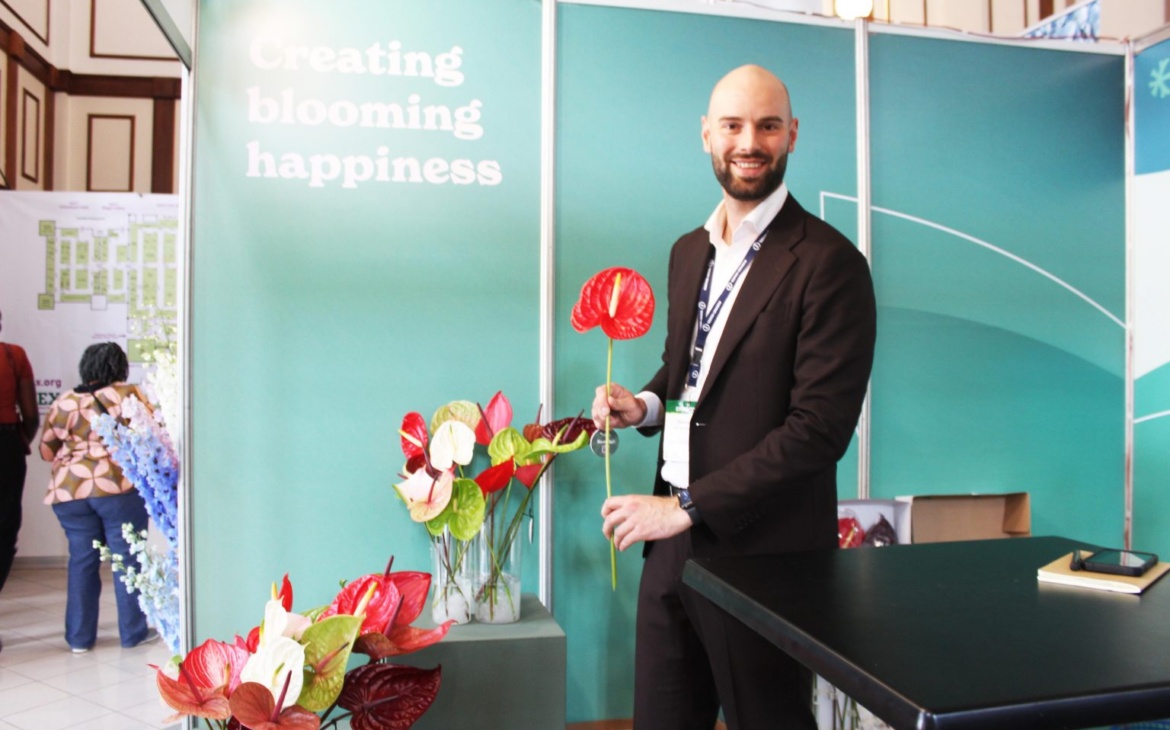
Among the companies hoping to drive that diversification is Anthura, a Dutch breeding company with more than eight decades of experience developing ornamental plants. During IFTEX 2026 in Nairobi, the company introduced growers to one of its flagship products: the anthurium cut flower.
“We are here today with the anthurium cut flower, and we are looking for new growers here in Kenya or other countries here in Africa to see if there are growers who see the opportunity to grow the anthurium cut flower,” said Steven van den Bosch, Account Manager at Anthura.
Diversifying Beyond Traditional Cut Flowers
Based in Bleiswijk, the Netherlands, Anthura specializes in breeding anthuriums, phalaenopsis orchids and bromeliads. The company sees significant potential for anthuriums in Kenya, where growers are increasingly exploring new products capable of delivering premium returns in international markets.
According to van den Bosch, one of the flower’s greatest strengths is its exceptional longevity.
“The really nice feature of these flowers is that they have a really long vase life,” he explained. “The vase life is approximately, for some varieties, up to 40 days.”
For an industry where post-harvest performance can significantly influence profitability, such longevity presents an attractive proposition.
Compared to many traditional cut flowers, anthuriums can remain fresh for extended periods, reducing losses throughout the supply chain while providing greater value to consumers, retailers and event planners.
The long-lasting nature of the flower also opens opportunities beyond conventional retail channels. Hotels, restaurants, conference venues and luxury event organizers often seek decorative flowers that retain their appearance for extended periods without frequent replacement.
“We think it’s more for all different types of occasions, also for weddings, for the big events,” said van den Bosch. “Because it’s more of a hard flower, it’s really easy in the sun; you can leave it outside, it will not fall or anything in just one day.”
The hospitality sector, in particular, could benefit from the flower’s durability.
“A restaurant needs to change it only one time per month,” he added. “Just use clear water, and it will be fine.”
Anthura believes the crop can help growers diversify into premium niche markets rather than compete directly with established flower categories. The company points to growing demand for unique, high-end floral products that stand out in bouquets, interior décor and luxury events.
“It’s more of a trendy, luxurious flower,” van den Bosch noted.
The company’s confidence in the crop is reinforced by its performance in Europe, where commercial production has already gained traction. Anthura now hopes to replicate that success in Africa, using Kenya as a potential gateway into regional and international markets.
“We think that it’s a really good choice to start with this new type of cultivation,” van den Bosch said. “It’s already done in Europe, and it’s going quite well. The prices are really high these days.”
Kenya’s strategic position as a major floriculture exporter could provide additional advantages for growers interested in testing the crop. Anthura sees opportunities to supply nearby markets in the Middle East as well as destinations further afield.
“Maybe we see opportunities to do it in container transport to the Middle East or maybe to other countries. We can also ship it by plane,” van den Bosch said.
Can Anthuriums Thrive in Kenya?
The question many Kenyan growers are likely to ask, however, is whether anthuriums can thrive under local production conditions. Anthura has already begun exploring that possibility through pilot trials with selected growers.

“We are doing some tests by some companies and it’s going quite well,” van den Bosch revealed. “And we hope to find other growers also to start testing to see if we can make it a big crop here in Kenya.”
While Kenya’s climate differs significantly from that of the Netherlands, Anthura believes the crop can perform well when grown under suitable greenhouse conditions.
“The anthuriums do not need a lot of light, so maybe shading will also be needed,” he explained. “Humidity is no problem. It can go up to 80, 85, 90 percent humidity.”
The primary consideration, he said, is maintaining adequate night temperatures.
“The only thing that you need to consider is that the night temperature needs to be around 15 degrees, not lower. Otherwise, the production will go down quite far.”
With modern greenhouse technology becoming increasingly common among commercial flower farms, Anthura believes these requirements can be managed successfully.
Sustainability and Biological Production
Sustainability is another area where the company sees potential alignment with current trends in Kenyan floriculture.
As growers continue to adopt biological crop protection strategies and reduce dependence on conventional pesticides, Anthura has been conducting its own research into sustainable production systems.
“We’ve done some testing in our facility in the Netherlands to do it biological, to produce it totally 100 percent biological,” van den Bosch said. “We’re really far with it.”
Although challenges remain, particularly with pests such as thrips and bacterial diseases like Xanthomonas, he believes the crop is generally resilient.
“It’s a tropical plant, it’s a really hard plant, so other types of pests or diseases are not really an issue,” he said.
Innovation Driven by Breeding
Behind the company’s confidence lies a substantial breeding programme. Anthura currently offers around 50 commercial anthurium varieties while testing approximately 150 additional selections in its breeding facilities.
“We wanted to test them for three years to see how they are doing in cultivation, if it’s a success,” van den Bosch explained.
The company continually introduces new varieties to meet evolving market preferences.
“We try to introduce, per year, maybe four or five new varieties.”
Such continuous innovation reflects the increasingly dynamic nature of global floriculture, where breeders must respond to changing consumer tastes, emerging production challenges and evolving sustainability expectations.
Planting the Seeds of a New Market
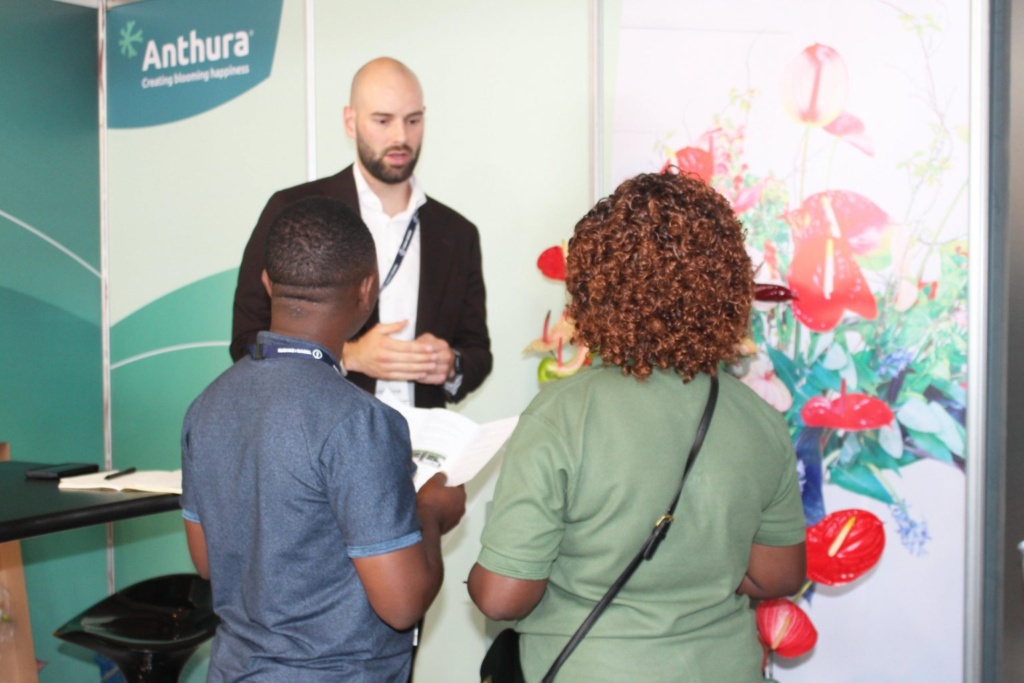
At IFTEX 2026, Anthura’s colourful display attracted considerable attention from visitors curious about the potential of a crop that remains relatively uncommon in Kenya’s commercial flower sector.
“The interactions were quite nice,” van den Bosch said. “Everybody was quite surprised that we were here with the anthuriums, because everybody thinks it’s a more tropical plant that’s really difficult to grow.”
However, he believes many of those concerns can be addressed through proper guidance and technical support.
“It needs to have a bit of guidance, but we have a clear cultivation guide that can help you with all the parts of the cultivation.”
As Kenya’s floriculture industry looks toward the future, diversification is likely to remain an important theme.
Whether anthuriums eventually become a significant commercial crop remains to be seen, but Anthura’s presence at IFTEX highlights the growing interest in expanding the range of flowers grown and exported from the country.
For van den Bosch, the objective is straightforward: identify pioneering growers willing to test a new opportunity and build a foundation for future growth.
“We think that I can find some growers who would like to test,” he said, “and I hope that it will be a success.”
Source: Floriculture
Read Also: Russell IPM’s Innovation
Author Profile

- How can we learn if we don't question?
Latest entries
 COP3115 October 2026Pacific Leaders Call for Urgent Climate Action Ahead of COP31
 Agriculture13 October 2026Can the buffalo fix Kenya’s milk problem? Farmers say start with the feed bill
 Events12 October 2026Cybersecurity in the Floriculture Industry
 Opinion & Analysis8 October 2026Why Africa Must Look to What Already Exists in Its Blue Economy


