
As climate change intensifies, financial institutions are increasingly being called upon to do more than finance economic growth.
They are expected to direct capital toward projects that reduce emissions, strengthen climate resilience, and help businesses and communities adapt to a rapidly changing world.
In Kenya, where climate-related disasters continue to affect agriculture, infrastructure, water resources and livelihoods, banks are becoming critical partners in the country’s transition to a low-carbon economy.
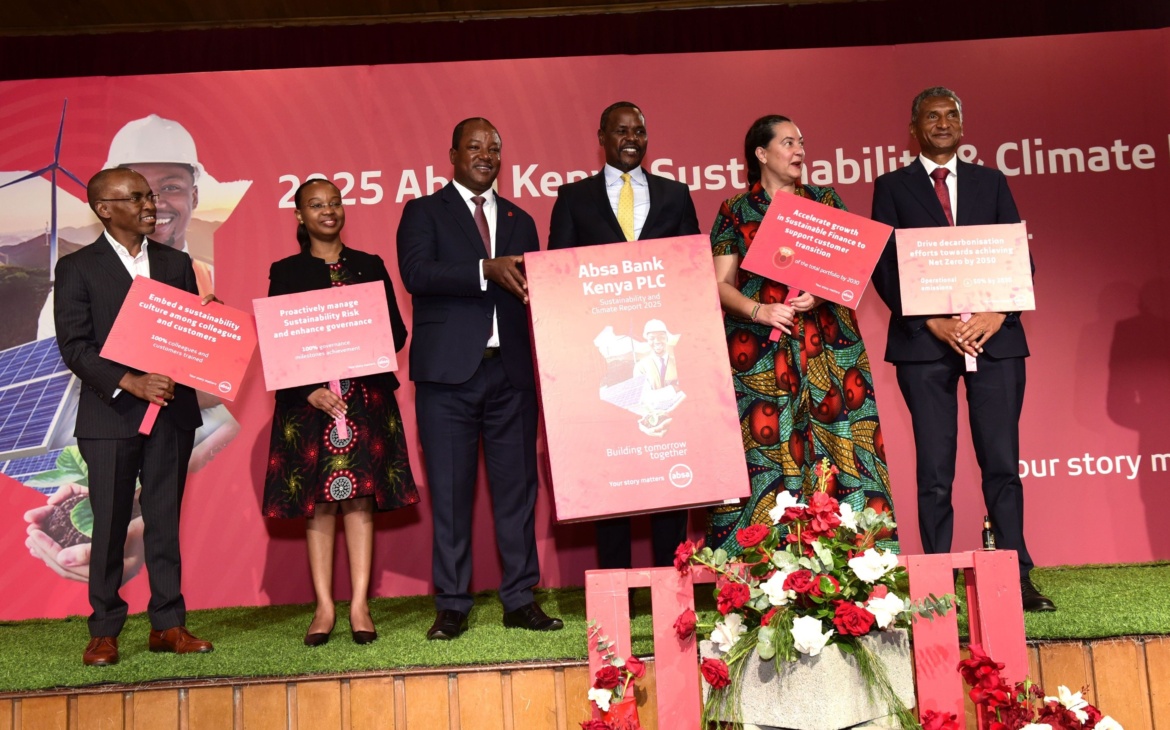
Absa Bank Kenya’s 2025 Sustainability and Climate Report offers a glimpse into how this shift is unfolding. Beyond measuring its own environmental footprint, the report illustrates how climate considerations are becoming embedded in lending decisions, risk management, governance and long-term investment planning.
Between 2022 and 2025, the bank disbursed KES 204 billion in sustainable finance, channeling funds into sectors that promote inclusive economic growth while supporting environmental and social outcomes.
Of this amount, KES 57.8 billion qualified as climate finance, supporting investments in renewable energy, energy efficiency, climate-smart agriculture and other low-carbon initiatives.
The figures also reflect the growing integration of sustainability into mainstream banking. In 2025 alone, Absa disbursed KES 55.3 billion in sustainable finance, representing 30 percent of its annual loan disbursements, well above its initial target of 10 percent.

“We aspire to deliver growth responsibly, innovate with purpose, and contribute to lasting progress for future generations,” said Abdi Mohamed, Managing Director and Chief Executive Officer of Absa Bank Kenya.
The financing was spread across several priority areas, including KES 26.4 billion through Timiza, KES 10 billion for youth enterprises, KES 7.9 billion for small and medium-sized businesses, KES 6.5 billion in climate finance, KES 2.7 billion benefiting low-income households, and KES 1.8 billion supporting women-owned businesses.
While sustainable finance remains broader than climate finance, the report indicates that climate-related investments are becoming a growing component of Kenya’s financial landscape as businesses seek cleaner technologies and governments tighten climate disclosure requirements.
From financing to decarbonisation
The report also highlights efforts to reduce the bank’s own environmental footprint.
Since adopting 2019 as its baseline year, Absa says it has reduced its energy consumption by 41 percent, largely through energy efficiency measures and retrofitting its facilities. Five premises have achieved Excellence in Design for Greater Efficiencies (EDGE) certification, while a pilot programme to solarise four branches demonstrated energy efficiency improvements ranging between 30 and 51 percent.
The bank now plans to expand solar installations across 51 branches, its headquarters and 61 ATMs, as part of its broader decarbonisation strategy.
These efforts support Absa’s commitment to achieve net zero operational emissions by 2040 and net zero financed emissions by 2050, aligning with wider industry efforts to reduce greenhouse gas emissions.
Another milestone has been biodiversity restoration. By the end of 2025, the bank reported planting more than 1.8 million trees, including over 283,000 trees during the year, contributing to Kenya’s national goal of growing 15 billion trees by 2032.
Green products gaining momentum
One of the more tangible examples of climate finance is the introduction of the Eco Home Loan, a mortgage product designed to encourage environmentally sustainable housing.
The financing supports homebuyers seeking to install solar panels, rainwater harvesting systems, energy-efficient lighting, insulation, wastewater recycling systems and other green upgrades. By reducing the upfront cost of sustainable housing, the product aims to make climate-friendly homes more accessible to Kenyan households.
The report also notes that sustainability considerations are increasingly shaping product development, lending decisions and risk assessments, reflecting growing recognition that climate risks have become financial risks.
Beyond compliance
Kenya’s financial sector is undergoing significant regulatory change, with institutions preparing for new climate disclosure requirements under the Central Bank of Kenya’s Climate Risk Disclosure Framework and the Kenya Green Finance Taxonomy, alongside international sustainability reporting standards.
According to the report, Absa has integrated sustainability into its governance framework through Board oversight, dedicated climate-risk teams and environmental and social risk assessments that influence credit decisions and investment strategies.
“The Board remains committed to supporting a culture grounded in accountability, innovation, inclusion, and sustainability leadership,” said Mohammed Nyaoga, Chairman of the Board of Directors.
The bank has also expanded partnerships with organisations including the International Finance Corporation (IFC), the Kenya Green Building Society, the United Nations Global Compact, UN Women, the Africa Guarantee Fund and the Kenya Bankers Association to strengthen sustainable finance and environmental stewardship.
Climate investment as an economic opportunity
Speaking during the launch of the report at Strathmore University, Dr. Eng. Festus K. Ng’eno, Principal Secretary in the State Department for Environment and Climate Change, said the private sector has become an essential partner in achieving Kenya’s climate ambitions.
“The achievements highlighted today show that sustainability is a strategic imperative that creates value for communities, businesses, and the nation,” he said.
He noted that investments by financial institutions complement government efforts in ecosystem restoration, climate adaptation, pollution control and green economic growth.
The Principal Secretary also challenged the banking sector to deepen investments in agroforestry, commercial forestry, renewable energy, sustainable agriculture, circular economy enterprises and other nature-based solutions capable of generating both environmental and economic returns.
“Climate risks have increasingly become financial risks,” Dr. Ng’eno observed. “The resilience of our economies, businesses, and communities will depend on the choices we make today.”
Looking ahead
As Kenya works toward implementing its Second Nationally Determined Contribution (NDC) under the Paris Agreement, climate finance is expected to play an increasingly important role in mobilising the investment needed for mitigation and adaptation.
While the financing gap remains substantial, reports such as Absa’s suggest that sustainability is gradually moving from being a corporate social responsibility initiative to becoming part of core banking strategy.
Whether through financing renewable energy, supporting climate-smart businesses, developing green financial products or reducing operational emissions, Kenya’s financial sector is steadily positioning itself as a key enabler of the country’s green transition.
The challenge going forward will be scaling these investments quickly enough to match the pace of climate change—ensuring that sustainability delivers measurable benefits not only for businesses, but also for communities and ecosystems that continue to bear the greatest impacts of a warming planet.
Read Also: Nairobi Talk Open as First Global Biodiversity Review Finds the World Off-track for 2030 Targets


