

Walking through the Expo booth at the Global Conservation Tech and Drone Forum on World Wildlife Day to the KWS stand, it was apparent that conservation in Kenya has entered a new chapter, one driven by intelligence systems, artificial intelligence, and youth-led institutional reform, as Erustus Kanga, Director General of the Kenya Wildlife Service (KWS), had declared.
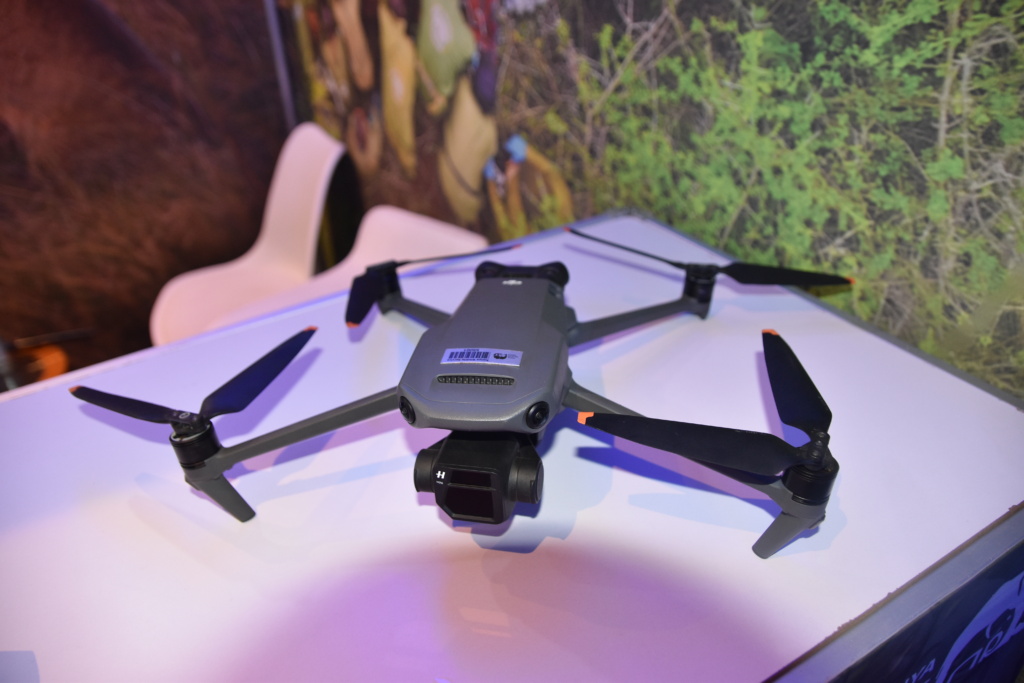
Admiring the drone on display, I imagined a young ranger at dawn over the Tsavo plains, studying a thermal screen instead of scanning the horizon with binoculars.
The aircraft above him does not roar; it hums. Its infrared eye cuts through darkness, mapping heat signatures across miles of protected land.
Less than three decades ago, that ranger would have walked into the bush armed with little more than instinct and courage. Today, he flies.
“This is not a symbolic shift. It is structural,” Dr Kanga had said.
A Nation That Set Aside 24 Percent

Kenya’s conservation footprint is vast. Between 24 national parks, 29 national reserves, six marine reserves, four marine parks, and an additional 276 community and private conservancies, roughly 24 percent of the country’s landmass is dedicated to wildlife and resource conservation.
“That,” Dr. Kanga emphasized, “is a powerful statement from Kenyans.”
But scale brings complexity. Wildlife crime networks now operate across borders with advanced communications and coordinated logistics. Climate change is altering habitats, intensifying droughts, and shifting migratory corridors.
Moreover, communities are increasingly sharing space with wildlife, and traditional patrol-based models, Kanga argued, are no longer sufficient.
“Wildlife crime has become technologically sophisticated,” he said. “We must shift from isolated monitoring to intelligence-led, integrated conservation.”
The Institutional Reset

Over the last three years, KWS has undergone a quiet but sweeping transformation.
After more than a decade without large-scale recruitment, the Service brought in over 1,500 young officers, including 1,274 rangers and 147 graduate cadets, most under the age of 30. Among them are ICT graduates deliberately integrated into operations.
The strategy is generational, according to the Director General.
By recruiting young officers between 18 and 27, KWS is effectively building a 30-year succession pipeline. These recruits will carry institutional memory and technological expertise into the middle of the century.
Simultaneously, KWS’s internally generated revenue has grown from KSh 4 billion in 2022 to nearly KSh 10 billion projected this year, a growth Kanga partly attributes to improved systems and technology-driven efficiencies.
But he was careful to temper the narrative.
“Aircraft and drones alone will not guarantee conservation success,” he noted. “Systems will.”
That systems-thinking approach has defined KWS’s drone integration program.
From Hardware to Intelligence
According to KWS, the rollout involved structural viability assessments, regulatory compliance checks, governance system development, maintenance planning, and airspace coordination.
Training has gone beyond flight skills. Drone pilots have been embedded in real field operations, coordinating with patrol teams and command centers. Fixed-wing systems extend surveillance reach across vast landscapes, while rotary drones provide tactical responsiveness.
Moreover, artificial intelligence integration is also underway, layered onto ranger programs and long-range communication systems to enable near real-time data collection across expansive ecosystems.
This highlights the country’s attempt to institutionalize conservation technology.
On the Frontline: The Ranger Perspective
If policy sets direction, rangers absorb the risk.
At Lewa Conservancy, Edward Ndiritu has witnessed the evolution of wildlife crime over two decades.
A veteran ranger and leader within Kenya’s and Africa’s ranger associations, Ndiritu speaks less about strategy and more about survival.

“We are the people in front,” he said. “Our lives are always in danger.”
In the early 2010s, as poaching pressures intensified across East Africa, conservancies faced coordinated criminal incursions. Today, he noted, the threat landscape has modernized.
“In the past, poachers used to walk. Now they drive vehicles. They use technology. So even us, the rangers, we have to up our game.”
At Lewa, AI-enabled camera systems monitor known infiltration routes. Night-capable drones equipped with thermal imaging detect human movement before contact occurs.
Integrated data platforms, including EarthRanger software introduced during peak poaching years, allow teams to track assets, wildlife, and threats in a unified operational picture.
The result, Ndiritu says candidly, crime has declined.
Technology has not replaced rangers. It has made their work safer, more anticipatory, and more coordinated.
Crucially, ranger networks now share intelligence globally through associations spanning Kenya, Africa, and international federations. Knowledge transfer, from Namibia to London and beyond, is part of the defensive strategy.
Conservation has become a connected profession.
Bridging Savannah and Silicon
Beyond the protected areas, Kenya is positioning itself as a continental innovation hub.
John Paul Okwiri, Chief Executive Officer of the Konza Technopolis Development Authority, framed conservation technology within a broader innovation ecosystem.
Konza Technopolis, often referred to as Kenya’s “Silicon Savannah,” envisions engineers, AI developers, and environmental scientists collaborating to create scalable climate and biodiversity solutions.
The message from the forum was clear: conservation challenges are not isolated environmental problems; they are technological and systems challenges.
The convergence of climate tech, AI modelling, and field conservation creates an opportunity for Kenya not only to adopt solutions but to develop them.
That ambition raises a strategic question.
Will Kenya remain a consumer of conservation technologies developed elsewhere? Or can it become a producer, exporting models of integrated, tech-enabled wildlife governance to the continent?
Building Local Capacity
For Noah Odongo of Phantom Technology, the answer depends on capacity.
Integrating drones into conservation requires more than equipment procurement. It demands licensing literacy, tactical coordination systems, data governance frameworks, and continuous training.
“One of the gaps we discovered,” Odongo explained, “is that what is common knowledge in the drone industry is not common knowledge in conservation.”
Bridging that divide has involved starting from foundational digital training for some rangers and building upward toward coordinated, unit-based operations were drone data flows seamlessly into field response.
This is slow work. It is also nation-building work.
A Sovereign Conservation Model?
By dedicating nearly, a quarter of its land to conservation and embedding technology into institutional DNA, the country is testing whether a sovereign, tech-enabled conservation model can be sustained at scale.
At KWS, the mantra is nature first.
To Dr. Kanga, the argument is almost theological, reminding the audience that “Humanity came last in the order of creation. If ecosystems collapse, so does society.”
But rhetoric alone cannot secure elephant corridors or protect black rhinos from sophisticated syndicates.
Data, predictive analytics, aerial intelligence, and young professionals fluent in both ecology and algorithms now stand between species survival and extinction pressure.
If the strategy holds, Kenya may not only protect its wildlife, but it may redefine how the world does it.
Read Also: In Kenya, Women Are Redefining the Future of Conservation
Author Profile

- How can we learn if we don't question?
Latest entries
 Oceans22 October 2026Seamounts Under Threat: Can Governments Turn Ocean Promises into Protection?
 Events21 October 2026New Guide Links Animal Welfare to Biodiversity and Human Health
 COP1717 October 2026The World Has a Plan to Save Nature. Can It Deliver by 2030?
 Agriculture16 October 2026“There Is No Shortcut”: A Kiambu Grower’s Decade in Mushrooms


