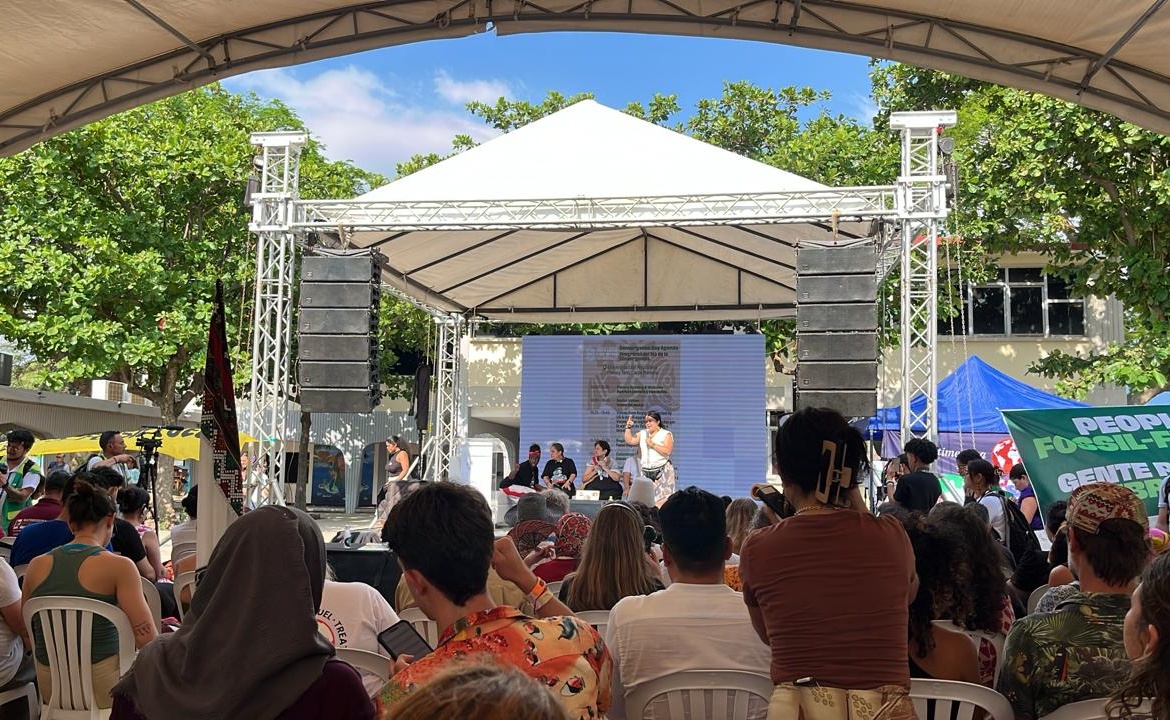
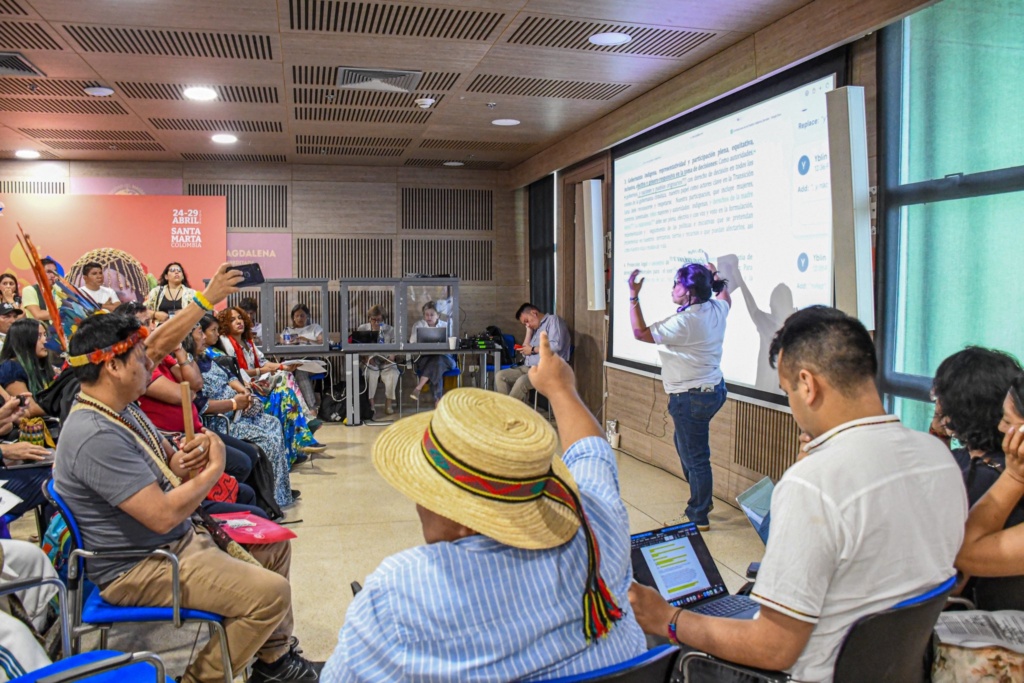
In Santa Marta, Colombia, on Sunday, April 26, 2026, hundreds of community representatives, women, youth, Afro-descendant groups, peasant farmers, and Indigenous leaders gathered not in a side room but as a central part of the architecture of a global climate conference.
The venue was the Corporación Bolivariana del Norte, and the occasion was the government-organised Pre-Assembly of the Peoples (Preasamblea de los Pueblos), a preparatory space convened ahead of the First International Conference on Transitioning Away from Fossil Fuels, co-hosted by Colombia and the Netherlands from April 24 to 29, 2026.
The conference itself is structured around parallel dialogue “chapters” for academia, parliamentarians, workers and unions, Indigenous peoples, subnational governments, and civil society.
The Pre-Assembly was the civil society chapter’s preparatory moment: a day-long process of opening harmonisation, multi-stakeholder dialogue, and sectoral discussion, built around the conference’s three pillars, overcoming economic dependence on fossil fuels, transforming supply and demand, and advancing international climate cooperation.
Its purpose was practical: to consolidate territorial delegations, gather community-level proposals, and select representatives for the main People’s Assembly the following day.
Among the strongest voices that day were those of Indigenous leaders, for whom the transition away from fossil fuels is not a future policy question; it is a present-tense struggle over land, sovereignty, and survival.
Óscar Daza, Secretary General of OPIAC (the National Organisation of Indigenous Peoples of the Colombian Amazon, Karebaju people), was unequivocal: “The Indigenous peoples of the world have made historic demands, such as the non-extraction of natural resources from our territories, so that our resources that are there in the territory remain intact, remain still.”
He added that any just transition must reflect those long-standing struggles: “As Indigenous peoples, we want those historic struggles to somehow be reflected and taken up here by the different States.”
From Santa Marta, Patricia Suárez, a Murui Indigenous woman and advisor to OPIAC, participated in a press conference alongside Amazon Watch and Colectivo Quipa. She warned of a “profound contradiction” between the global transition and the reality in the Amazon: extractivism is expanding without respecting free determination.
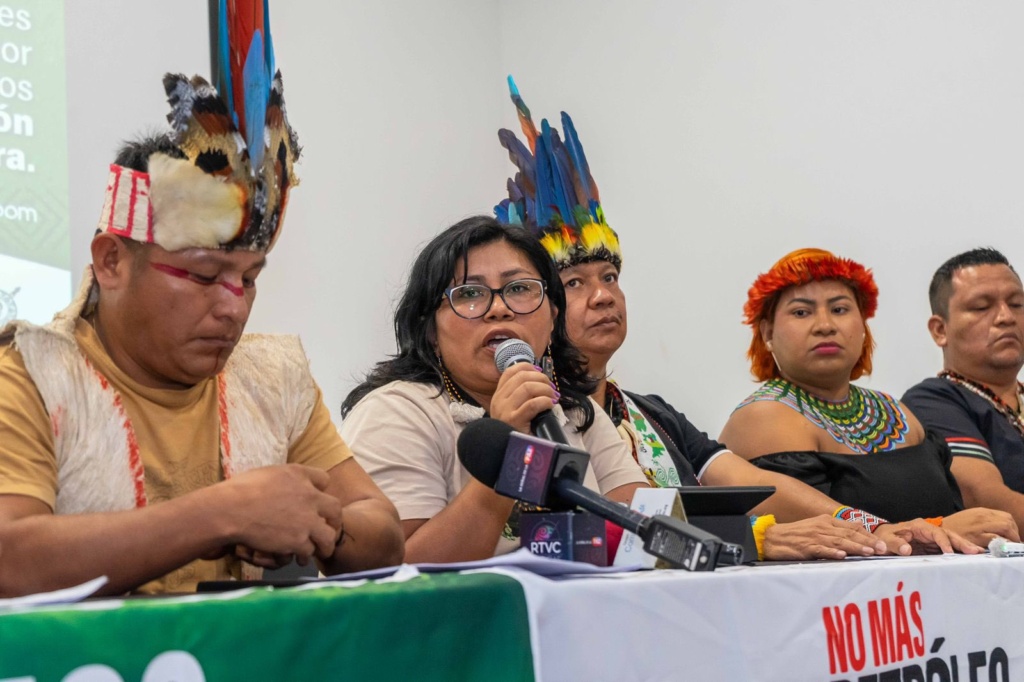
She expressed solidarity with the Indigenous peoples of Ecuador. “There is no just transition” without CLPI, territories free of extractivism, and recognition of their own systems. The Amazon doesn’t need to be saved; it’s saving the world,” she said.
Edison Canelos, Vice President of the Achuar Nationality of Ecuador (NAE), pointed to the lived contradiction at the heart of transition talks.
“Without prior consent, without prior consultation, without prior decision, without prior action by the owners of the territory, which we Indigenous nationalities are, the Government has decided to create oil exploration blocks,” he said, calling instead for a different kind of development: community tourism, bio-enterprises, and leaving oil in the ground.
Colombia’s Ministry of Environment framed the Pre-Assembly positively, describing it as a space for collective construction, territorial defence, and amplifying community voices in the global transition agenda. Though not all civil society actors were uncritical of the process.
Some noted tensions between the government-convened Pre-Assembly and the independently organised People’s Summit for a Fossil Free Future, held mainly at the Universidad del Magdalena from April 24 to 26, pointing to concerns about information flow, logistical support, and the depth of meaningful participation in the official process.
The distinction matters. The People’s Summit was coordinated by a broad coalition of civil society networks and operated outside the formal conference structure, emphasising independent grassroots demands.
The Pre-Assembly, by contrast, was an official government space, designed to feed community voices upward into high-level negotiations, but operating within the boundaries of that structure.
Whether those voices will be genuinely heard in the outcomes of the Santa Marta conference remains to be seen. What the Pre-Assembly demonstrated, at minimum, is that the communities most affected by fossil fuel extraction, and by the disruptions of transition, are showing up, organised and articulate, with demands they have been making for decades.
As Daza put it: “Their territories must be protected from any type of extraction, not only from oil, gas and coal, but also from minerals.”
That is not a new ask. But in Santa Marta, it found a larger stage.
Author Profile

-
Seeker.
Inspire AFRIKA.
Latest entries
 Corporate15 October 2026Water, Sanitation and Digital Learning at the Centre of Garissa School Upgrade
 Agriculture14 October 2026Africa’s Food Systems Future Depends on Listening to Farmers
 Weather Forecasts13 October 2026Rain and Rising Temperatures Forecast Across the Greater Horn of Africa
 Climate9 October 2026Beyond Negotiations: Africa Expects Concrete Outcomes from Antalya