Looking over the foliage of the trial farm, rose breeder Edward Mwaura bends down and inspects the new flower varieties. The increasingly erratic weather patterns and shifting market demand toward organic inputs have meant breeders like Edward are continuously innovating to supply the market with varieties resilient to pests, diseases, and other climate adversities, maintaining Kenya’s image as a top global exporter of cut flowers, the largest in Africa, with floriculture playing a key role in its economy.
“Market demand drives our innovative choices,” he says. Edward, holding a master’s degree in Plant Breeding and eight years of experience in breeding, is a breeding assistant at NIRP International and part of the growing number of young professionals in the horticultural field.
The Art of Breeding

The phenotype, the physical appearance of a plant, is determined by the plant genotype, and the interaction between the genes of the plant with the environment.
“Clients usually want a good color, and the variety should be thornless to ease handling,” says Edward.
Customers may like varieties that look good in a vase with a special shape and head size, but ultimately, the vase life of the flower is key.
“Normally, flowers with between 10 to 14 days plus of vase life are preferred,” he says.
Productivity is also a key feature that has to be considered when breeding a new variety as growers target optimum return.
“Growers in the Kenyan market seek premium flowers because of the altitude. A high altitude, like Kenya’s, where the flower belt lies between 2000 to 3000 meters, means flowers will take a little longer to mature. That informs the preference of bigger head sizes,” he says.
“High productivity, above 250 stems per meter square, is preferred. Anything above 180 stems is much better compared to lower yields,” he says.
At NIRP International, breeders seek to enhance available varieties to be resistant to disease, pests, and drought.
To ensure that optimum quality is achieved in new varieties, Edward says that developing a new variety usually takes between 7 to 10 years.
“When you develop a plant, you might not be able to deduce the performance of the product in the first trial since it has not been subjected to different environmental conditions,” says Edward.
He highlights that a national performance trial is necessary.
“To determine whether the product is stable with very high productivity and commercially viable, you need to test different altitudes to see if there’s variation.”
Edward emphasizes that the rule in breeding before introduction, dictates trial in different cycle and different environments.
“Breeding is global, but adoption is local,” he notes.
Proactive Strategies Against Pests
Despite being in the forefront in developing resistant varieties, for breeders, pests are a challenge that, if not well managed, would be catastrophic to their process.
“These pests don’t just damage the plants; they also distort data, compromising genetic evaluation, and also slowing the breeding process. For instance, the pests may attack after the crossing process has been done and eat all the pollen, affecting the entire breeding process.”

Edward says that tackling pests, which often is overwhelming young genotypes, requires a proactive strategy, not just reactionary control.
At NIRP, the breeders apply the Kaizen philosophy, which means the continual improvement of already existing varieties.
He further emphasizes that using integrated pest management is proactive.
“Using biological inputs is preferable as it does not harm the environment and can control pests for a long period as it is rare for pests to develop resistance against biologicals, as opposed to synthetic pesticides,” he says.
Breeding requires a highly integrated program that covers both systemic and contact to “ensure that you’re not giving a chance for resistance, and properly rotating the molecules of inputs used.” This strengthens the plant’s immunity and maintains reliable trial data.
Sustainable Breeding
As the effects of climate change become more apparent, breeders are under pressure to respond.
Highlighting the temperature spikes, irregular rainfall, new disease patterns, and how this has rattled the production of varieties, Edward says breeders must anticipate the future climate, not just the present one.
“We are trialing roses under heat stress, saline irrigation, and minimal input, preparing the genotype to be resilient to these conditions,” says Edward.
He emphasizes that to create a tolerant genotype, the parent has to be exposed to these stress conditions to ensure a stable genetic makeup.
“At NIRP, we implement best breeding protocols to come up with a variety that will have to survive in these harsh climates. The industry demands climate-ready varieties, and we must deliver; this is our job!”
As they breed these varieties, they consider different markets globally as Kenya’s export are dominant not only in Europe but also in the Middle East and Southeast Asia.
“Different markets have different preferences. For example, the Middle East asks for fragrance and heat tolerance because the climate there is so harsh, and Europe prefers soft hue and delicate architecture.”
To make selections of varieties that meet specific market needs, breeders track the preferences consistently.
“At NIRP, we visit clients to understand this,” he adds.
Among the summer flowers bred at NIRP are Tanacetum (Starlight and Moonlight), Helichrysum in the Paper Moon series (Yellow, Ivory, Red, Honey, and New Ivory), Eryngium (Bluebell and Arabian Dawn), Eucalyptus gunnii ‘Yvas’, and a wide range of Astilbe varieties including Close Harmony, Hard Rock, Hip Hop, Black Pearls, and several chinensis types like Cardinal, Heart & Soul, Hot Pearls, Ivory Pearls, and Love & Pride.
Spray rose varieties include Charmy Rosever, Safari Rosever, Dragon Rosever, Flambeu Rosever, Classic Rosever, and Vintage Rosever. For Hybrid Tea (HT) types, varieties such as Fashion Violet, Grandslam, Fashion Gold, Sweetspot, Hotspot, Granddonna, Inevitable, Shabby Chic, Desert Rose, Copacabana Leading, Moka Rosa, Ceme Caramel, Tropical Versilia, Black Pearl, Bella Donna, Metallica, Caramel Macchiato, Moka Loka, and Tiger are notable, alongside many others.
Future of Rose Breeding in Kenya
Edward intimates that the future of rose breeding in Kenya is precision, speed, and impact.
“The future has an explosive potential. Kenya is not just a production hub; the nation is becoming an innovation hub with rising local talent exploring biotech and integrating artificial intelligence in the breeding process,” says Edward, emphasizing that the country is poised to lead the next wave of smart, sustainable breeding.
Edward highlights that the industry is employing molecular breeding techniques and CRISPR-Cas9.
“These new techniques are relegating genetical modification. GMO is the introduction of foreign DNA in another variety, while CRISPR-Cas9 is about silencing the gene and then amplifying better genes in the variety. You don’t introduce any external gene,” he says.
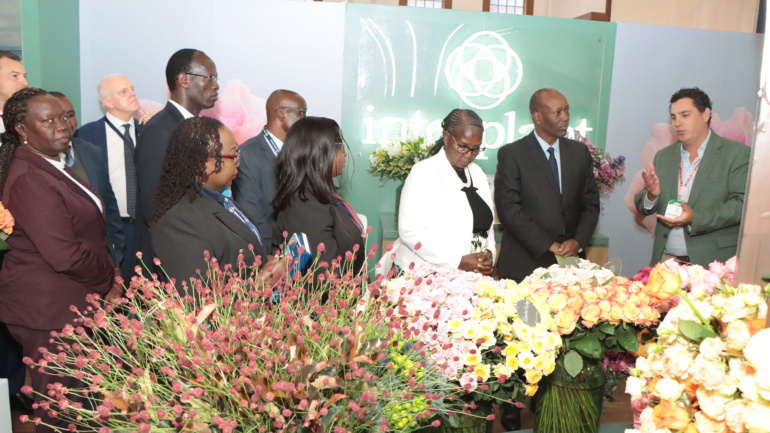
He further lauds the important role played by expos and trade shows in the horticulture industry, highlighting not just the product showcases but also the knowledge ecosystem in the events.
“These events bring together breeders, growers, researchers, suppliers, buyers, and all the other stakeholders. During these shows, like the upcoming IFTEX, industry players get a chance to improve the value chain by exchanging insights, testing assumptions, and forging lasting partnerships,” he says.
Moreover, these events accelerate innovation and help align the entire value chain to industry trends and customer demands.
“These are opportunities to understand client needs from product to end-user,” he adds.
Looking ahead, Edward says Kenyan breeders are preparing genotypes that can thrive in stressful microclimates, anticipating what will happen tomorrow.
Read Also: Love Takes Time, So Does Roses