

Jacob’s Ladder Africa (JLA), a Panafrican non-governmental organisation with a sharp focus on advancing Africa’s green jobs and skills agenda will play a leading role at the second Africa Climate Summit (ACS2).
The event scheduled for September 8–10, 2025, at the Addis International Convention Centre in Addis Ababa, Ethiopia will see JLA positioning climate action as an opportunity to unlock employment and economic justice, particularly for youth, women, and marginalized communities.
The organization will spearhead two major engagements during the summit. On September 10, it will host a high-level session at the Africa Pavilion in collaboration with the African Union Commission’s Department of Education, Science, Technology and Innovation (AUC-ESTI).
Partners in the session include the Ethiopian Ministry of Planning and Development, UNECA, UNEP, Addis Ababa University, PACJA, WWF, AGRA, World Vision, P4G, and SNV. The dialogue will highlight strategies for developing Africa’s green workforce and aligning them with climate ambitions.
This agenda ties directly into the AUC’s Continental Strategy for Technical and Vocational Education and Training (CTVET) 2025–2034, which prioritizes future-ready skills to drive sustainable industrialization, climate resilience, and inclusive growth.
To reinforce this momentum, the AUC will also convene Africa Skills Week 2025 in October, placing green skills development at the center of the Decade of Education and Skills Development (2025–2034).
Alongside the high-level session, Jacob’s Ladder Africa will run the Green Jobs & Skills Pavilion, an African-led, solutions-driven platform designed to tackle the dual challenges of climate vulnerability and unemployment.
The Pavilion will create space for governments, civil society, indigenous groups, and the private sector to exchange ideas and showcase innovations in green job creation.

“Africa’s youth, women, and marginalized communities need real jobs and sustainable livelihoods, not empty promises. When supported, they become the innovators and changemakers advancing Africa’s green transformation,” said Sellah Bogonko, Co-Founder and CEO of Jacob’s Ladder Africa.
She described the Pavilion as a call to recognize green jobs and skills as the vital bridge between climate ambitions and economic justice.
The Pavilion will spotlight sectors with the greatest potential for employment growth. Projections show that:
- Renewable energy could create up to 4.5 million jobs by 2030, particularly through decentralized solar and clean cooking solutions.
- Sustainable agriculture could unlock 700,000 jobs, including 377,000 from climate-smart farming technologies.
- E-mobility is expected to expand into a $2.85 billion market by 2030, generating work across manufacturing, logistics, servicing, and software development.
Jacob’s Ladder Africa’s leadership at ACS2 builds on the foundation laid during ACS@ONE, a series of civil society-led dialogues in 2024 that tracked progress since the inaugural summit in Nairobi and explored African-led solutions.
JLA is aligning with Agenda 2063 through keeping its focus on actionable outcomes, reframing climate action as a driver for prosperity and resilience rather than dependency.
ACS2 is co-convened by the Ethiopian government and the African Union Commission and is expected to attract more than 45 heads of state and government, ministers, development partners, youth leaders, civil society, and private sector representatives.
The summit’s broader theme, “Accelerating Global Climate Solutions: Financing for Africa’s Resilient and Green Development,” will set the stage, but JLA’s interventions are poised to ensure that Africa’s climate ambitions are anchored in livelihoods and opportunities for its people.
Author Profile

-
Seeker.
Inspire AFRIKA.
Latest entries
 Corporate15 October 2026Water, Sanitation and Digital Learning at the Centre of Garissa School Upgrade
 Agriculture14 October 2026Africa’s Food Systems Future Depends on Listening to Farmers
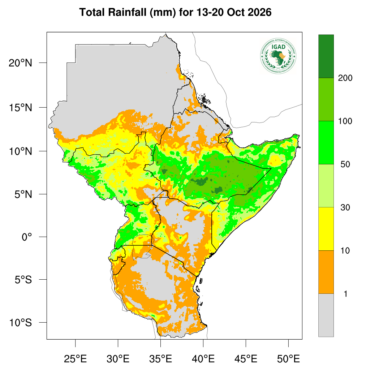 Weather Forecasts13 October 2026Rain and Rising Temperatures Forecast Across the Greater Horn of Africa
 Climate9 October 2026Beyond Negotiations: Africa Expects Concrete Outcomes from Antalya


