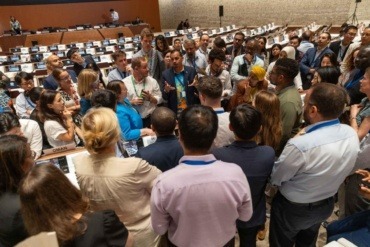
As the second part of the fifth session of the Intergovernmental Negotiating Committee to develop an international legally binding instrument on plastic pollution, including in the marine environment (INC-5.2), enters a second week in Geneva, negotiations are wrestling with a sprawling treaty text while clinging to hopes for consensus before the deadline on 14th August.
INC Chair Luis Vayas noted that the Committee would take stock of progress made, consider the outcomes of the contact groups, and decide on the way forward. He explained that the Assembled Text is for informational purposes only and represents a snapshot of discussions in the contact groups as of Friday afternoon, 8 August.
Compiled from each contact group’s contributions, the Assembled Text bundled bracketed proposals, placeholders for unresolved concepts, and entirely new articles not in the Chair’s original draft.
In some areas, like Articles 3 and 5 on plastic products and product design, it carried footnotes clarifying that the content was “not agreed” and that line-by-line negotiations had yet to begin.
Elsewhere, such as Article 11 on financial mechanisms, the text reflected a revised Co-Chairs’ draft accepted as a constructive basis for further talks, a rare point of consensus.
The snapshot also exposed glaring gaps. Contact Group 1 had yet to start textual negotiations on key provisions like definitions (Article 2), exemptions (Article 4), and sustainable production (Article 6).
The article on scope remained only as a placeholder, with divergence still deep. Contact Group 4 had opened all its assigned articles, but several, including the preamble and Articles 14–18, were still awaiting full consideration.
INC Chair Luis Vayas acknowledged the “plethora of unresolved issues” and urged a shift in pace, pushing delegates to send agreed text to the Open-ended Legal Drafting Group wherever possible.
Yet for many observers, the 34-page draft, swollen from its original 22 pages and bristling with 1,488 square brackets, underscored the scale of the task ahead.
Key Contentious Articles
- Article 3 & 5 (plastic products & design): minimal convergence, procedural roadblocks, debates over adding new text vs focusing on bridging proposals.
- Article 6 (supply/sustainable production): still without line-by-line negotiation.
- Article 11 (finance): new Co-Chairs’ text welcomed as constructive, but calls for additional funds/mechanisms.
- Articles 14–18 (national plans, reporting, evaluation, information exchange, awareness): split opinions on binding requirements and Indigenous Peoples’ references.
Kuwait, for the LIKE-MINDED GROUP, supported by the RUSSIAN FEDERATION, INDONESIA, MOROCCO, and INDIA, called for consensus to be reflected in all decisions.
ETHIOPIA, supported by others, lamented that consensus had been used to “hold the entire process hostage” and called for informal discussions to address challenging articles.
Colombia suggested that delegates work informally before reconvening in a stocktaking plenary on Tuesday.
The EU, with CHILE, requested that the INC consider meeting in informal settings, with the EU suggesting that more than two meetings could be convened at the same time.
INC Chair Vayas noted that informal meetings are needed to provide alternative ways to seek common ground and reminded delegates to speed up the pace of work for a concrete and clean text.
Moreover, several delegates underlined the importance of harmonizing language on Indigenous Peoples and local communities throughout the treaty text, with many also supporting including the knowledges, sciences, and practices of Indigenous Peoples in national plans.
Other proposals included adding text to address: that access to, use, and sharing of traditional knowledge and knowledge of Indigenous Peoples and local communities shall respect national legislation protecting collective intellectual rights and procedures for the free, prior, and informed consent of knowledge holders.
Several others called for replacing “knowledge of Indigenous Peoples” with “knowledges, sciences, and practices of Indigenous Peoples” and “local community knowledge” with “local knowledge systems.”
With just four formal negotiating days left at INC-5.2, the pressure in Geneva is mounting. Ministers are expected to join this week, but delegates warn that “political will alone may not suffice” to bridge deep divisions.
The Assembled Text now sprawls with 1,488 square brackets, a visual reminder of the unresolved issues. As one delegate put it, the question is no longer whether the clock is ticking, but whether negotiators can deliver something worth celebrating by 14 August.
Read Also: Will Geneva Deliver Global Action on Plastics or More Deadlock
Author Profile