
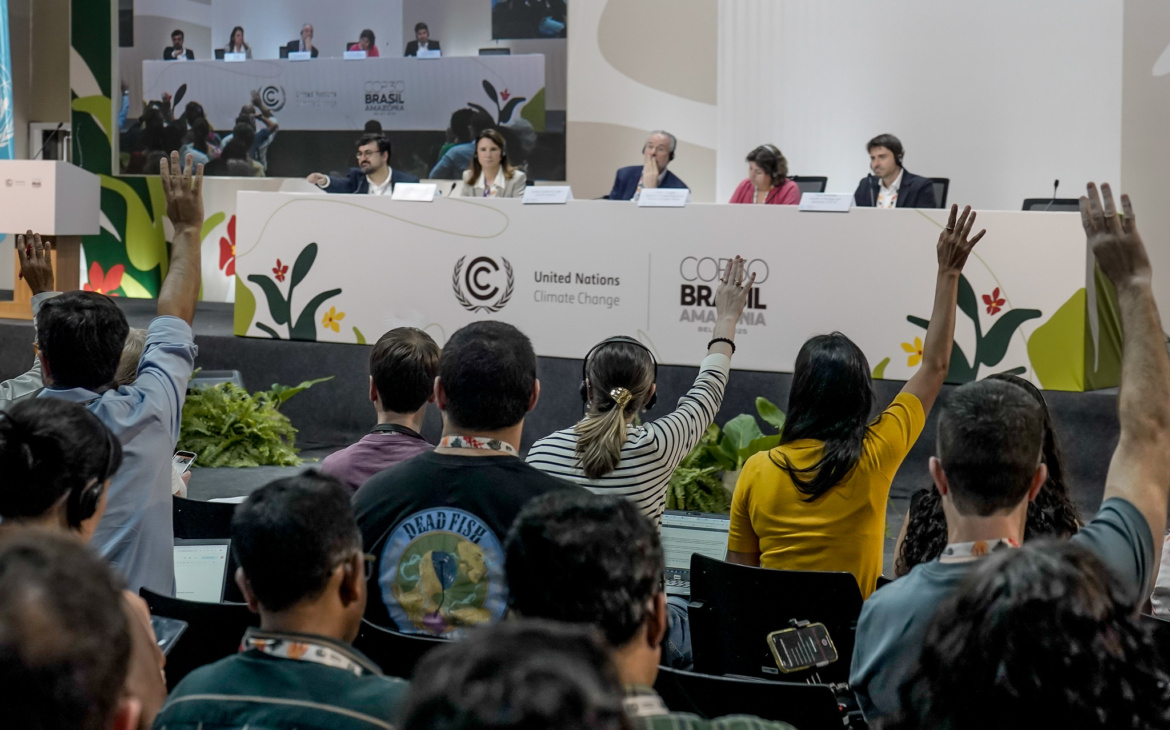
The Belém Declaration on Sustainable Public Procurement (SPP), announced on Day 3 of COP30, marks a pivotal shift in how nations plan to align their economic engines with the global net-zero agenda.
This landmark commitment reframes government spending as one of the most powerful, yet underutilized, levers for climate action.
By linking public purchasing to the Paris Agreement and UN Sustainable Development Goals, governments can track emissions reductions, promote social inclusion, and strengthen economic resilience.
Public procurement, typically focused on acquiring cement, vehicles, or computers at the lowest price, accounts for 13–20% of global GDP (around $13–20 trillion annually) and nearly 15% of global greenhouse gas emissions.
The Belém Declaration turns this spending power into a climate tool, embedding sustainability, equity, and resilience across all government procurement, from ministry paper to steel for highways.
Unveiled at a high-level COP30 event co-hosted by Brazil’s Ministry of Management and Innovation, UNIDO’s Industrial Deep Decarbonisation Initiative (IDDI), and UNEP, the declaration’s early signatories include Brazil, Mexico, Norway, the Netherlands, and Colombia. Negotiations are ongoing to bring in other nations such as the UK, Canada, and Costa Rica.
From Policy to Practice
Signatory nations commit to integrating sustainability criteria into national procurement laws, conducting lifecycle emissions assessments, and establishing cross-border monitoring systems for transparency.
Brazil has already enacted a decree enforcing sustainability standards across federal tenders, a model that could inform future African policies.
The declaration also emphasizes inclusive growth, prioritizing SMEs, women-led firms, and marginalized communities. Through these measures, governments can accelerate low-carbon transitions while redistributing economic opportunities.
If fully implemented, analysts estimate the declaration could cut 1–2 gigatonnes of CO₂ annually by 2030, roughly the EU’s current emissions, while creating up to 20 million green jobs worldwide.
Africa Steps Forward: Kenya and Ghana Lead the Way
Although no African country is an initial signatory, the continent has already entered the conversation decisively.
On the same day, Kenya and Ghana co-championed the Global Framework for Public Procurement of Near-Zero and Resilient Buildings (NZERB).
This initiative builds directly on Belém’s principles, emphasizing climate-resilient, low-emission infrastructure.
Ghana’s Ministry of Works and Housing and Kenya’s National Treasury positioned the framework as Africa’s contribution to a new procurement paradigm, linking urban adaptation, climate equity, and economic development.
During Africa Day celebrations at COP30, officials from the African Development Bank (AfDB) and the African Union (AU) described the framework as a “bridge” connecting Africa’s green industrialization agenda with global decarbonization efforts.
It aligns with the Addis Ababa Climate Declaration and the continent’s call for $1.3 trillion in grant-based climate finance.
Kenya’s pilot projects, including a green e-procurement module and initiatives in public transport, serve as testbeds for sustainable procurement.
By linking tenders to environmental performance metrics, the Treasury aims to ensure that every shilling spent contributes to the country’s Nationally Determined Contributions (NDCs).
Economic and Social Promise
According to UNIDO projections, Africa could capture 20–30% of global green procurement gains by 2030, unlocking $50–100 billion in AfDB-backed investments. In Kenya, this translates into opportunities across ethical mining, circular manufacturing, and green infrastructure.
For example, as the government phases in low-emission cement and steel, local suppliers are incentivized to decarbonize production. Procurement frameworks that reward fair labor standards could uplift thousands of informal waste workers transitioning into circular economy jobs.
Across the continent, green procurement in water, transport, and construction could protect millions from the worsening impacts of climate change.
The African Public Procurement Network (APPN), a 25-member platform chaired by Zimbabwe, has adopted the Belém principles for its 2026–2030 roadmap. VP Constantino Chiwenga emphasized that Africa’s procurement reforms “must tackle corruption and inefficiency as climate issues, not just governance problems.” The APPN aims to harmonize standards, introducing transparency measures and emissions tracking tools to ensure funds are used effectively.
Challenges: Governance, Capacity, and Finance
Despite its promise, implementing the declaration in Africa faces longstanding barriers. Procurement corruption remains a challenge: opaque tendering and inflated contracts are estimated to cost 10–25% of public spending annually.
Weak institutional capacity also hampers lifecycle emissions assessments and verification of sustainability claims.
To address these gaps, the AU, AfDB, and UNECA are promoting a continental knowledge platform to provide data tools, standardized green tender templates, and training for procurement officers.
Integrating these mechanisms could position Africa as a co-architect of the global procurement order, not just a participant.
Financial constraints also matter: many African governments face debt pressures limiting upfront investment in greener technologies. Success will require aligning with initiatives such as the Baku-to-Belém Roadmap for Climate Finance, mobilizing affordable capital for the Global South.
A New Era for Public Policy
By transforming procurement into a vehicle for climate action, the Belém Declaration redefines fiscal responsibility and environmental stewardship.
For Africa, and Kenya in particular, it presents an opportunity to turn policy innovation into tangible impact, delivering cleaner cities, resilient infrastructure, and fairer markets.
It bridges environmental goals with development priorities, embodying the principle that climate action must be economically and socially inclusive.
Author Profile

- How can we learn if we don't question?
Latest entries
 Events12 October 2026Cybersecurity in the Floriculture Industry
 Opinion & Analysis8 October 2026Why Africa Must Look to What Already Exists in Its Blue Economy
 Agriculture5 October 2026The Search for a Smarter Way to Feed Crops
 Events30 September 2026The Goat, the Market and the Dryland: Heifer International’s Push for Livestock Resilience


